
Key takeaways
- Step 4 teaches operators what the equipment is made of and how it fails, so that inspection finds abnormalities instead of ticking boxes.
- Step 5 puts inspection items into the daily standard and has supervisors review the results.
- Training comes first: inspection checklists are only as good as the skill of the person using them.
- Both steps feed planned maintenance: what operators find becomes tags, work orders and updates to the PM plan.
- MaintWiz keeps step 4 lessons as one point lessons with initiator, verifier and approver, and every routine-inspection finding goes to the abnormality register with an owner and a target date.
Steps 4 and 5
What are steps 4 and 5 of autonomous maintenance?
The first three steps clean the equipment, cut the dirt and write a standard for keeping it clean, inspected and lubricated. Steps 4 and 5 raise the inspection part of that standard. Step 4, general inspection, gives operators the knowledge to inspect properly: how the equipment works, what each part does, what normal looks like and how parts wear. Step 5, autonomous inspection, adds the inspection points to the standard, assigns them to operators and makes them part of the shift. In the JIPM seven-step sequence, steps 4 and 5 are where operators become inspectors.
Why skills come first
The reason for the pause between cleaning and inspection is skill. An operator who has cleaned a gearbox for months knows where it leaks; an operator who has been taught how bearings and seals fail knows what a changing sound or a warm housing means. Step 4 builds that second kind of knowledge.
Steps 4 and 5 of autonomous maintenance
Skill first, then routine
Teach how the equipment works and fails
Practise inspecting the real equipment
Add inspection items to the CIL standard
Operators inspect on the shift
Supervisor reviews the results
Findings feed planned maintenance
 maintwiz.comAI CMMS built for TPM
 WhatsApp us
 +91 93459 29168
 Book a demo
What is taught in step 4, general inspection?
| Topic | What operators learn | Typical teaching method |
|---|---|---|
| Equipment structure and function | What the main assemblies are, how they work, what each is for | Walk-through at the equipment with the drawing |
| Fasteners and fits | How bolts, keys and couplings loosen and what looseness looks like | Demonstration on a spare part |
| Lubrication | Lubricant types, quantities, what contamination does | Lesson plus hands-on at the lubrication points |
| Drives and transmission | Belts, chains, gears, couplings, their wear signs and tension checks | Lesson at the equipment |
| Pneumatics, hydraulics and electrics | Leak signs, pressure and temperature, loose or damaged cables, safe limits of what an operator may do | Lesson with the safety rules stated first |
| Measurement | Reading gauges and marks against limits | Practice on the live equipment |
The list is a starting set; the equipment decides it. Each subject is taught in short lessons, often as one point lessons, followed by finding real abnormalities on the equipment. Safety comes first: the lesson states what an operator may check and what must be left to maintenance, and the plant's safety lead sets those limits.
Step 4: general inspection (Sotenken), one subject at a time
After the walk-through of how the equipment is built, each unit follows the same four stages
- Lesson
- Practise on the equipment
- Add items to the CIL standard
- Step audit
- 1
Fasteners and fits
How bolts, keys and couplings loosen; what looseness looks like
- 2
Lubrication
Lubricant types, quantities, what contamination does
- 3
Drives and transmission
Belts, chains, gears and couplings; wear signs and tension checks
- 4
Pneumatics, hydraulics and electrics
Leak signs, pressure and temperature, loose cables, the operator's limits
- 5
Measurement
Reading gauges and marks against limits
Safety rules are stated first in every lesson
maintwiz.comAI CMMS built for TPMWhatsApp us+91 93459 29168Book a demo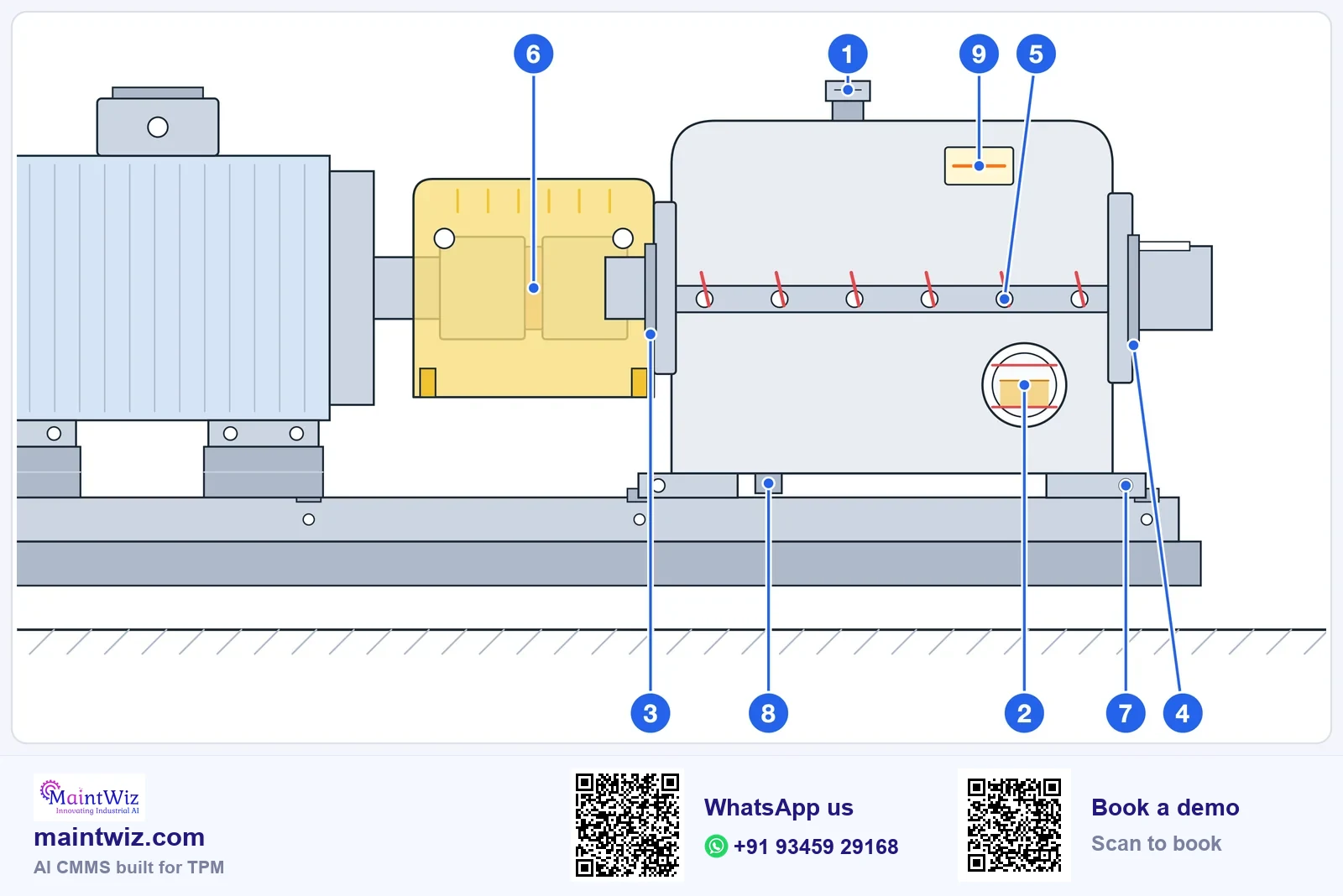
| No. | Inspection point on the gearbox | What operators check |
|---|---|---|
| 1 | Breather | Open, clean, not blocked |
| 2 | Sight glass with minimum and maximum band | Oil level between the lines |
| 3 | Input seal | Dry, no seep |
| 4 | Output seal | Dry, no seep |
| 5 | Housing bolts with match marks | Marks still aligned |
| 6 | Coupling | Guard fitted, no unusual noise |
| 7 | Foundation bolts | All present and tight |
| 8 | Drain plug | Dry, no weep |
| 9 | Temperature label point | Label colour unchanged |
How do you teach inspection skills so that they stick?
- Teach one subject per session, at the equipment, for about as long as a one point lesson takes to read.
- Follow each lesson with a practice inspection of the real equipment, with a trainer present.
- Ask operators to find and tag abnormalities, and review what they found against what the trainer expected.
- Record who has been trained on what, so a skills matrix shows the gap.
- Repeat the lesson when a new operator joins or the equipment changes.
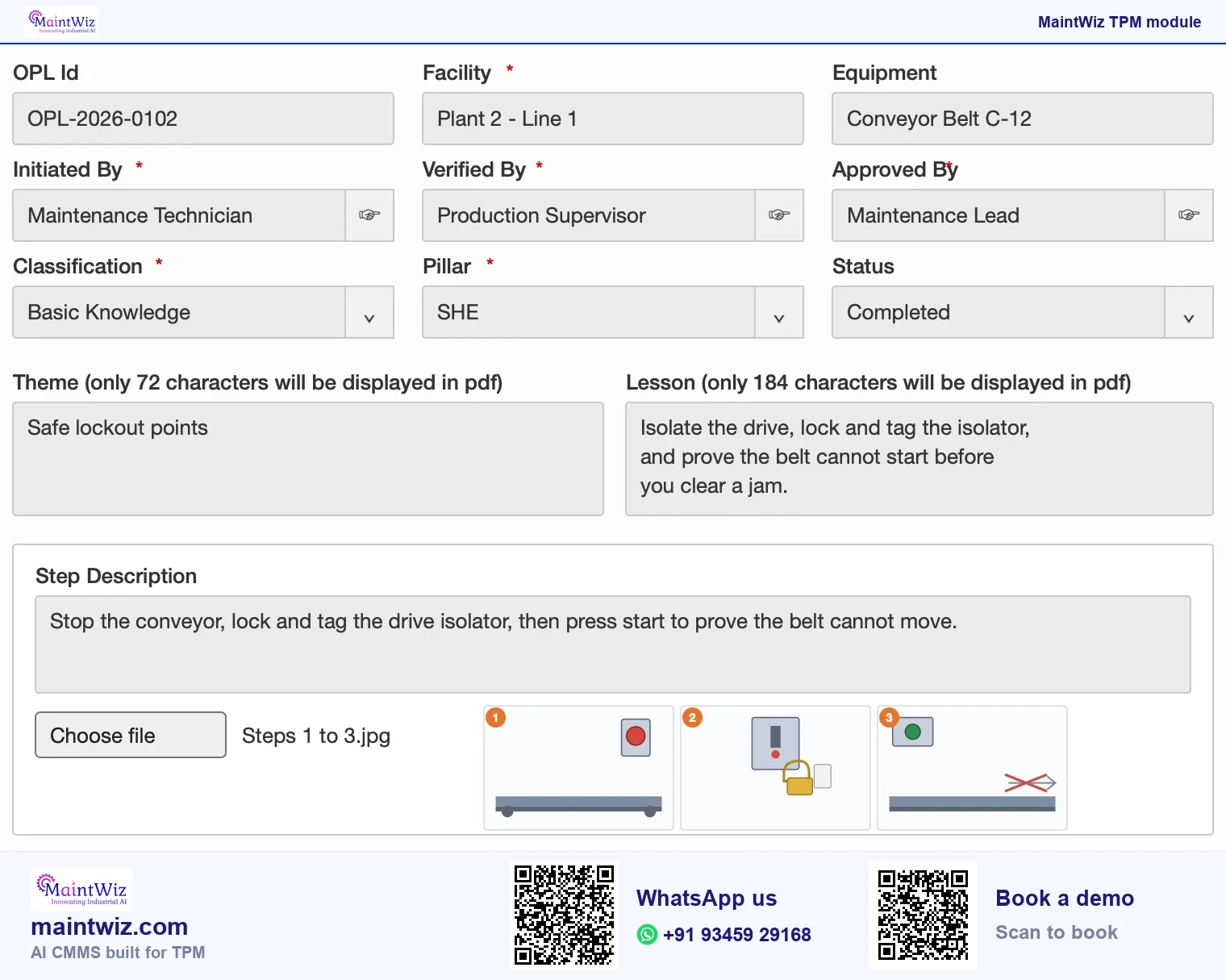
MaintWiz education and training holds the training plan, sessions, schedule and dashboard for every step 4 lesson, and each lesson is kept as a one point lesson (Figure 4).
Keep step 4 and 5 findings in one register and turn a tag into a work order. Book a demo.
Downloads
Steps 4 and 5 templates: visual controls, CIL standards and daily check
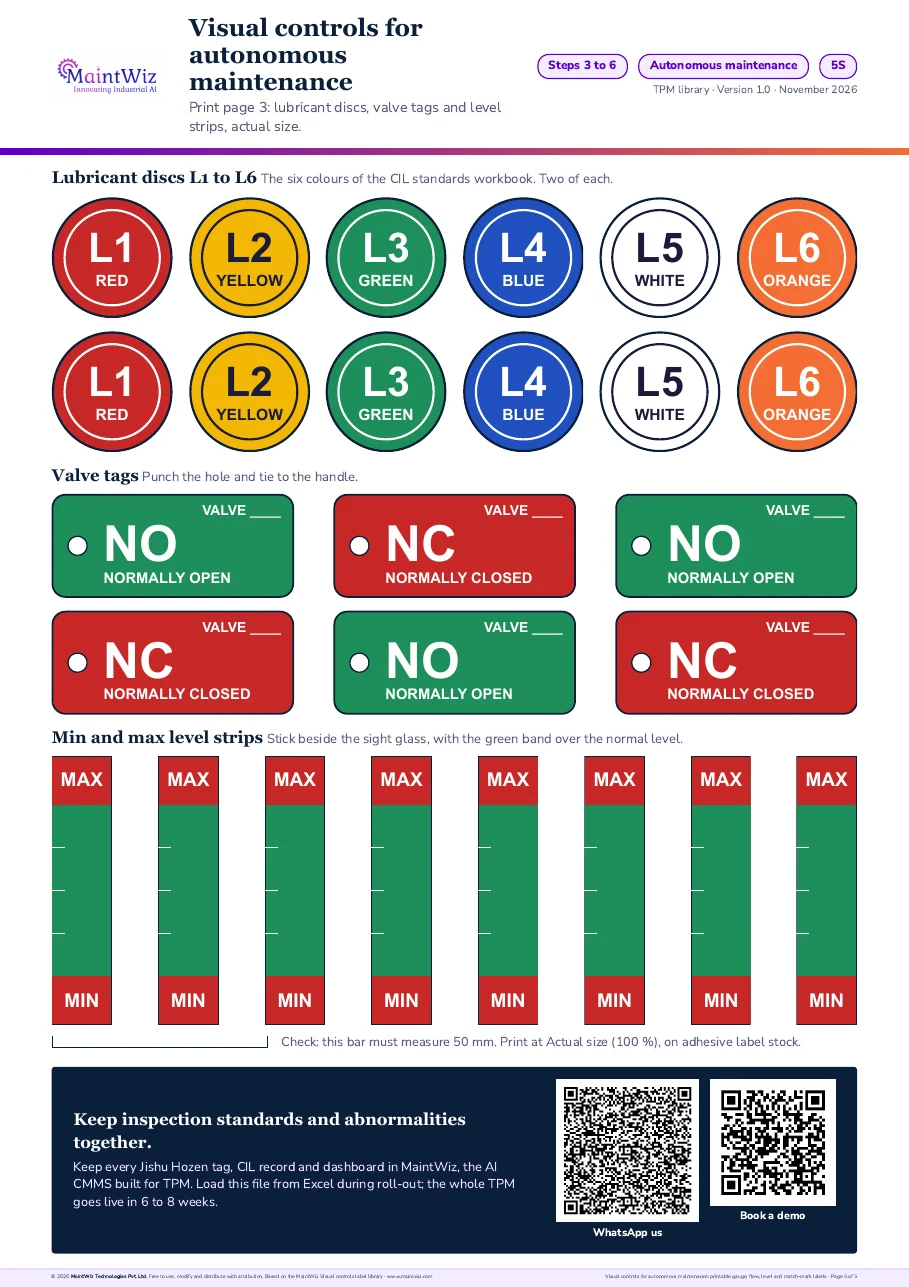
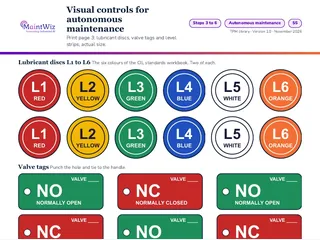 PDFVisual controls for autonomous maintenance: printable gauge, flow, level and match-mark labels
Print gauge range arcs, flow arrows, lubricant discs, valve tags and level strips at actual size
- Pages
- 5
- A4
- Created
- 5 November 2026
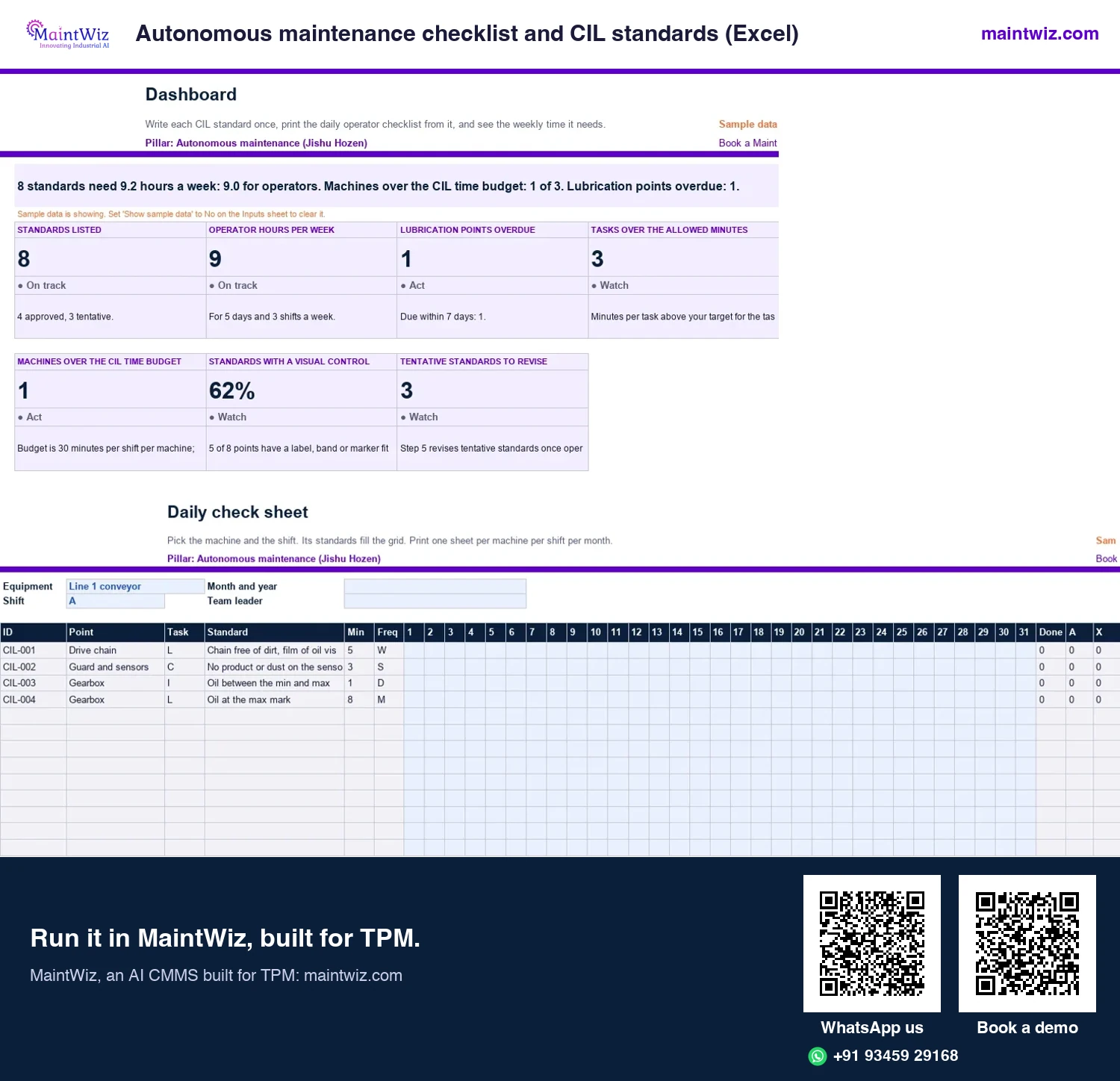
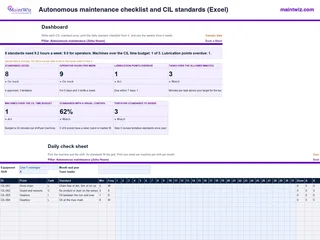 ExcelAutonomous maintenance checklist and CIL standards (Excel)
Write each cleaning, inspection and lubrication standard once, print the daily operator checklist for any machine
- Sheets
- Dashboard, Inputs, Frequencies, Lubricants, Machines, Standards, Daily check sheet, Lube schedule, Lube route, Read me
- A4
- Version
- v1.0, 2 November 2026
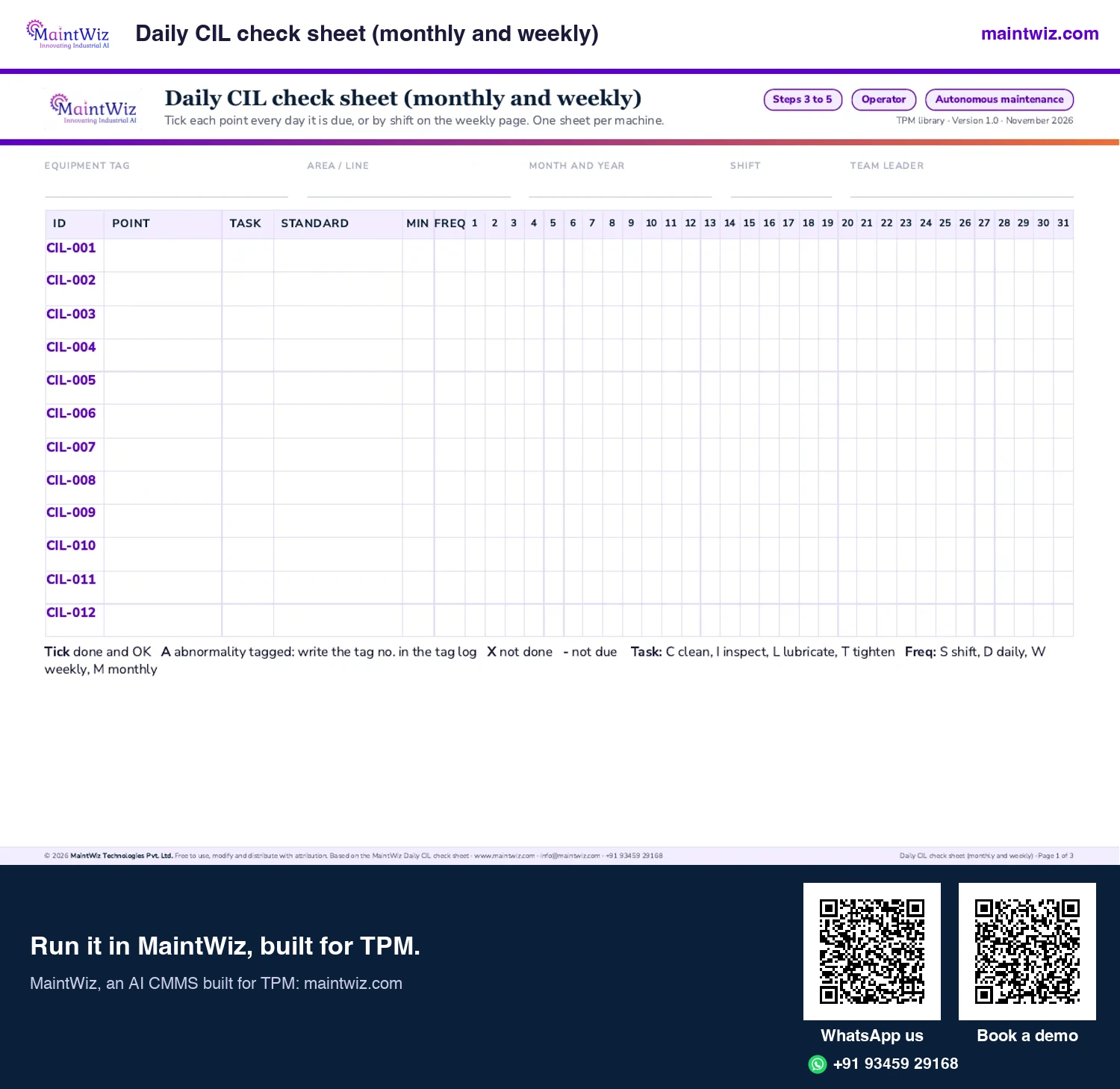
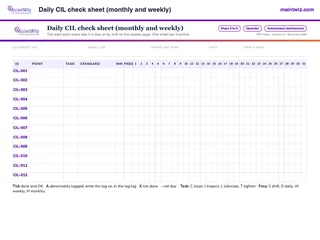 PDFDaily CIL check sheet (monthly and weekly)
Print a daily operator checklist for one machine, monthly or weekly with A, B and C shift boxes
- Pages
- 3
- A4 landscape
- Created
- 5 November 2026
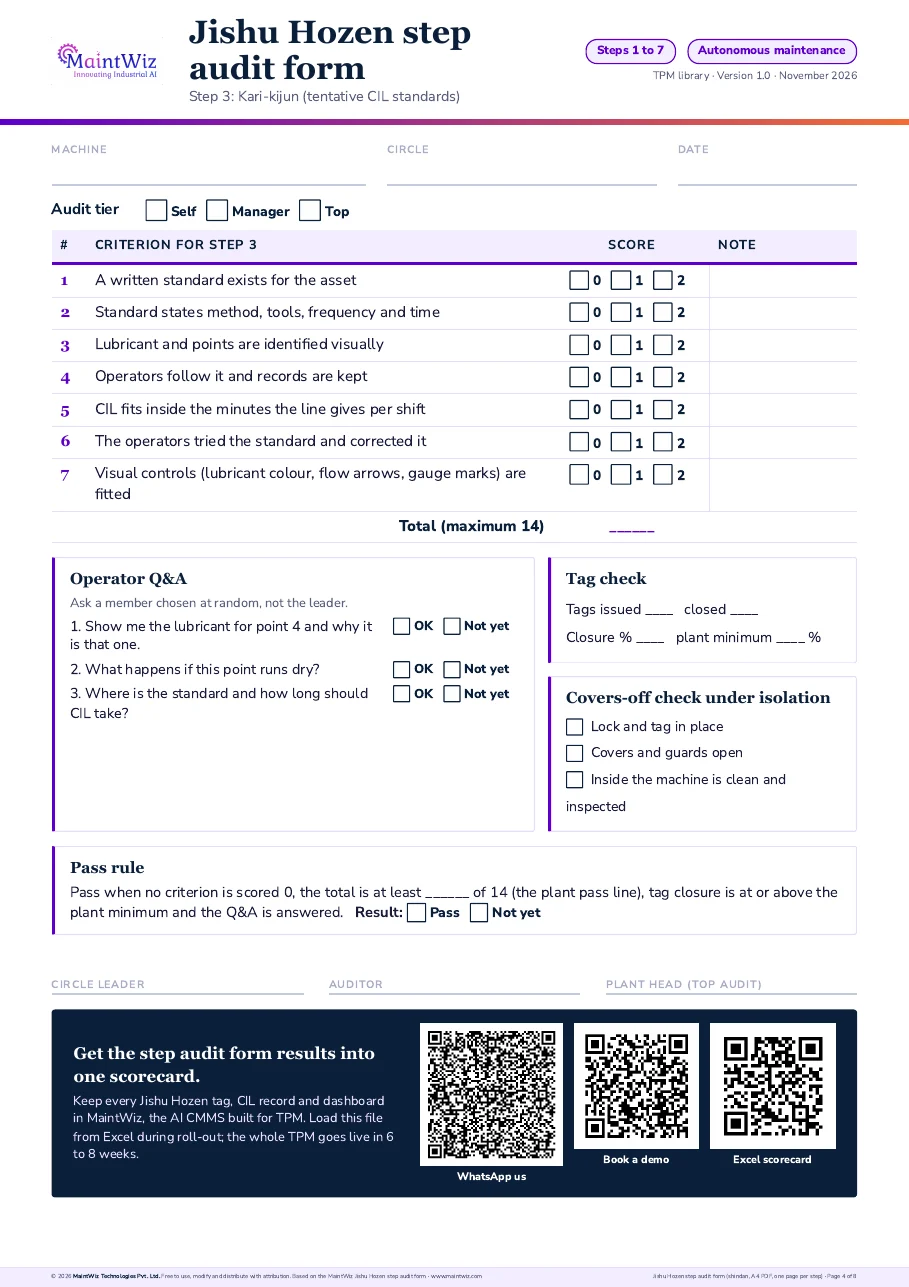
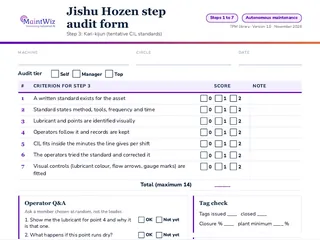 PDFJishu Hozen step audit form (shindan, PDF, one page per step)
Audit any machine with a one-page Jishu Hozen (autonomous maintenance) step audit form: scored criteria, operator questions, tag check and three-tier shindan sign-off.
Inside: One form per step, Step 1 Shoki Seiso (initial cleaning) to Step 7 Jishu Kanri (autonomous management) · Criteria scored 0, 1 or 2 with a pass rule · Three operator questions, a tag count and a covers-off check under isolation · Sign-off by circle self-audit, manager and top management
- Pages
- 8
- A4
- Created
- 5 November 2026
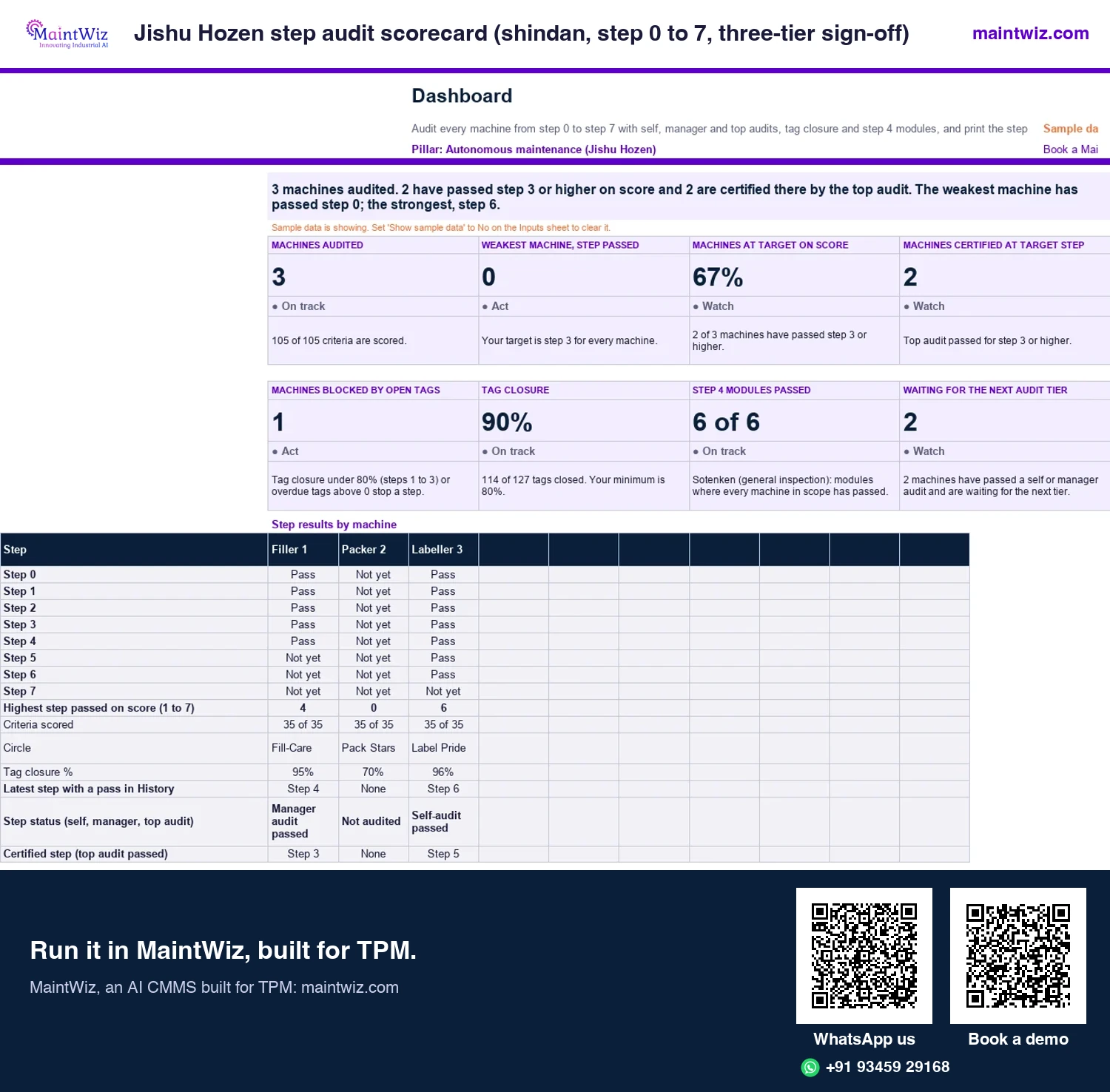
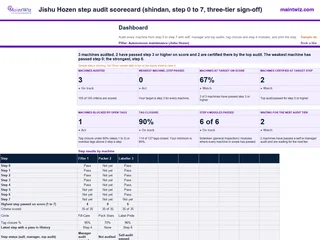 ExcelJishu Hozen step audit scorecard (shindan, step 0 to 7, three-tier sign-off)
Audit every machine through the seven Jishu Hozen steps with self, manager and top audits
- Sheets
- Dashboard, Inputs, Audit, Step 4 modules, History, Certificate, Read me
- A4
- Version
- v1.1, 5 November 2026
Step 5
What is step 5, autonomous inspection?
Step 5 turns the skill from step 4 into routine. The inspection points found useful in step 4 are written into the standard from step 3, with the method, the limit and the time, and operators carry them out on the shift. Supervisors review the results, and findings feed the planned maintenance plan so that what operators see is acted on.
What step 5 adds
| Step 5 element | What it looks like |
|---|---|
| Updated standard | Inspection items added to the CIL standard with method, tool, limit, frequency and time |
| Routine | Operators do the inspection on the shift, with results recorded |
| Supervisor review | Results are read, overdue or missed items are chased, and abnormalities are checked for closure |
| Link to maintenance | Findings that need maintenance become tags or work orders and may change the PM plan |
| Time | The whole routine still fits within the time the shift allows |
How do steps 4 and 5 connect to planned maintenance?
Operators are better placed than a monthly inspection to notice a change, and maintenance is better placed to repair it. Step 5 makes the hand-off explicit. Findings that operators can fix are fixed by operators; those that need skills or parts become a tag for maintenance. Repeat findings on the same equipment are a signal for the planned maintenance plan: a task may be missing, an interval may be wrong or a condition check may be worth adding. Choose those tasks by failure mode and consequence (TPM vs RCM).
Check also what operators should not do: adjustments and repairs outside their training. The standard lists the stop-and-call conditions, and the step 4 lessons repeat them.
Audit
How do you audit steps 4 and 5?
| Step | Criteria checked (score 0, 1 or 2 each) |
|---|---|
| Step 4 | Inspection skills training delivered; inspection checklists cover key components; abnormalities found in inspection are logged; operators can explain the basic function of the equipment |
| Step 5 | Standards updated with inspection items; operators inspect routinely on the shift; supervisors review the results; findings feed the planned maintenance plan |
A step passes at 7 of 8 points, the first score at or above the 80% pass mark. Audit with an operator and someone from outside the area, at the equipment, with evidence in hand. Score both steps on the free step audit scorecard, which scores all seven steps the same way.
Common mistakes in steps 4 and 5
- Skipping the training and issuing inspection checklists to operators who do not know what to look for.
- Copying maintenance's inspection list onto the operator's sheet without limiting it to what operators may safely do.
- Adding inspection time without removing something, so the routine no longer fits the shift.
- Recording results but not acting on them, which teaches operators that the inspection does not matter.
- Using the checklist as a compliance exercise: initials with no findings for months is a warning, not a success.
- Not feeding repeat findings back to the PM plan.
Running steps 4 and 5
How does MaintWiz run steps 4 and 5?
- Register entry: abnormalities found on routine inspection go in against the equipment, with tag colour and category.
- Assignment: each entry has an owner and a target date, with an overdue alert when the date passes.
- Work order: a tag is converted to a work order after manual review, when the fix needs maintenance.
MaintWiz runs this in its autonomous maintenance software, on the abnormality register shared with the other TPM modules. Book a demo to run steps 4 and 5 on your own equipment.
FAQ
Frequently asked questions
What is step 4 of autonomous maintenance?
Step 4 is general inspection: operators are taught how their equipment works and fails, and practise inspecting its main components, so they can find abnormalities that cleaning alone would not reveal.
What is step 5 of autonomous maintenance?
Step 5 is autonomous inspection: inspection items are added to the standard from step 3 and operators carry them out routinely on the shift, with supervisors reviewing the results and feeding findings to maintenance.
Why teach inspection before asking operators to inspect?
A checklist only works if the person using it knows what a problem looks like. Teaching how the equipment works and fails first makes the inspection find real abnormalities rather than produce initials.
How long do steps 4 and 5 take?
Plan one short lesson and one practice inspection per subject, then audit. Each step ends when its audit passes, not on a date. Teach the subjects in the order of Figure 2, so each unit adds its items to the CIL standard before the next begins.
Should operators inspect everything maintenance inspects?
No. Operators inspect what they are trained and permitted to check safely. Anything needing special skills, tools or isolation stays with maintenance, and the standard states the stop-and-call conditions.
How do steps 4 and 5 feed planned maintenance?
Findings that need maintenance become tags or work orders, and repeat findings on the same equipment show where the planned maintenance plan lacks a task or has the wrong interval.
Where do inspection training sheets live in MaintWiz?
In MaintWiz, step 4 skills are kept as one point lessons with theme, pillar, equipment and illustrated steps, an initiator, verifier and approver, and a PDF to post at the equipment. Abnormalities found on routine inspection go to the MaintWiz abnormality register.