
Key takeaways
- RCM is an analysis method: for each asset, what must it do, how can it fail, and which task or design change handles each failure mode.
- TPM is a management system: operators and maintenance together remove equipment losses and sustain the gains.
- RCM outputs a task list and decisions; TPM outputs routines, ownership and loss reduction.
- They combine well: RCM can set the planned maintenance content that TPM then executes and improves.
TPM vs RCM
What is the difference between TPM and RCM?
RCM chooses the tasks, TPM runs them
Seven questions on one side, pillar execution on the other
RCM lane: seven questions per asset
- Functions
- Functional failures
- Failure modes
- Failure effects
- Consequences
- Proactive tasks
- Default actions
Output: a task list with intervals
TPM lane: pillars carry the tasks out
- Keikaku Hozen schedules the tasks
- Jishu Hozen operators inspect and tag (efuda) the symptoms
- Kobetsu Kaizen redesigns where no task works
- Kyoiku Kunren builds the skill to do the tasks
↺ Failure data flows back from the pillars to RCM
 maintwiz.comAI CMMS built for TPM
 WhatsApp us
 +91 93459 29168
 Book a demo
RCM (reliability-centred maintenance) is a structured analysis. Its standard formulation, set out in SAE JA1011, asks seven questions about each asset: what are its functions, how can it fail to deliver them, what causes each failure, what happens when it fails, how much does it matter, what can be done to predict or prevent it, and what if nothing can. TPM (Total Productive Maintenance) is a way of running a plant: operators care for equipment, teams attack losses, maintenance is planned, and training and audits keep it going.
A plant can run TPM without formal RCM, using experience and manufacturer guidance to set tasks. A plant can run RCM without TPM and find the task list hard to execute, because the people and routines are missing.
Downloads
RCM worksheet, criticality ranking and pilot selection templates (Excel)
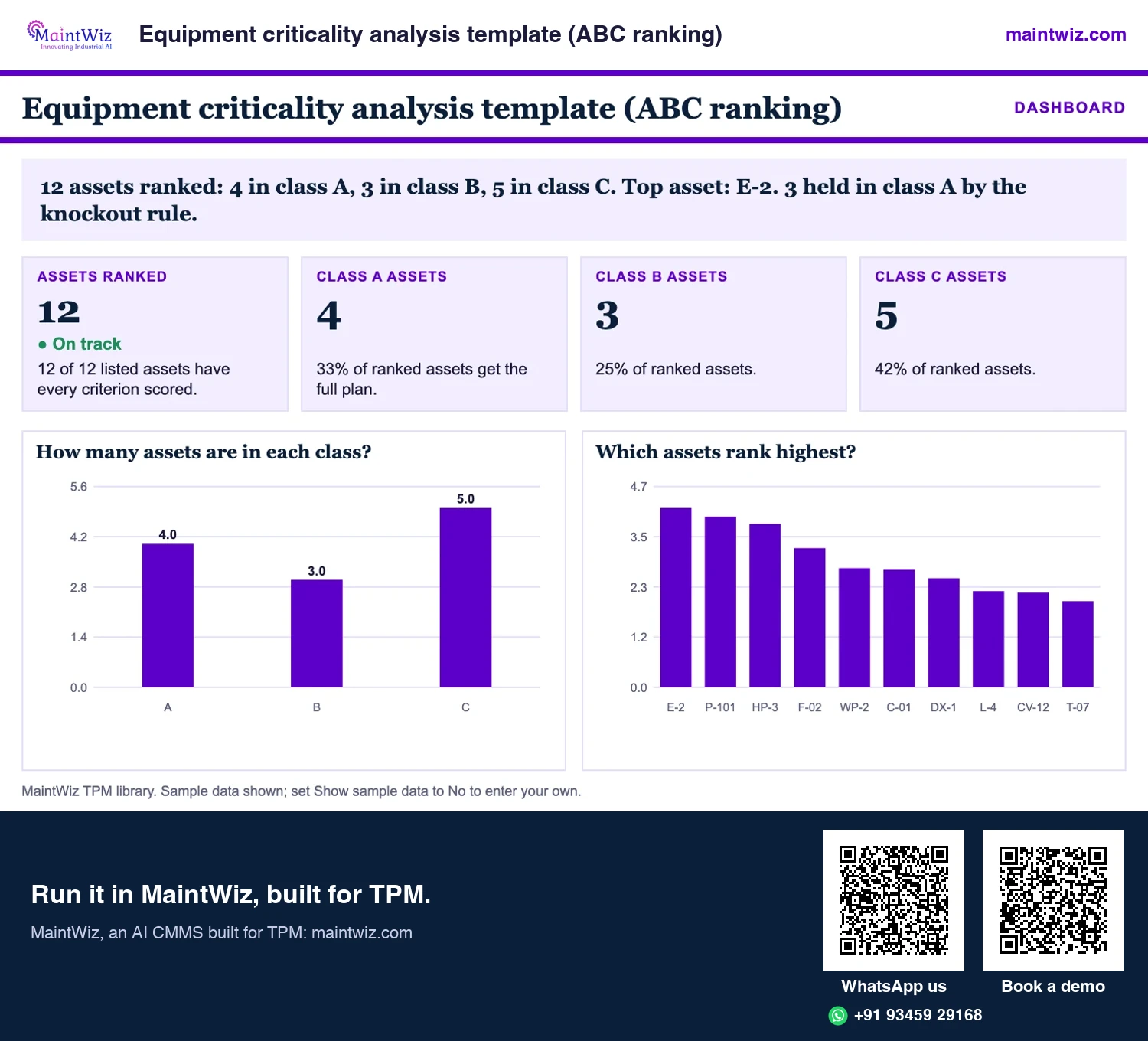
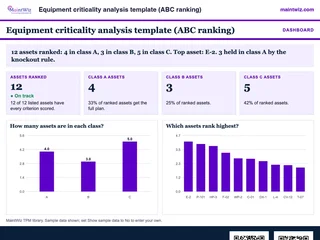 ExcelEquipment criticality analysis template (ABC ranking)
Score equipment on safety, environment, production, standby and detectability, rank it A, B or C
- Sheets
- Dashboard, Inputs, Criteria, Strategy, Assets, Read me
- A4
- Version
- v1.1, 5 November 2026
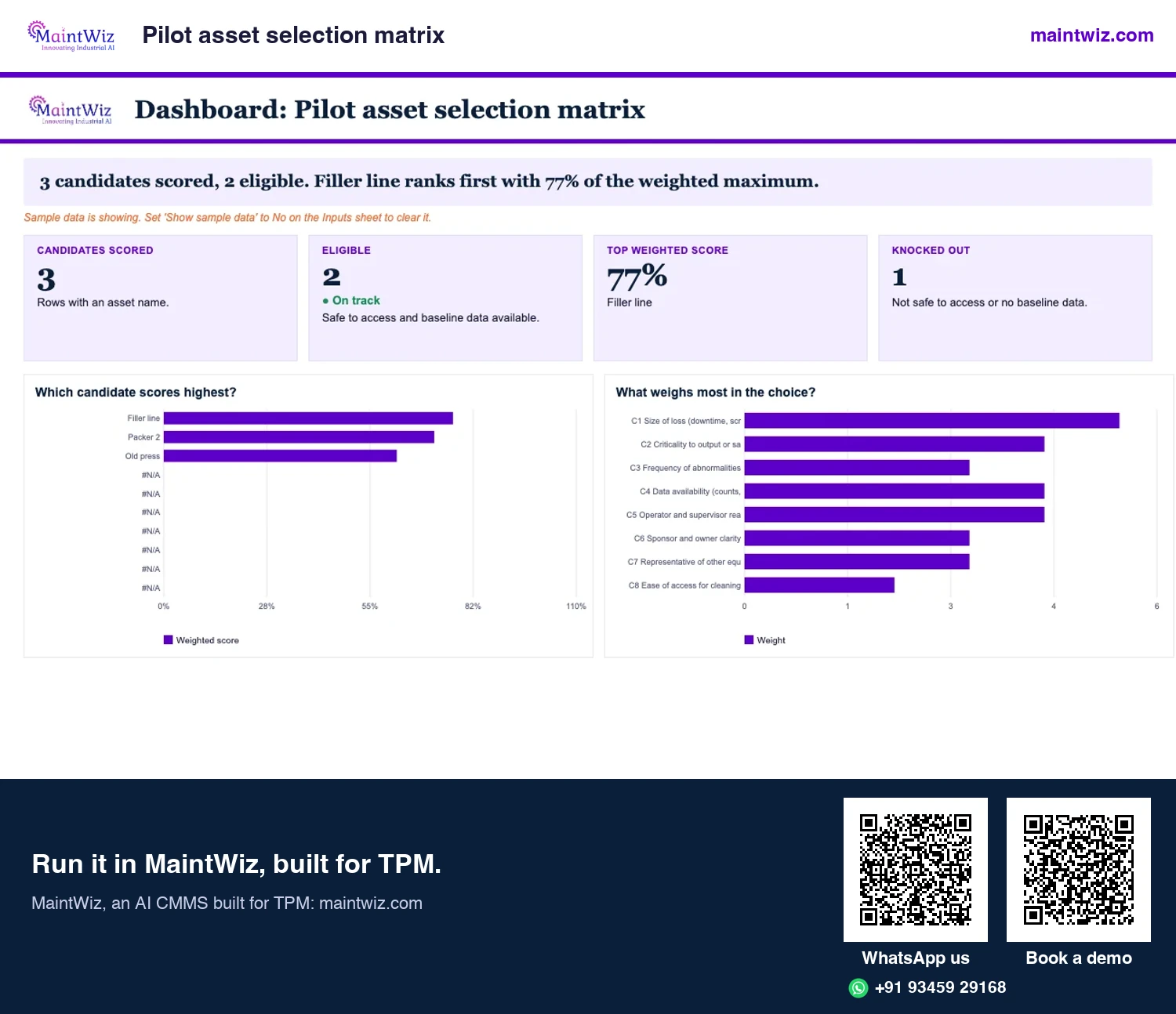
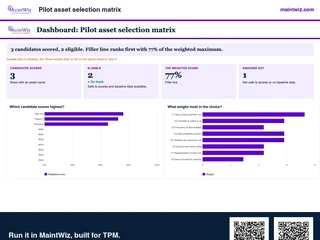 ExcelPilot asset selection matrix
Rank candidate assets on weighted criteria with safety and baseline-data gates
- Sheets
- Dashboard, Inputs, Criteria, Candidates, Read me
- A4
- Version
- v1.1, 4 November 2026
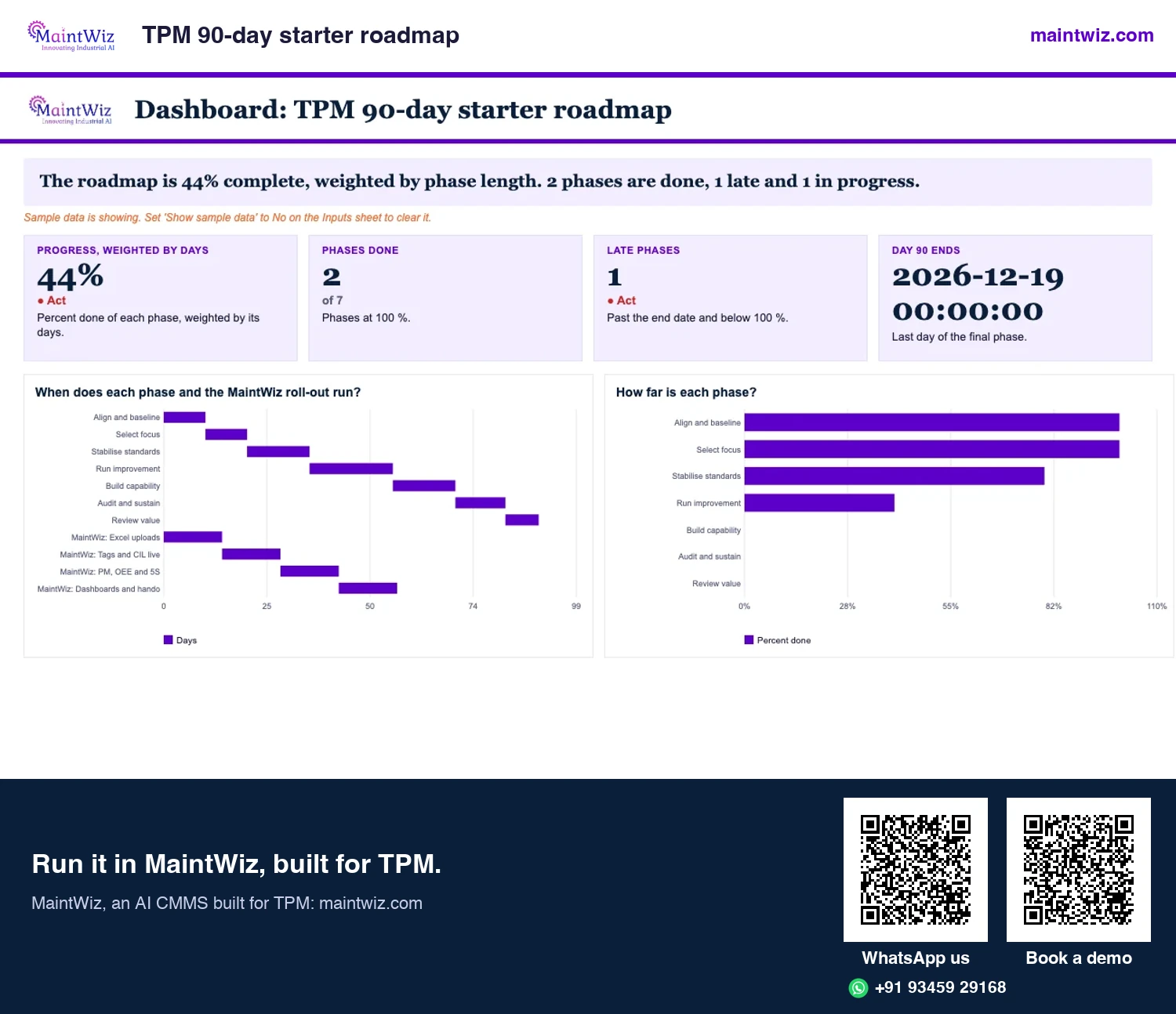
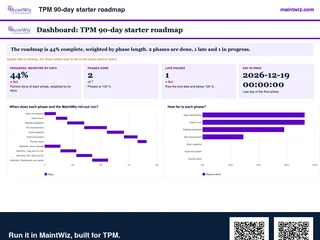 ExcelTPM 90-day starter roadmap
Seven dated phases for the first 90 days, with the 6 to 8 week MaintWiz roll-out running as a second lane
- Sheets
- Dashboard, Inputs, Roadmap, Read me
- A4
- Version
- v1.1, 4 November 2026
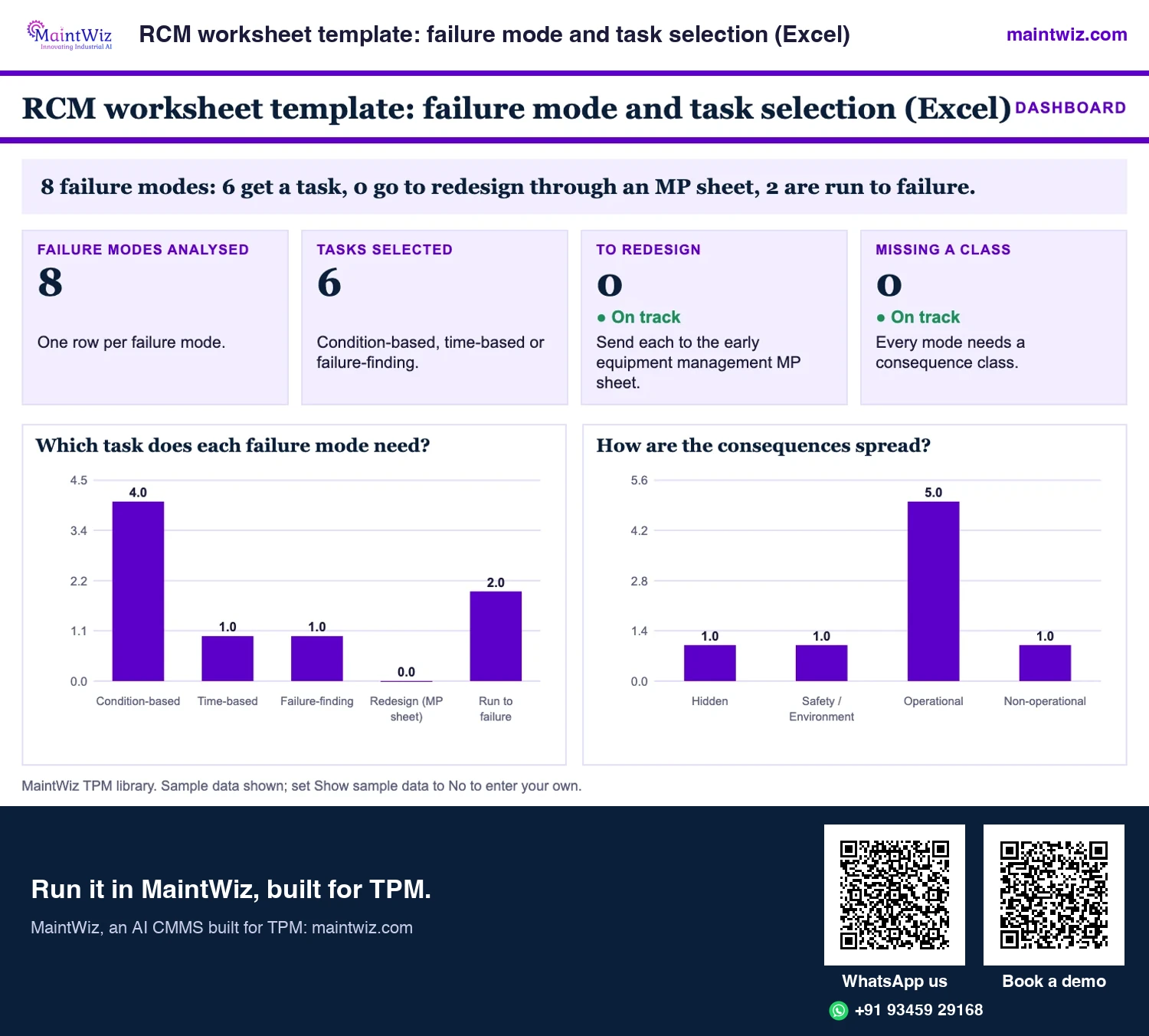
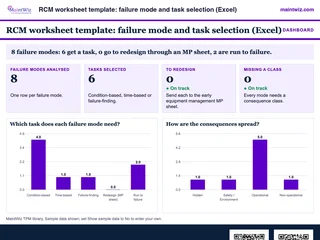 ExcelRCM worksheet template: failure mode and task selection (Excel)
Pick the maintenance task for every failure mode in an RCM worksheet: condition-based, time-based, failure-finding, redesign or run to failure, by consequence class.
Inside: Worksheet: asset, function, functional failure, failure mode and effect · Consequence class: hidden, safety or environment, operational · Feasibility questions that drive the decision logic · Task, interval and owner, with MP sheet redesign route
- Sheets
- Dashboard, Inputs, Worksheet, Results, Read me
- A4
- Version
- v1.0, 5 November 2026
Side by side
How do TPM and RCM compare side by side?
| Aspect | TPM | RCM |
|---|---|---|
| Core question | How do we remove equipment losses and keep equipment in condition, with everyone's help? | What maintenance does each asset need to keep doing its function, given how it fails? |
| Nature | Management system and culture | Analysis method with a defined process |
| Scope | Whole plant: eight pillars, operators to management | Selected assets, usually the critical ones, analysed one at a time |
| Who does the work | Operators, maintenance, engineers, managers | A facilitated team of operations, maintenance and engineering |
| Main outputs | Routines, standards, ownership, loss reduction projects | Task list, task intervals, design changes, run-to-failure decisions |
| Typical metrics | OEE, MTBF, MTTR, tags closed, audit scores | Failure consequences, task coverage, reduced failure modes |
| Strength | Builds ownership and sustains improvement | Matches effort to consequence and failure mode |
| What it needs | A criticality ranking, so routines go first to the assets that matter most | Pillar routines and work orders to carry out the task list |
Which first
When should you start with TPM, and when with RCM?
- Start with TPM when basic conditions are poor: dirty equipment, no standards, operators who do not report problems, unclear ownership. Analysis is wasted if the equipment is not kept in basic condition.
- Start with RCM, or a lighter criticality and failure mode review, when a few critical assets carry high consequence (safety, environment, major output) and the maintenance strategy for them is unclear.
- Do both in sequence when you can: a TPM pilot builds cleaning, inspection and data habits, and an RCM review of the critical assets then sets what planned maintenance should contain.
- Rank assets by criticality first; see the pilot asset selection matrix.
Decide by the problem you have: weak basic conditions and ownership point to TPM first; an unclear strategy for critical assets points to RCM first. Bring your critical-asset list to a demo and see its tasks scheduled in MaintWiz, an AI CMMS built for TPM, as time, condition and event-based PM schedules with work orders and history.
How do TPM and RCM work together?
| TPM element | How RCM helps | How TPM helps RCM |
|---|---|---|
| Planned maintenance pillar | Sets the tasks and intervals by failure mode and consequence | Provides the schedule, work orders and history to execute and test them |
| Autonomous maintenance | Identifies the failure modes operators can detect early, so their inspection points are meaningful | Operators find the symptoms and report them, which feeds the failure data RCM needs |
| Focused improvement | Identifies design changes where no task is adequate | Teams run the project and verify the result |
| Early equipment management | Failure analysis informs specifications for new equipment | Lessons from running equipment are recorded in the same form |
| Education and training | Defines the competence needed for the tasks | Delivers and records it |
Related methods
TPM and FMEA, preventive maintenance and condition monitoring
RCM uses failure mode analysis, close to FMEA (failure mode and effects analysis), but applies it to decide maintenance tasks. FMEA by itself is often used for design and process risk. Preventive maintenance is a category of task (time or usage based) that an RCM analysis may select; TPM's planned maintenance pillar includes it. Condition monitoring is a predictive task type chosen when a measurable condition signals failure early enough to act.
In short: RCM selects task types, TPM runs the system that carries them out, and the maintenance system holds the schedule and history.
Common mistakes when comparing TPM and RCM
- Treating them as competitors: they address different problems.
- Running RCM on every asset: it is resource-heavy and is normally reserved for assets where consequence justifies it.
- Running TPM routines on equipment with no criticality ranking, so effort is spread evenly.
- Expecting the task list to execute itself: RCM output needs scheduling, ownership and feedback.
- Ignoring operators in RCM: they know the symptoms of failure.
CMMS fit
Where does a CMMS fit between RCM and TPM?
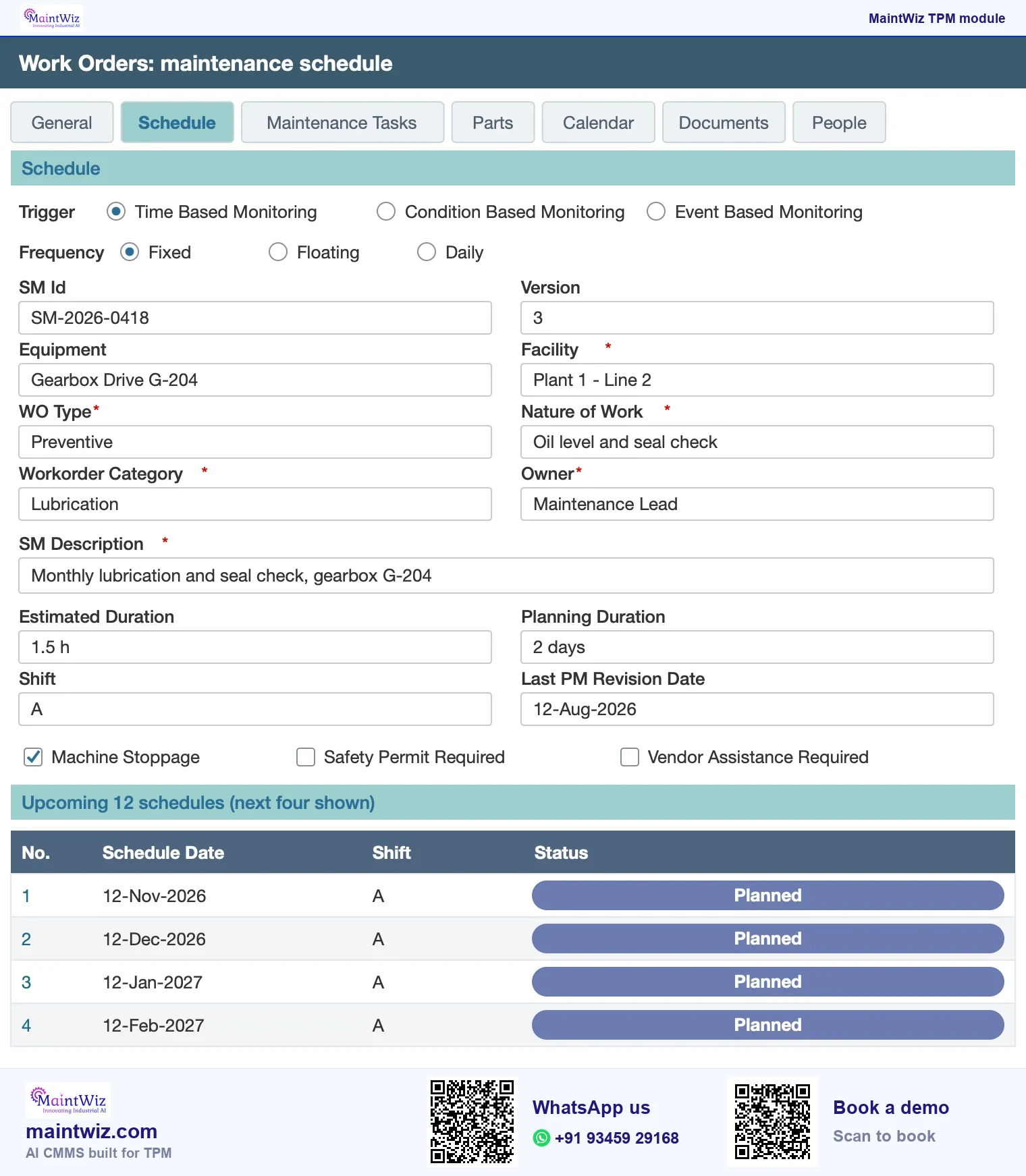
MaintWiz, an AI CMMS built for TPM, holds the tasks an RCM review selects as time, condition and event-based PM schedules with work orders and history, and its Jishu Hozen tags feed the failure data RCM needs. Planned maintenance then runs those tasks and improves them.
Report the result with the TPM KPIs: PM compliance, MTBF and OEE on the same definitions.
Book a demo to see one critical asset's PM schedule, tags and history on one record.
RCM questions
The seven RCM questions in plain words
| Question | In plain words | Output |
|---|---|---|
| Functions | What is this asset supposed to do, and to what standard? | Function statements |
| Functional failures | In what ways can it fail to do it? | Failure states |
| Failure modes | What causes each of those failures? | A list of causes |
| Failure effects | What happens when each occurs? | Effect descriptions |
| Failure consequences | How much does it matter: safety, environment, operations or cost? | Consequence class |
| Proactive tasks | Can a task prevent or predict it, and is it worth doing? | Task and interval |
| Default actions | If no task is worth doing, what then? | Redesign, run to failure or failure-finding |
An example of how each approach handles the same problem
Consider a pump whose mechanical seal leaks repeatedly. A TPM team would look at the condition: operators clean around the pump and find the leak earlier, the team looks for contamination or misalignment that shortens seal life, a focused improvement project removes the source, and an inspection point is added to the standard. An RCM analysis would list the pump's function, the failure of the seal to contain fluid, the causes of that failure, the consequence (a spill, a stop) and the proactive task or redesign that is worth doing, such as a condition check at an interval or a different seal arrangement. Each answers part of the question; together they find the cause and set the routine.
One leaking pump seal, two routes
The same problem handled by TPM and by RCM
TPM route
- Cleaning finds the leak
- An efuda (tag) is hung
- Kobetsu Kaizen removes the misalignment
- A CIL inspection point is added
RCM route
- Function: contain fluid at the rated pressure
- Functional failure: the seal leaks
- Failure mode: seal face wear from misalignment
- Consequence: spill and stop
- Task: vibration and alignment check at a set interval, or a seal redesign
maintwiz.comAI CMMS built for TPMWhatsApp us+91 93459 29168Book a demoRCM, RCA, FMEA and preventive maintenance optimisation
| Term | What it is | Relation to the others |
|---|---|---|
| RCM | Selects maintenance tasks from functions, failure modes and consequences | Applies failure analysis to maintenance strategy |
| RCA (root cause analysis) | Finds why a specific event happened | Used after a failure; RCM looks ahead at all modes |
| FMEA | Lists failure modes and effects, often with risk scores | Feeds RCM or design reviews |
| PM optimisation | Reviews existing preventive tasks for value | A lighter alternative to full RCM |
| TPM | Management system to remove losses with operator involvement | Executes and improves what the analysis selects |
For the maintenance task side see planned maintenance and Jishu Hozen; for loss data see the six big losses.
Track MTBF and MTTR per critical asset before and after the RCM review to see whether the selected tasks work.
FAQ
Frequently asked questions
What is the difference between TPM and RCM?
RCM is an analysis method that chooses maintenance tasks by function, failure mode and consequence. TPM is a management system that involves operators and maintenance in removing equipment losses. RCM outputs a task list for critical assets; TPM outputs the routines that carry it out.
Is TPM better than RCM?
They do different jobs. RCM decides which maintenance each critical asset needs; TPM builds the operator and maintenance routines that carry it out and remove losses. Run both in sequence: TPM restores basic conditions and RCM sets the tasks for critical assets, held in MaintWiz, an AI CMMS built for TPM, with PM schedules, tags and work orders.
Can TPM and RCM be used together?
Yes. RCM can set the tasks and intervals for the planned maintenance pillar, while TPM provides the operators, routines, training and data to execute and refine them.
What is the difference between RCM and TPM?
RCM is an analysis method that chooses maintenance tasks by function, failure mode and consequence. TPM is a management system that involves operators and maintenance in removing equipment losses.
Is RCM part of TPM?
No. RCM is a separate analysis method, though it can inform TPM's planned maintenance pillar by setting which tasks to do and how often. A plant can run either one without the other, and many use both together.
What is the RCM standard?
SAE JA1011 sets evaluation criteria that a process must meet to be called reliability-centred maintenance. Its standard formulation asks seven questions about each asset, from its functions and failure modes to the consequences and the task that prevents or predicts the failure.
RCM vs TPM: which should come first?
Start with TPM basics where cleaning, standards and ownership are weak, because analysis is wasted on equipment in poor condition. Start with RCM where a few critical assets carry high consequence and the maintenance strategy for them is unclear.
Can MaintWiz hold the tasks an RCM review selects?
Yes. Each task an RCM review selects becomes a MaintWiz PM schedule with a time, condition or event trigger, a fixed or floating frequency and upcoming due dates, and runs as work orders. Jishu Hozen tags and breakdown records on the same equipment list give the next review its failure data.
Sources
Sources
- SAE JA1011, Evaluation criteria for reliability-centered maintenance (RCM) processes. https://www.sae.org/standards/content/ja1011_200908/