
Key takeaways
- Step 0 is preparation: purpose, safety training, a model area, a baseline and the tag rules. It comes before the seven steps and gives step 1 a safe, agreed start.
- Step 1 uses cleaning as inspection: every abnormality found is tagged, logged with an owner and a date, and photographed before and after.
- Operators do the cleaning; maintenance coaches and removes guards only under the plant's safety rules.
- The step passes when abnormalities are tagged and logged, before-and-after records exist and operators took part.
- In MaintWiz every step 1 tag is registered against the equipment with an owner, a target date and an overdue alert, and converts to a work order when maintenance is needed.
Step 0
What is step 0 in autonomous maintenance?
Step 0 is the preparation that makes step 1 safe and useful. It comes before the seven steps begin. The sponsor explains why the plant is doing this; operators and supervisors are trained on the purpose, the tag rules and the safety rules; a model area is chosen; and a baseline is taken so that progress can be seen later. JIPM runs autonomous maintenance as a seven-step sequence, and step 1 is the first audited step.
| Step 0 task | What it produces | Who |
|---|---|---|
| Explain the purpose and the rules | A briefing record and a tag legend | Sponsor, TPM lead |
| Safety training | Trained operators; isolation and guard rules understood | Safety lead, supervisor |
| Choose the model area | One equipment or line with willing owners, safe access and visible problems | Steering group |
| Take a baseline | Photographs, a current loss or downtime figure, and time spent on cleaning today | Operators, supervisor |
| Prepare tools and materials | Cloths, brushes, containers, tags, camera, PPE | Supervisor |
| Agree the schedule | Time released in the shift plan for step 1 | Production manager |
Before the cleaning starts, write the tag legend and name who closes each colour; the first week of tags then arrives already owned.
Score the model area on the readiness self-assessment before the briefing.
Step 0 and step 1 of autonomous maintenance
Preparation first, then the initial cleaning that finds abnormalities
Train on purpose and safety
Choose the model area
Photograph the baseline
Agree the tag rules
Clean with covers and guards opened
Tag and log every abnormality
Keep before-and-after records
Pass the step 1 audit
Blue: step 0, preparation. Teal: step 1, initial cleaning.
 maintwiz.comAI CMMS built for TPM
 WhatsApp us
 +91 93459 29168
 Book a demo
What is step 1: initial cleaning and inspection?
In step 1 the operators of one equipment clean it thoroughly, with guards and covers opened where the safety rules allow, and look closely at everything they uncover. The purpose is not a clean machine for its own sake. Cleaning brings people close to the equipment, and what they find, such as leaks, loose or missing fasteners, wear, damage, build-up and hard-to-reach points, is the raw material for every later step. Each finding is tagged on the equipment and logged in a register with an owner and a target date (Figure 2).
The Jishu Hozen staircase
Seven steps, each closed by a step audit before the team climbs to the next
- 0PreparationPurpose, safety training, model area, baseline, tag rules
- 1Initial cleaningShoki seisoStep audit
- 2Sources and hard-to-access placesHasseigen konnan-kasho taisakuStep audit
- 3CIL standardsJishu hozen kari-kijunStep audit
Steps 1 to 3 Restore basic conditions
- 4General inspectionSotenkenStep audit
- 5Autonomous inspectionJishu tenkenStep audit
Steps 4 to 5 Inspection skills
- 6StandardisationHyojunkaStep audit
- 7Full self-managementJishu kanri tetteiStep audit
Steps 6 to 7 Autonomous management
Japanese names as taught by JIPM; each tread ends at a step audit gate
maintwiz.comAI CMMS built for TPMWhatsApp us+91 93459 29168Book a demoThe operators' participation matters as much as the result. A contractor who cleans the machine overnight produces a clean machine and no learning; the audit therefore asks whether operators took part.
Log every step 1 abnormality in MaintWiz: owner, target date, tag colour and a closure dashboard. Book a demo.
Downloads
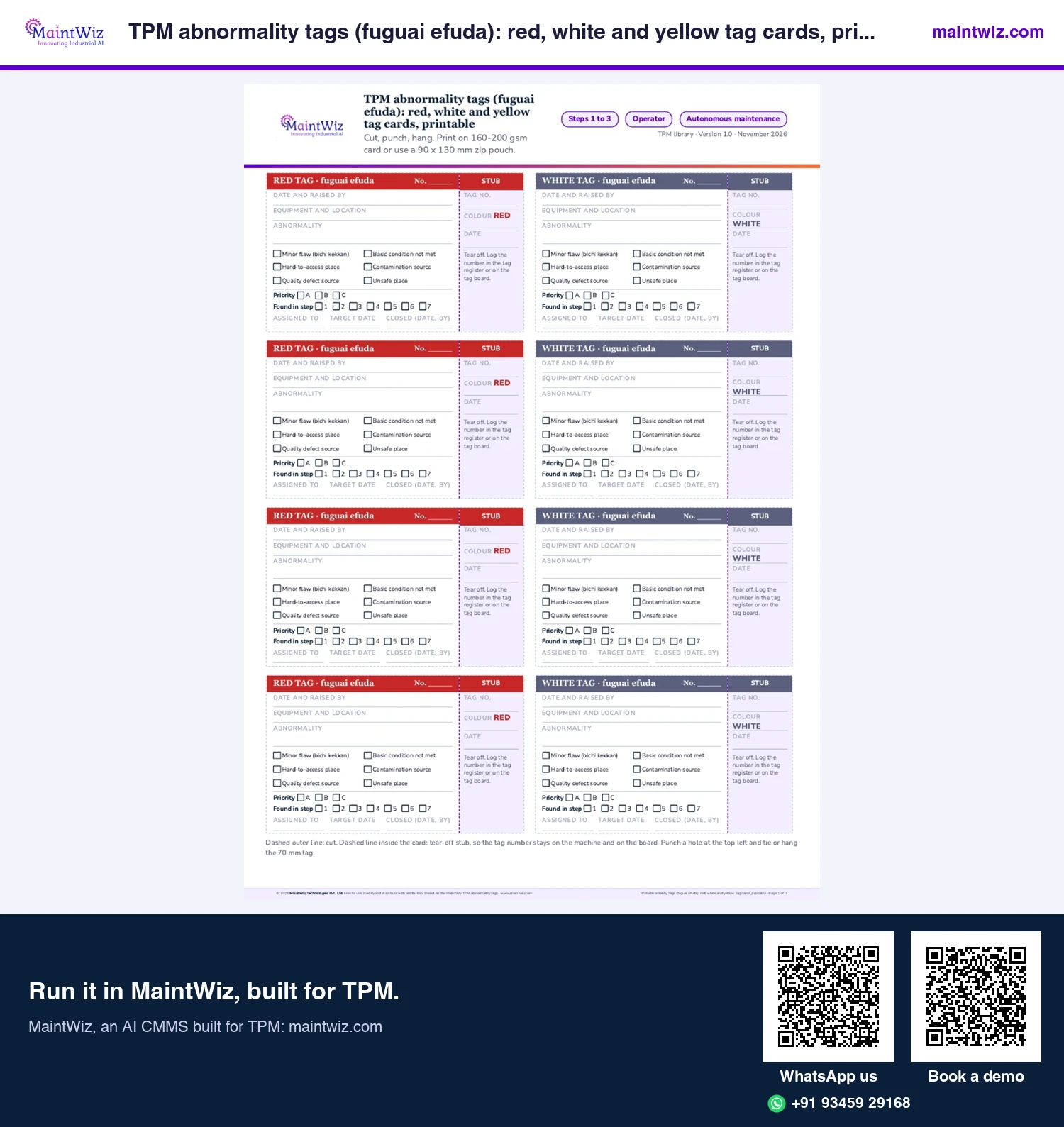
Step 1 initial cleaning: step-gate scorecard, tag register and tag cards
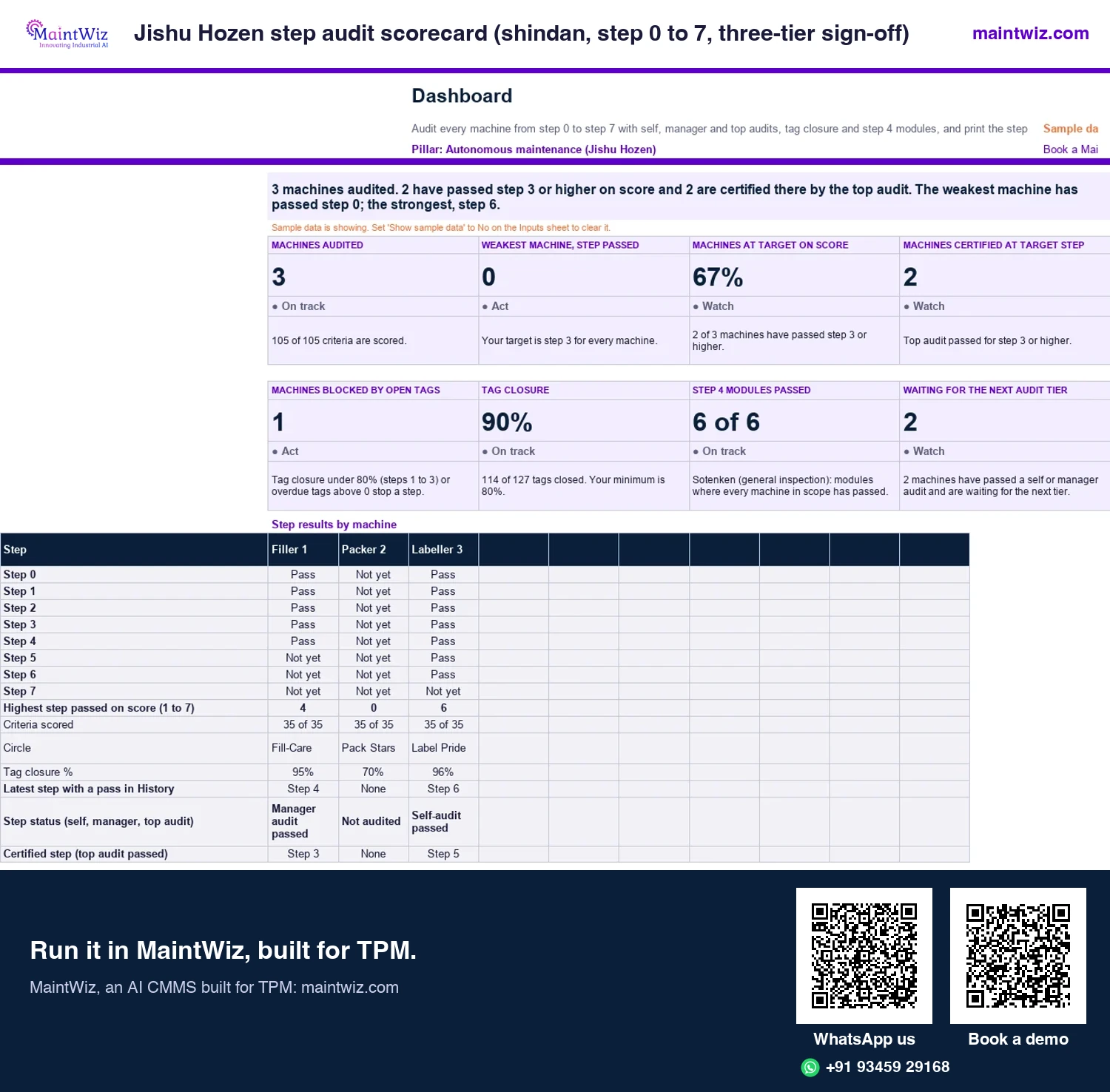
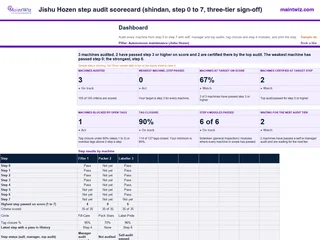 ExcelJishu Hozen step audit scorecard (shindan, step 0 to 7, three-tier sign-off)
Audit every machine through the seven Jishu Hozen steps with self, manager and top audits
- Sheets
- Dashboard, Inputs, Audit, Step 4 modules, History, Certificate, Read me
- A4
- Version
- v1.1, 5 November 2026
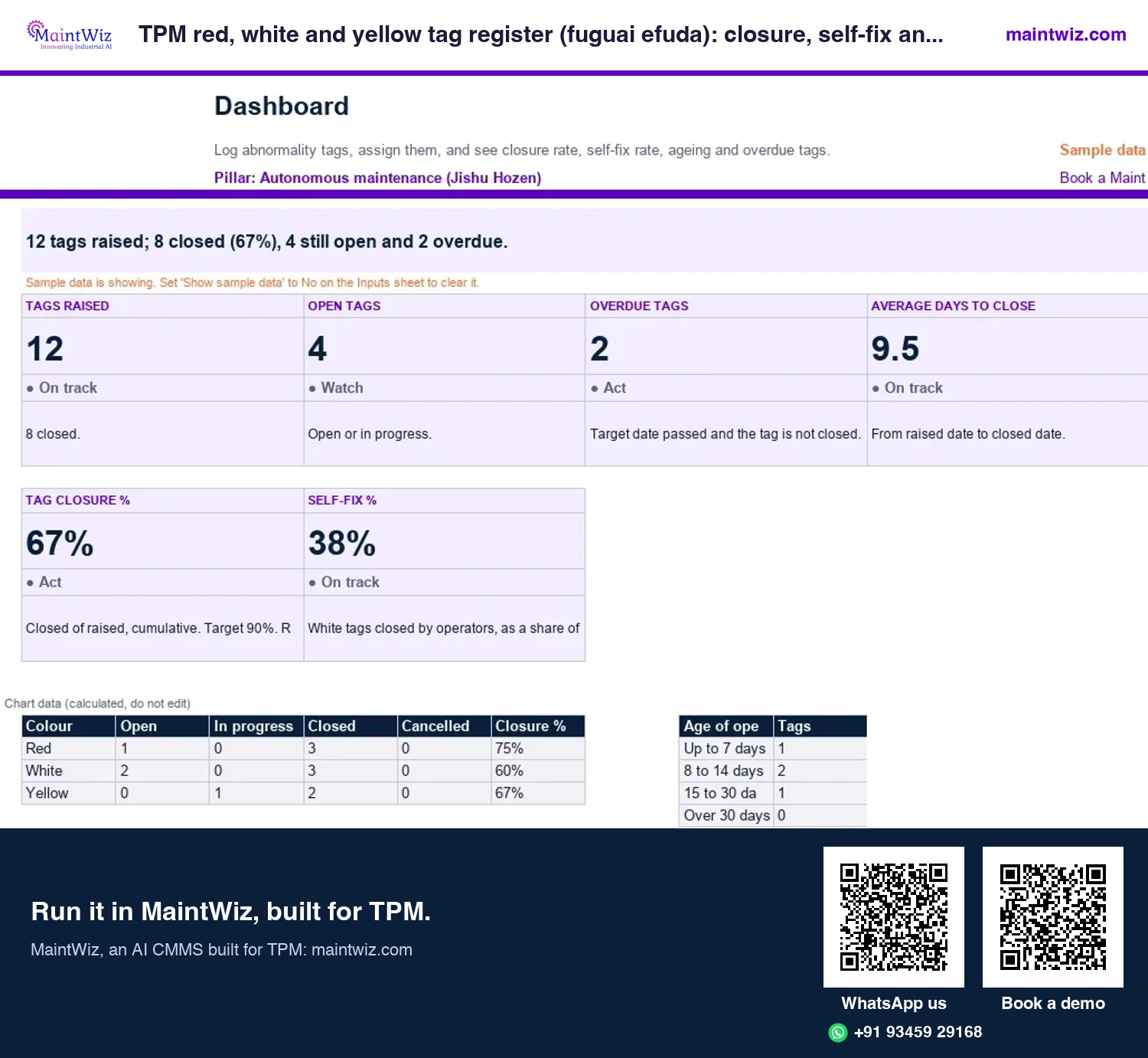
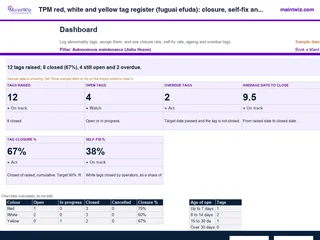 ExcelTPM red, white and yellow tag register (fuguai efuda): closure, self-fix and ageing
Log every abnormality tag, see closure rate and self-fix rate by colour, and find overdue tags before an audit does
- Sheets
- Dashboard, Inputs, Register, Read me
- A4
- Version
- v1.0, 2 November 2026
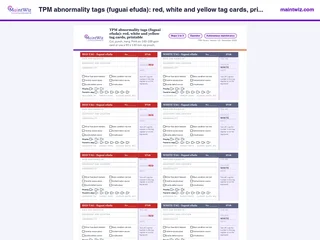 PDFTPM abnormality tags (fuguai efuda): red, white and yellow tag cards, printable
Print two-part red, white and yellow tags with a tear-off stub, priority and step boxes, eight per A4
- Pages
- 3
- A4
- Created
- 5 November 2026
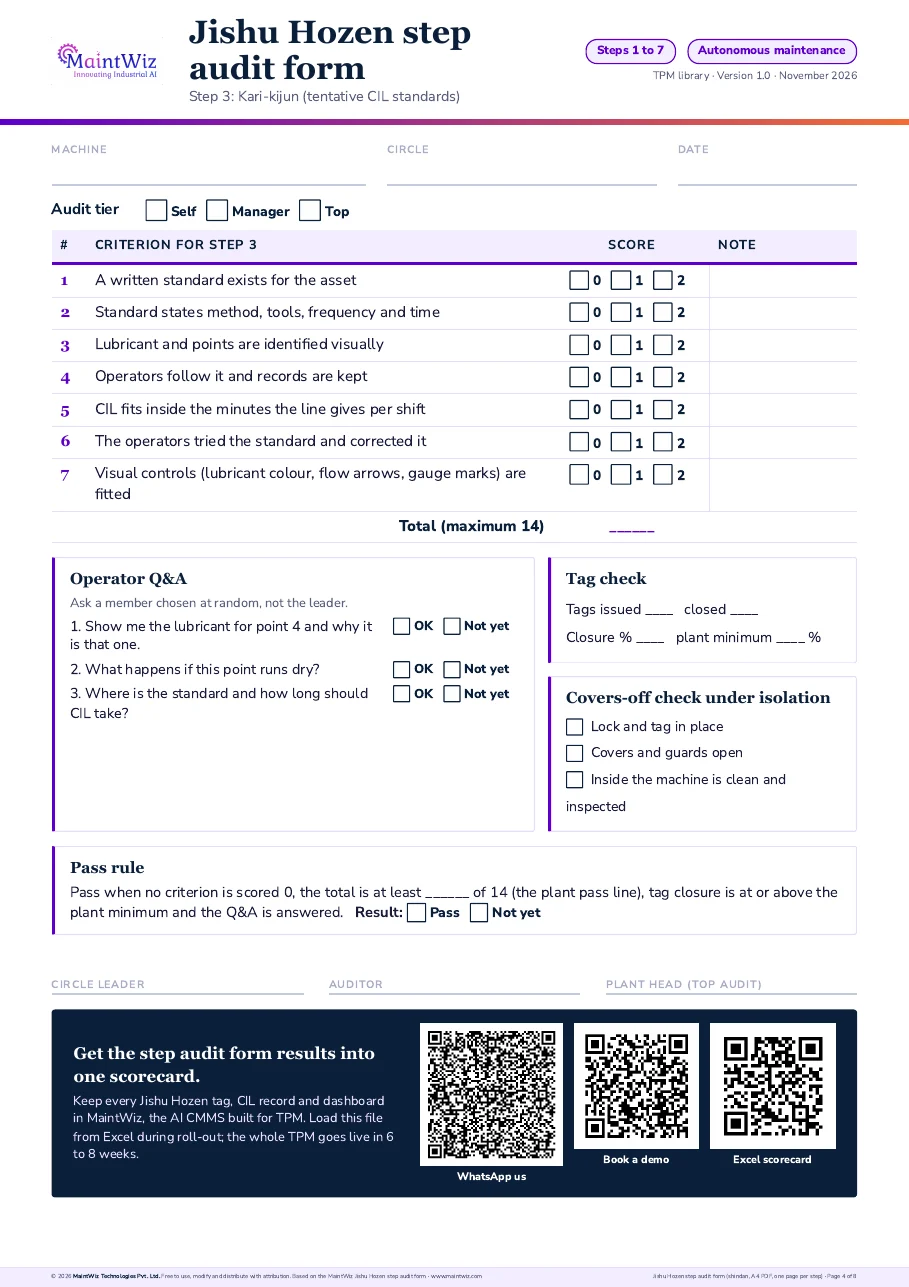
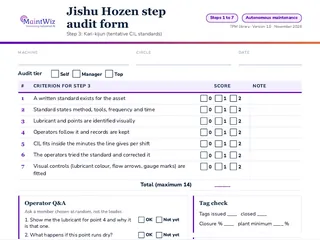 PDFJishu Hozen step audit form (shindan, PDF, one page per step)
Audit any machine with a one-page Jishu Hozen (autonomous maintenance) step audit form: scored criteria, operator questions, tag check and three-tier shindan sign-off.
Inside: One form per step, Step 1 Shoki Seiso (initial cleaning) to Step 7 Jishu Kanri (autonomous management) · Criteria scored 0, 1 or 2 with a pass rule · Three operator questions, a tag count and a covers-off check under isolation · Sign-off by circle self-audit, manager and top management
- Pages
- 8
- A4
- Created
- 5 November 2026
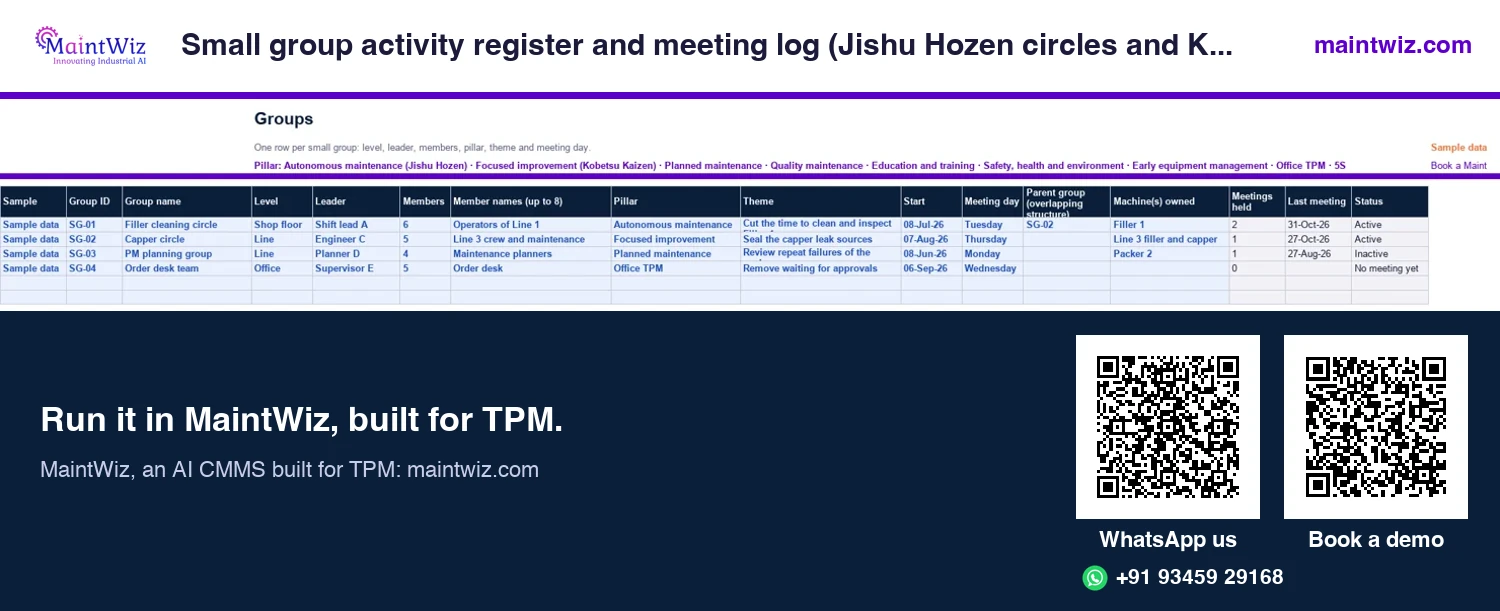
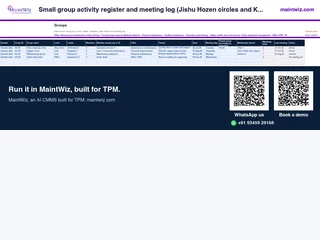 ExcelSmall group activity register and meeting log (Jishu Hozen circles and Kaizen themes)
Register every small group, log its meetings and track Jishu Hozen circles up the seven steps or Kaizen themes up
- Sheets
- Dashboard, Inputs, Groups, Meetings, Activities, Board, Read me
- A4
- Version
- v1.1, 5 November 2026
What to look for
What should operators look for while cleaning?
| Look for | Examples | Usual action |
|---|---|---|
| Leaks and seepage | Oil, coolant, air or product escaping at seals, joints and hoses | Tag; maintenance repair; step 2 source countermeasure |
| Loose, missing or damaged fasteners | Bolts, guards, covers, clamps | Tighten or replace if the rule allows; otherwise tag |
| Wear and damage | Worn belts, chains, bearings, cracked parts, frayed cables | Tag for maintenance |
| Contamination and build-up | Dust, product, chips, grease where it should not be | Clean; log the source for step 2 |
| Abnormal sounds, heat or vibration | Noise during manual movement, hot housings | Tag; call maintenance if safety is at risk |
| Missing or unreadable labels and marks | Lubricant tags, direction arrows, gauge marks | Tag; fix in step 3 or step 6 |
| Hard-to-reach places | Points that cannot be cleaned, inspected or lubricated without removing parts | Log for step 2 |
The seven types of fuguai
What operators look for while cleaning: fuguai means abnormality
- 1
Minor flaws
Dirt, wear, play, looseness
- 2
Unfulfilled basic conditions
Missing lubrication, slack bolts
- 3
Inaccessible places
Grease nipple behind a guard
- 4
Contamination sources
Seal leak, product spill
- 5
Quality defect sources
Worn nozzle, loose guide
- 6
Unnecessary and non-urgent items
Idle tools, spare fittings
- 7
Unsafe places
Exposed shaft, oily floor
Each find gets an efuda (tag) and a register entry with its type
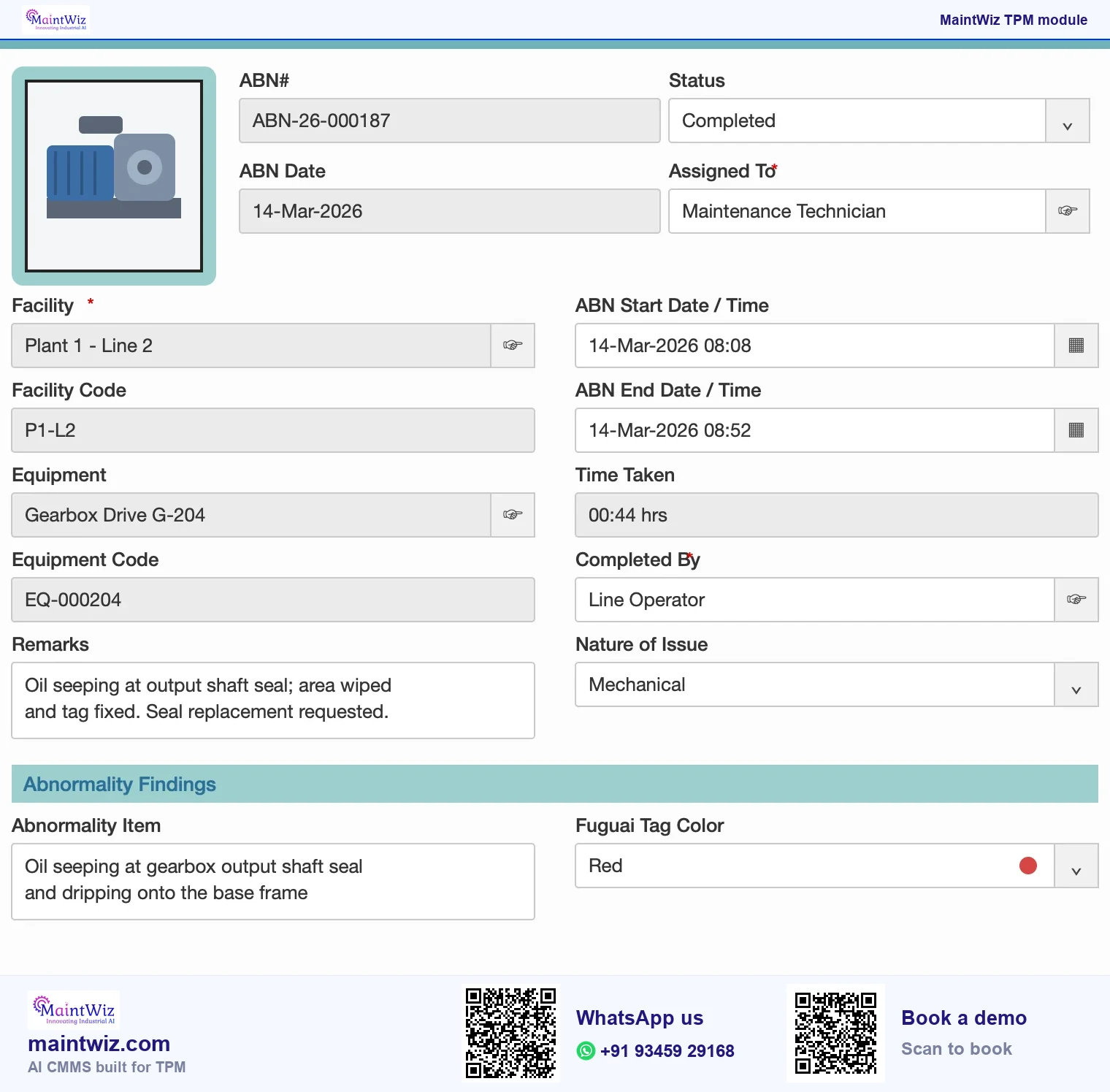
maintwiz.comAI CMMS built for TPMWhatsApp us+91 93459 29168Book a demoA worked tag: during initial cleaning on day 2, an operator finds oil weeping at a gearbox seal and raises a red tag. The register holds it like this.
| Register field | Entry for the gearbox seal |
|---|---|
| Equipment | The gearbox on the model-area machine |
| Nature of issue | Oil weeping at the output seal, found while cleaning |
| Tag colour and category | Red tag; leak |
| Owner and target date | Maintenance technician named at tagging; date set by the supervisor |
| Cause | Worn seal lip, confirmed when maintenance opened the housing |
| Countermeasure | Replace the seal; add the seal to the step 1 check list |
| Status | Closed once the operator confirms the leak has stopped |
Fix now or tag? A simple decision rule
| Situation | Decision |
|---|---|
| Operators can fix it safely with the tools and skills they have, and the rule allows it | Fix it, log it as a white tag and record the countermeasure |
| It needs maintenance skills, parts or downtime | Tag it red, log it, assign an owner and a date |
| It is a safety risk | Make safe first under the plant's rules, escalate to the safety lead, then log |
| It is a source of contamination or a hard-to-reach place | Log it for step 2 even if cleaning it now is easy |
| It is outside the equipment boundary | Tag it to the owner of the area |
Write the colour legend before cleaning starts; MaintWiz records the tag colour on every register entry (Figure 5).
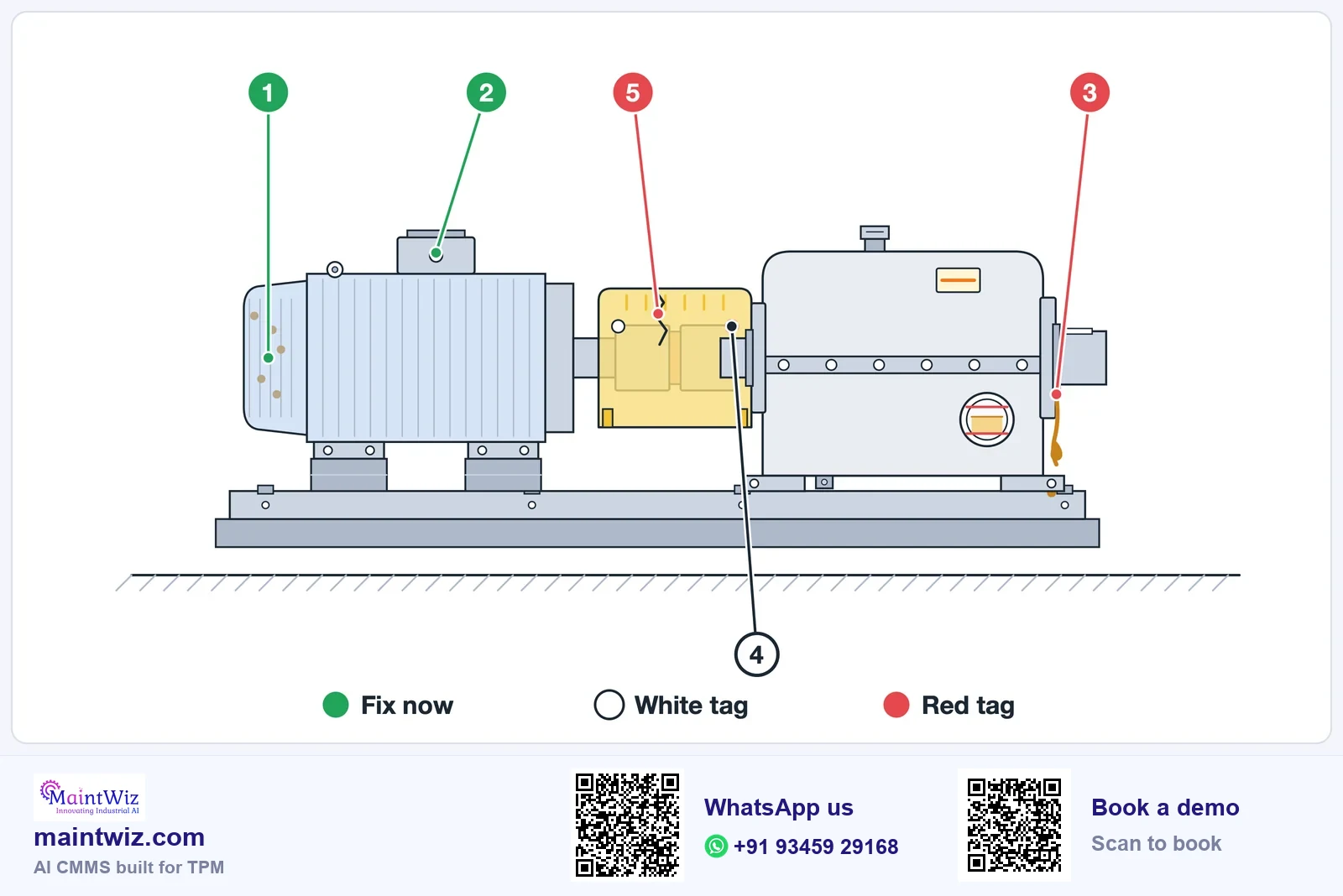
| No. | Find during initial cleaning | Decision |
|---|---|---|
| 1 | Clogged motor fan cover | Cleaned now |
| 2 | Loose terminal box screw | Tightened now, white tag raised and closed |
| 3 | Oil seep at the gearbox output seal | Red tag for maintenance |
| 4 | Missing coupling guard bolt | White tag for operators |
| 5 | Cracked coupling guard | Red tag for maintenance |
Three-day plan
A three-day plan for step 1
- Day 1: briefing and safety check; photograph the equipment; isolate; clean the outside, covers and panels; tag and log what is found; time the work.
- Day 2: open guards where permitted; clean internal areas; inspect and tag; fix what operators may fix; record contamination sources and hard-to-reach places.
- Day 3: finish cleaning; photograph after; review the tag list with maintenance; agree owners and target dates; prepare the step 1 audit.
On larger equipment, run the three days section by section. Do it with the operators, at the equipment, with safety first.
Roles in step 0 and step 1
| Role | In step 0 | In step 1 |
|---|---|---|
| Operators | Learn the purpose and the rules; help take the baseline | Clean, inspect, tag and log; fix what is allowed |
| Supervisor | Releases time, prepares materials | Joins the cleaning; reviews tags daily |
| Maintenance technician | Trains on safety and inspection | Coaches, takes red tags, removes guards under the rules |
| Pillar owner | Runs the briefing and sets the legend | Runs the step 1 audit |
| Safety lead | Approves the isolation and guard rules | Checks that work followed them |
| Sponsor | Explains why and attends the start | Visits the area and asks about the tags |
Audit
How is step 1 audited?
The step-gate audit scores four criteria 0 to 2 each: equipment is cleaned and inspected with covers and guards opened; abnormalities found are tagged and logged; before-and-after photographs or records are kept; operators took part in the cleaning. A step passes at 7 of 8 points, the first score at or above the 80% pass mark. The free Jishu Hozen step audit scorecard scores all seven steps the same way, 0 to 2 per criterion.
Do not move on if criterion 2 (tagged and logged) scores 0, whatever the total.
Common mistakes in step 1
- Hiring cleaners: the learning is lost.
- Cleaning the outside only because guards are never opened.
- Finding problems and not logging them, which teaches operators that findings do not matter.
- Logging everything as red so maintenance is overwhelmed.
- No baseline photographs, so the audit has nothing to compare.
- Treating step 1 as a one-off event: the area re-dirties unless steps 2 and 3 follow.
- Skipping safety training because the task looks simple.
- Starting without a tag legend, so two operators tag the same fault in different colours.
After step 1, the abnormality register keeps every tag visible, owned and ageing.
Running step 1
How does MaintWiz run step 1?
- Register entry: every abnormality found in cleaning goes in against the equipment, with its tag colour and category.
- Assignment: each entry has an owner and a target date, with an overdue alert when the date passes.
- Dashboard: tag records by colour and by day, so the team sees closure in its own area.
MaintWiz runs this in its autonomous maintenance software, on the abnormality register shared with the other TPM modules. Book a demo to run step 1 on your own equipment.
FAQ
Frequently asked questions
What is step 1 of autonomous maintenance?
Step 1 is initial cleaning and inspection: operators clean the equipment thoroughly, open covers where the safety rules allow, and use the cleaning to find abnormalities, which they tag and log with an owner and a date.
What is step 0 in autonomous maintenance?
Step 0 is preparation before step 1: explaining the purpose, training on safety and the tag rules, choosing a model area, taking a baseline and releasing time. It comes before the seven steps begin.
Who should do the initial cleaning?
The operators of the equipment, with maintenance coaching and a supervisor present. Outside cleaners produce a clean machine but no learning, and the step 1 audit asks whether operators took part.
What is the difference between a red tag and a white tag in step 1?
A red tag marks an abnormality that needs maintenance support and a white tag one that operators can fix themselves; the site writes the legend before cleaning starts. In MaintWiz the tag colour is recorded on every register entry.
How long does step 1 take?
A small machine can finish step 1 in the three days of the plan above; larger equipment runs the same plan section by section. The step ends when the step 1 audit passes, not on a date.
What comes after step 1?
Step 2: finding the sources of contamination and the hard-to-access places and dealing with them so that cleaning takes less time. Step 3 then writes the cleaning, inspection and lubrication standard.
Can software record the abnormalities found in step 1?
Yes. Each abnormality found during initial cleaning is entered in the abnormality register against the equipment with its tag colour, owner and target date, and closed after the countermeasure. Operators raise each tag on a phone at the equipment, with a photo.