
Key takeaways
- Three sheets, three jobs: the idea sheet captures and decides, the A3 report analyses and verifies a project, the poka-yoke sheet records an error-proofing change.
- An idea sheet needs few fields and a fast decision: the commonest reason ideas stop coming is that nobody answers them.
- An A3 report follows a fixed story: background, current state, target, analysis, countermeasures, results, follow-up.
- Verify every result on the same measure and definition as the baseline, and record where else the change applies.
- MaintWiz is an AI CMMS built for TPM: the Kaizen idea sheet and poka-yoke sheet sit beside the loss cost master, the KK report, all eight pillars, 5S, OEE and one point lessons in one AI CMMS; operators capture on mobile, tags become work orders, IoT signals raise work orders and ePTW covers safety. The whole roll-out takes 6 to 8 weeks.
Which sheet
Which Kaizen sheet do you need?
| Format | Purpose | Size of change | Who completes it | Decision |
|---|---|---|---|---|
| Kaizen idea sheet | Capture an improvement idea or a small change already made | Small, often within one area | Any employee, individually or in a group | Supervisor or committee accepts, defers or declines, and answers the author |
| A3 report | Run and report a focused improvement on a chronic problem | A project of weeks | A cross-functional team led by a project leader | Sponsor approves the theme and the result |
| Poka-yoke sheet | Record an error-proofing change: how a mistake is prevented or detected | A device or method that stops one type of error | Operators, maintenance or engineering | Verified by a test that shows the error is caught |
Kaizen means continuous improvement, as the Lean Enterprise Institute defines it. Within TPM the focused improvement pillar uses project teams for chronic losses, and the idea sheet gives everyone else a way to contribute (Figure 1).
Three Kaizen formats and what each is for
Pick the format that matches the size of the change
Idea sheet
Capture a suggestion
Poka-yoke sheet
Record an error-proofing change
A3 report
Run a project on one page
Smaller change on the left, larger change on the right
 maintwiz.comAI CMMS built for TPM
 WhatsApp us
 +91 93459 29168
 Book a demo
MaintWiz holds the Kaizen idea sheet and the poka-yoke sheet as records. Book a demo to see both sheets on your own ideas.
Downloads
Kaizen sheet format: idea sheet, A3 report form and tracker
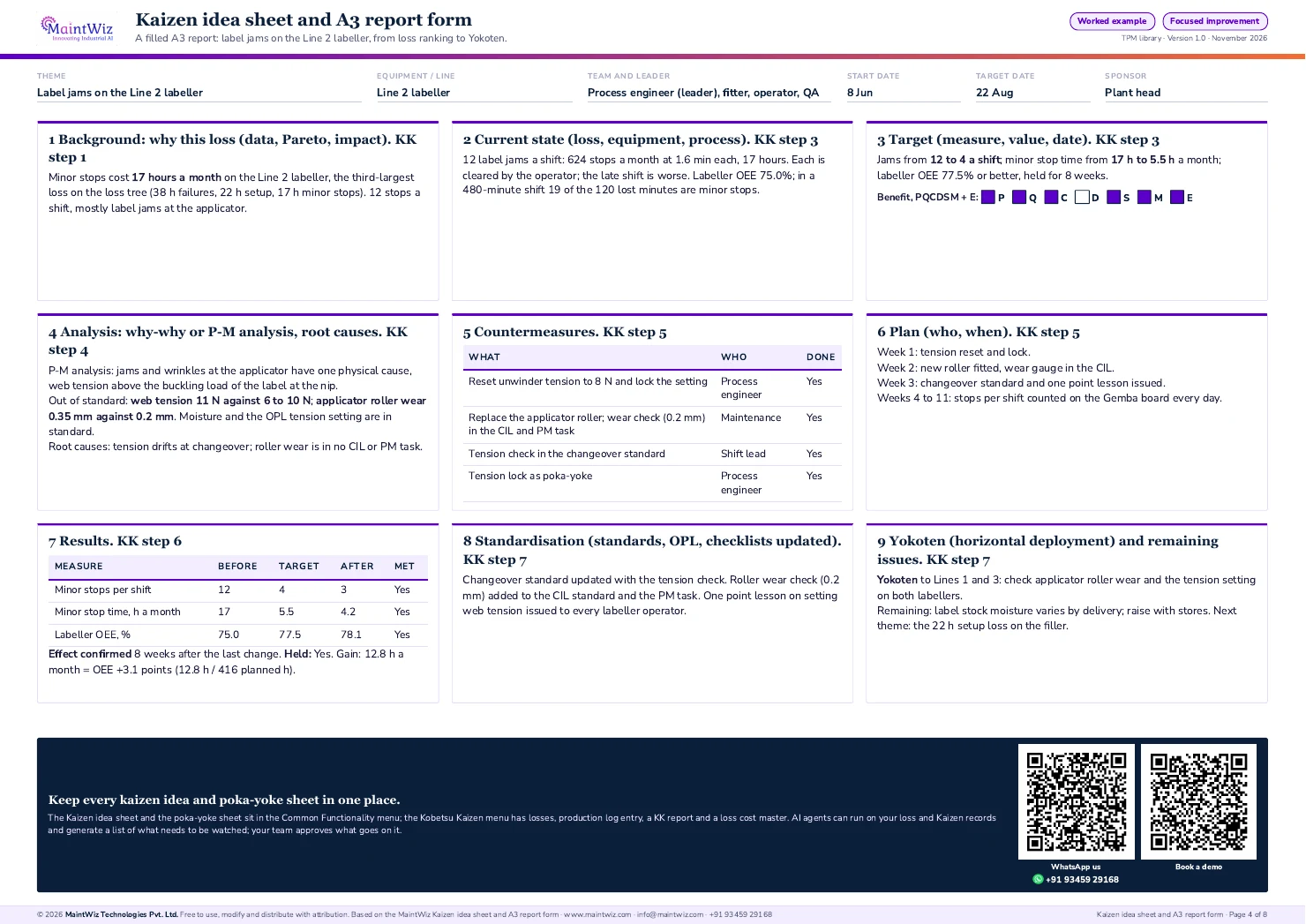
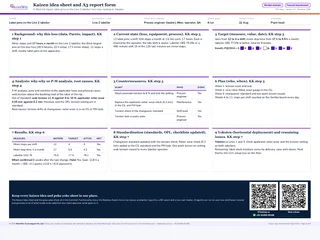 PDFKaizen idea sheet and A3 report form
Print the floor idea sheet and the A3 report form, plus a filled A3 report showing how a finished project reads
- Pages
- 8
- Idea sheet on one page; A3 report on one large sheet or two A4 pages
- Created
- 5 November 2026
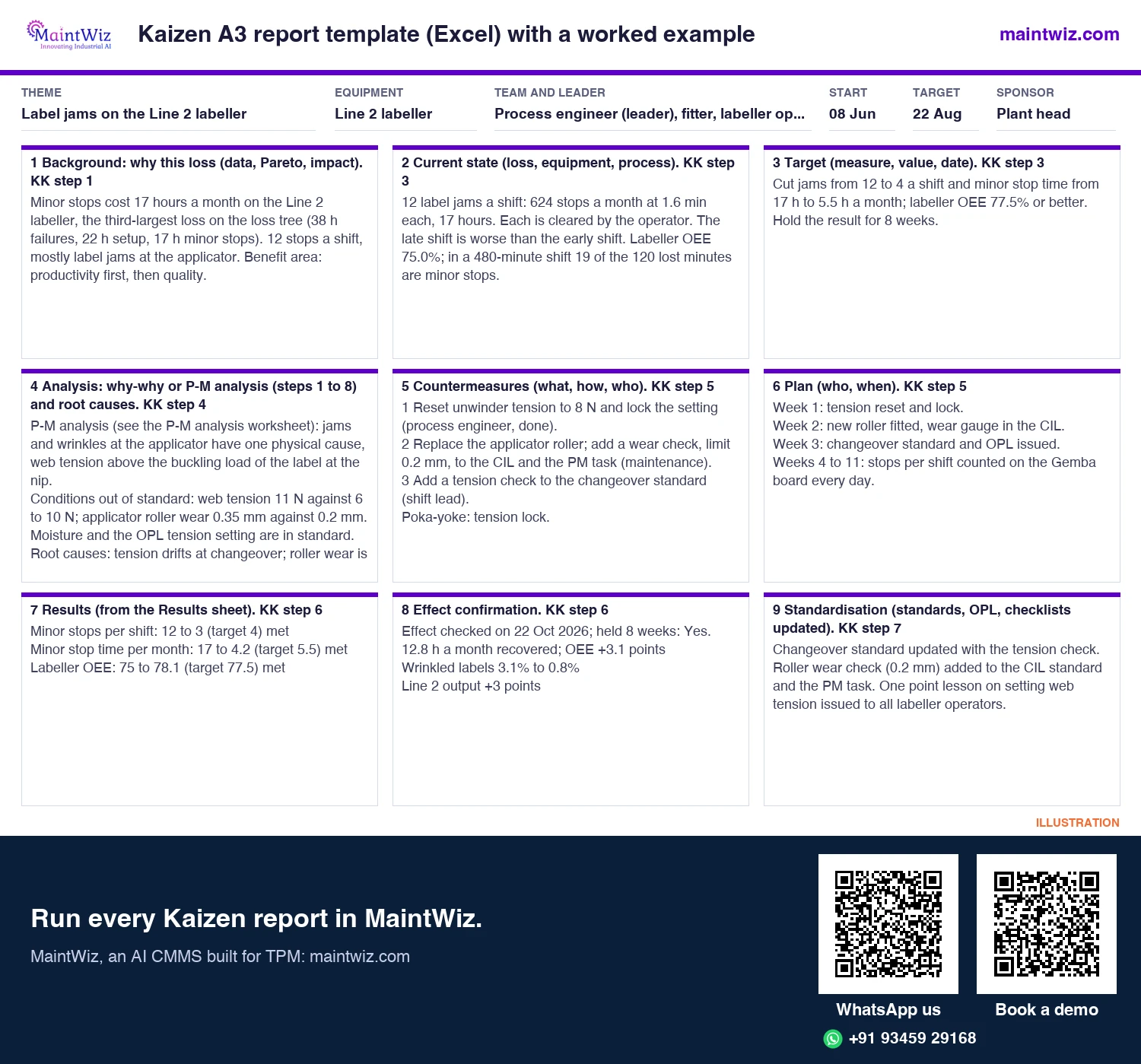
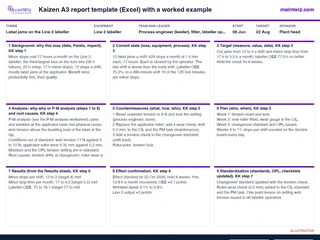 ExcelKaizen A3 report template (Excel) with a worked example
Run a Kobetsu Kaizen project as an A3 report, with the Line 2 labeller project filled in from loss ranking to Yokoten
- Sheets
- Dashboard, Inputs, Results, A3 report, A3 report, 2-page print, Calc, Read me
- One large sheet, or two A4 pages
- Version
- v1.1, 5 November 2026
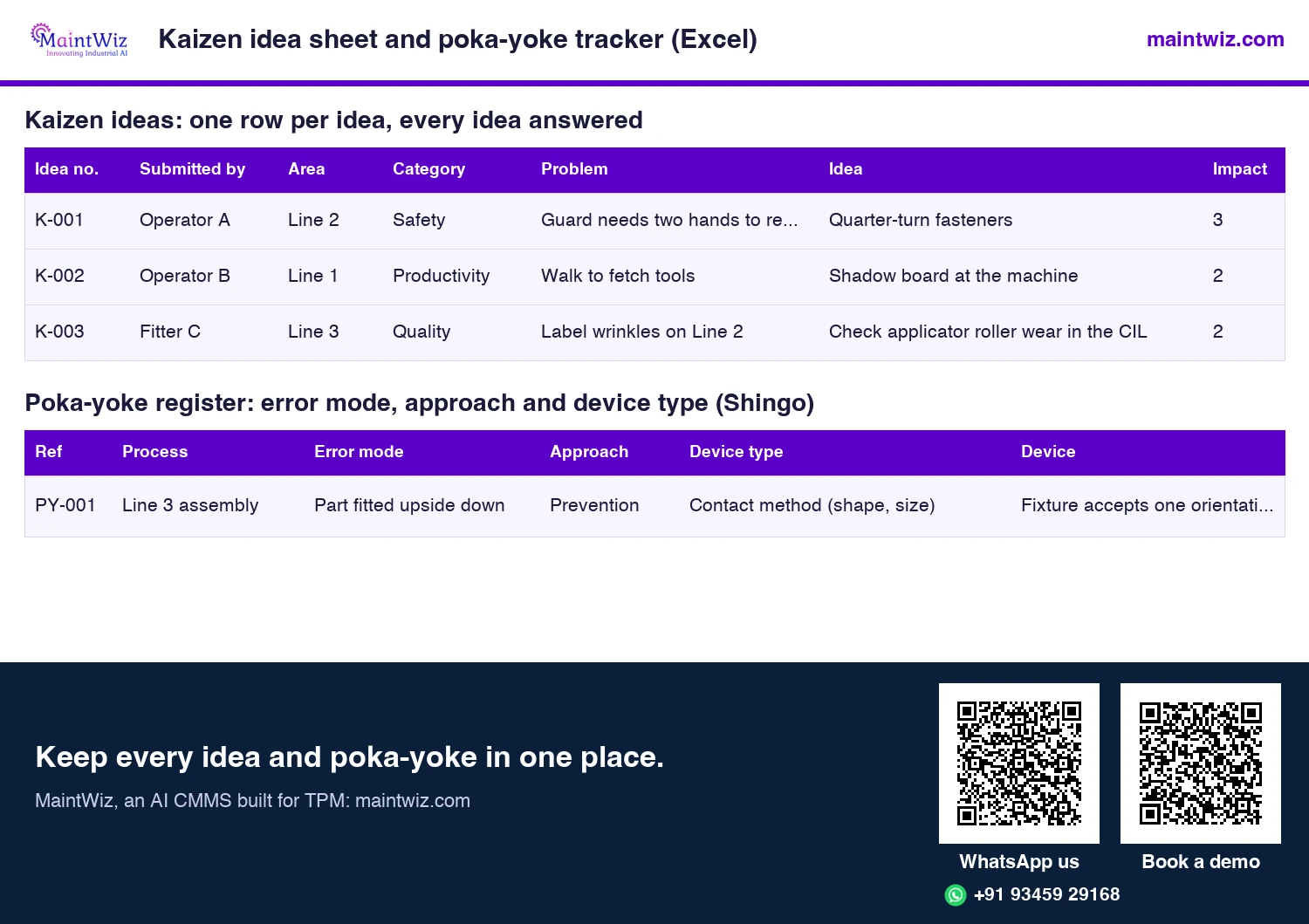
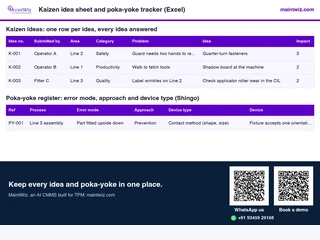 ExcelKaizen idea sheet and poka-yoke tracker
Collect floor ideas by PQCDSM and E category, answer every one
- Sheets
- Dashboard, Inputs, Ideas, Poka-yoke, Summary, Read me
- A4
- Version
- v1.1, 5 November 2026
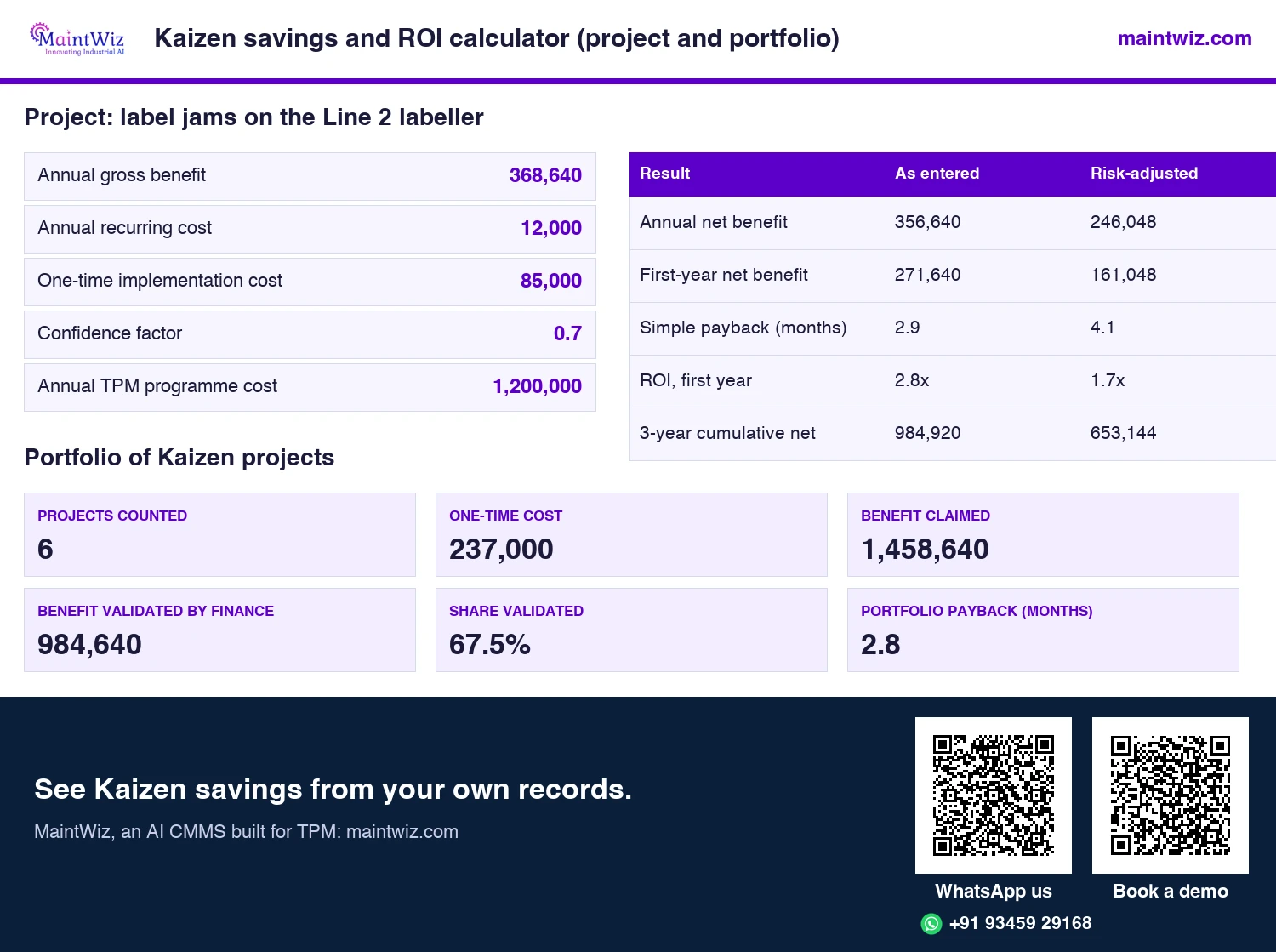
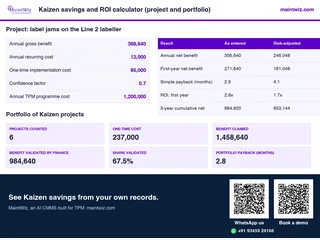 ExcelKaizen savings and ROI calculator (project and portfolio)
Test one Kaizen project for payback and ROI, then list up to 25 projects by loss to see which ones pay for the TPM
- Sheets
- Dashboard, Project, Sensitivity, Portfolio, Read me
- A4
- Version
- v1.1, 5 November 2026
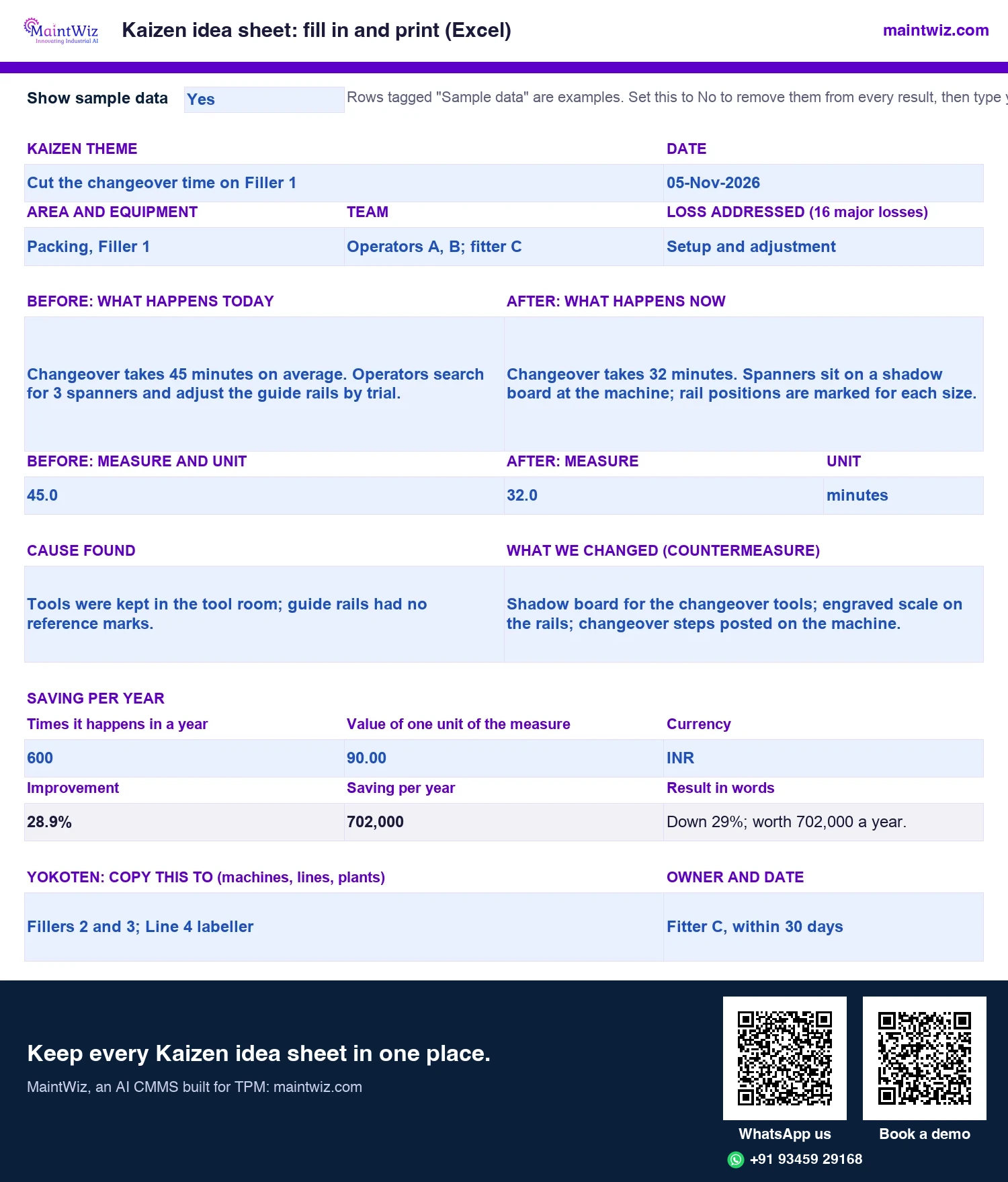
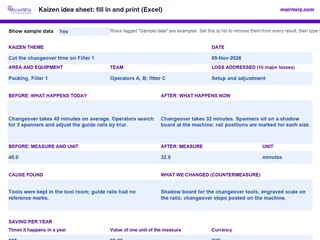 ExcelKaizen idea sheet: fill in and print
Write each Kaizen on one page: before, after, cause, countermeasure, yearly saving and the machines to copy it to.
Inside: Theme, date, area and equipment, and team · Loss addressed, picked from the 16 major losses · Before and after, cause and countermeasure · Yearly saving and the machines to copy it to (Yokoten, horizontal deployment) · Prints on one A4
- Sheets
- Kaizen idea sheet, Lists, Read me
- One page
- Version
- v1.0, 2 November 2026
Idea sheet
What does a Kaizen idea sheet contain?
| Field | Why it is there |
|---|---|
| Idea number and date | Identity and age |
| Name, department and area | Who suggested it and where |
| Equipment or process | Where the change applies |
| Problem before | The situation in the author's words, ideally with a photograph |
| Improvement made or proposed | What changes, ideally with a photograph or sketch |
| Result area | The benefit it targets, such as safety, quality, delivery, morale, cost, environment or productivity |
| Classification | A plant-defined type, for example restoring a condition or innovating a method |
| Expected benefit and how it will be checked | A measure, not a promise |
| Decision, decision date and decider | Accepted, deferred or declined, with a reason |
| Implementation owner and date | Who does it and by when |
| Result check and horizontal deployment | What happened and where else it applies |
Keep the form to one side of a page. The shorter it is, the more ideas arrive; add fields only when a decision needs them. Many plants separate ideas already implemented (recorded for recognition) from proposals (decided before action).
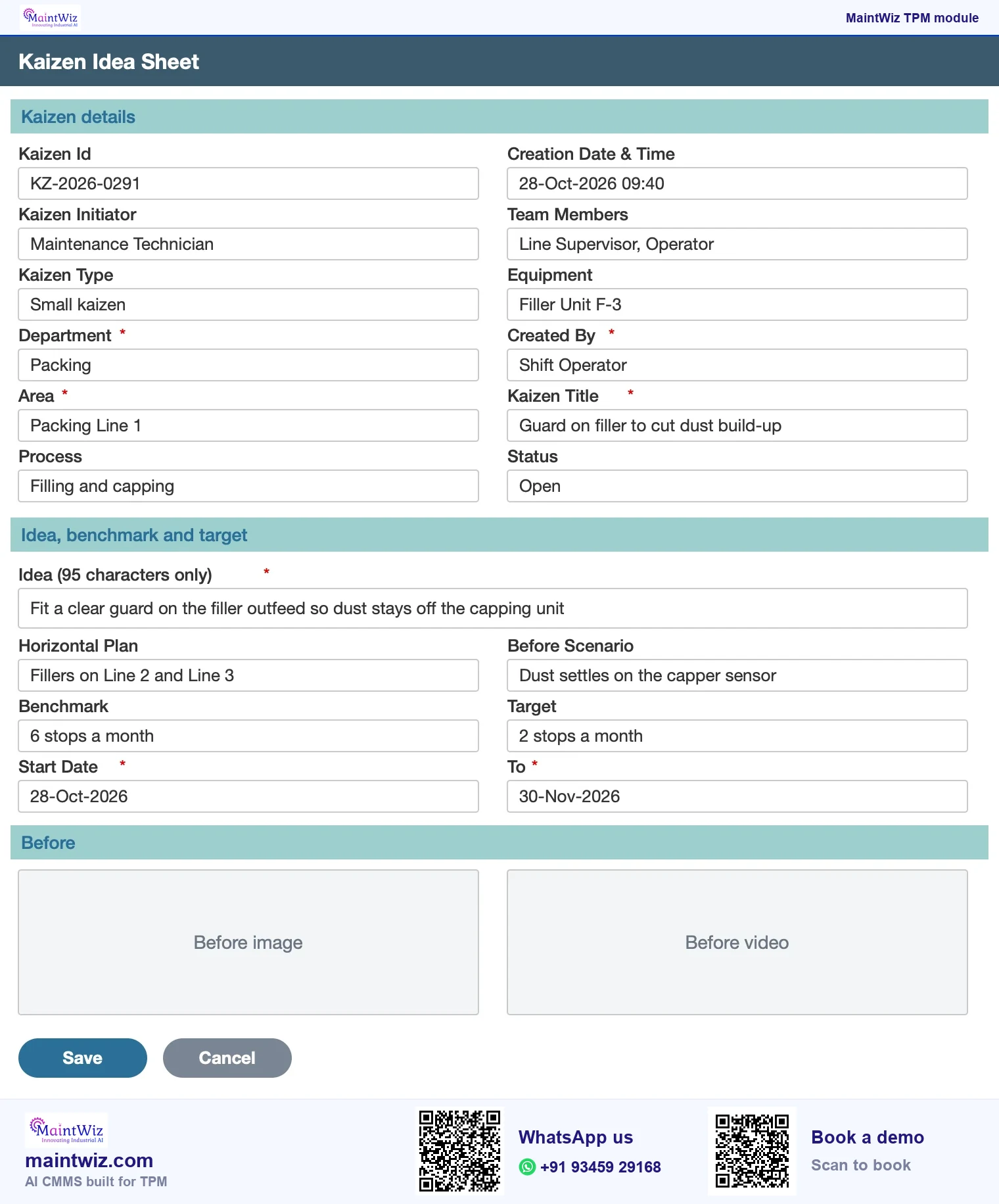
A filled-in Kaizen idea sheet
| Field | Filled-in idea sheet |
|---|---|
| Equipment or process | Labelling machine, packing line |
| Problem before | Web jams at the label roller stop the line several times a shift and operators clear them by hand |
| Improvement made or proposed | Replace the worn roller and add a roller wear check to the CIL standard |
| Result area | Productivity |
| Classification | Restoring a condition |
| Expected benefit and how it will be checked | Fewer minor stops, counted per shift on the same definition over several weeks |
| Decision | Accepted by the supervisor on the spot, with a reply to the author |
| Implementation owner and date | Line maintenance technician, by the end of the week |
| Result check and horizontal deployment | Stops per shift compared with the baseline; the same check added to the other labellers |
In MaintWiz the idea sheet is a record with its area, equipment, benchmark, target and before image.
What does a Kaizen A3 report contain?
The A3 report is the lean management format for solving a problem and telling its whole story on one page; in Kobetsu Kaizen it carries a project from theme to follow-up. A common layout has two halves, the left for understanding the problem and the right for solving it.
| Section | What it holds |
|---|---|
| Title and theme | The problem as a short statement, the project leader and the sponsor |
| Background | Why this problem matters now, linked to a loss or a goal |
| Current state | What happens today, with data or a process picture |
| Target | A measurable goal with a date, on a stated definition |
| Analysis | Root cause, for example by why-why analysis or P-M analysis |
| Countermeasures | Actions with owners and dates |
| Results | The measure after the change, on the same definition as the baseline |
| Follow-up | Standardisation, horizontal deployment, and what remains open |
Use P-M analysis for the analysis box, and pick the loss the project attacks from the ranking in six big losses (Figure 3).
In MaintWiz the loss behind an A3 project comes from the Kobetsu Kaizen menu (losses, production log entry and the loss cost master) and the losses behind it are reported in the KK report, beside the Kaizen idea sheet and poka-yoke sheet.
The Kaizen A3 report: eight boxes
Left: understand the problem. Right: act and check.
- 1Theme and background
- 2Current state and baseline
- 3Target
- 4Analysis of causes
- 5Countermeasures
- 6Plan: who, what, when
- 7Results (same measure)
- 8Standardise and follow-up
maintwiz.comAI CMMS built for TPMWhatsApp us+91 93459 29168Book a demo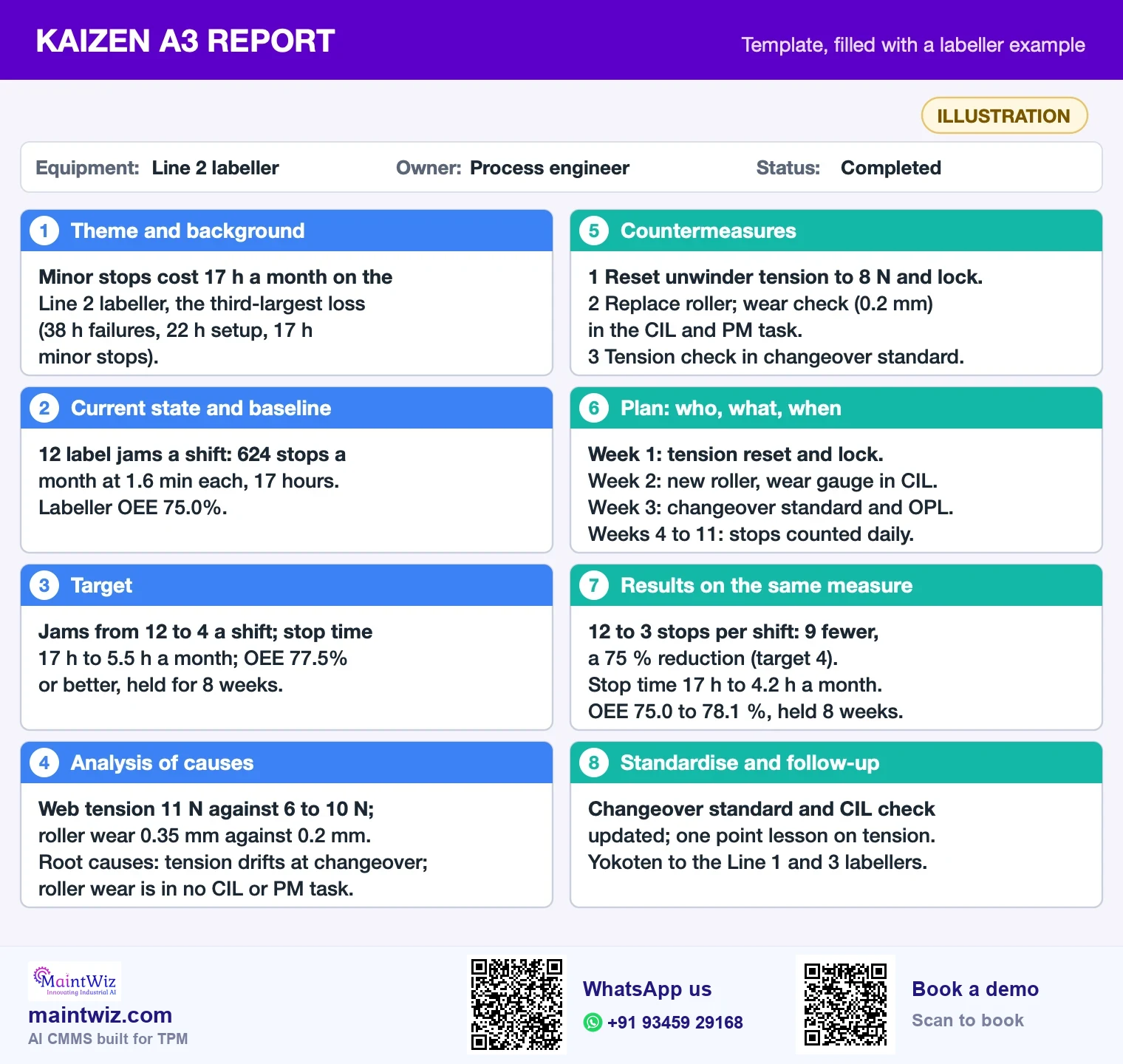
Kaizen event and Kaizen report templates
A Kaizen event, a focused workshop of a few days on one process or equipment, is planned and reported on the A3 report: theme and target before the event, analysis and countermeasures during it, results on the same measure afterwards. A Kaizen report template is the same A3 report with the results and follow-up boxes filled in. Smaller fixes raised during the event go on idea sheets.
Poka-yoke sheet
What does a poka-yoke sheet contain?
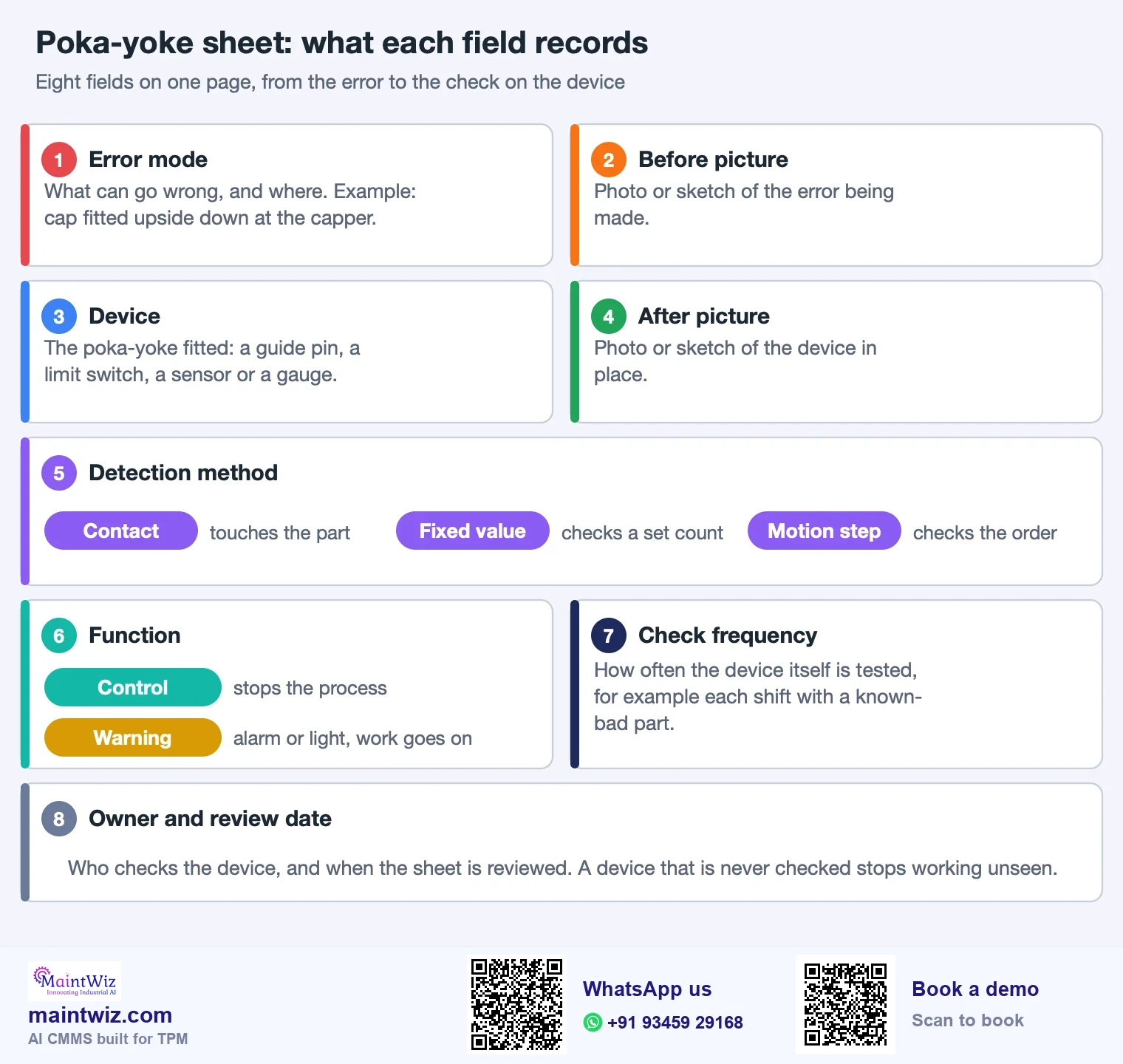
Poka-yoke is Japanese for mistake-proofing: a device or method is designed so that an error cannot occur or is caught at once. The sheet records what was changed and proves it works.
| Field | Why it is there |
|---|---|
| Process step and equipment | Where the error can occur |
| The error | What goes wrong, with how it was found |
| Type of control | Prevention (the error cannot happen) or detection (it is caught at once) |
| The device or method | A sketch or photograph of the change |
| Method of checking | How operators confirm the device works each shift |
| Verification | A test showing the device catches the error, with the date |
| Owner and review date | Who maintains it and when it is checked |
| Where else it applies | Similar steps and equipment |
A poka-yoke that is not checked stops working without anyone noticing; the check method and a review date are the fields most often missing (Figure 5).
Detection methods are contact (the device touches the part), fixed-value (it counts or checks a set number) and motion-step (it checks the order of movements). The function is control, which stops the process, or warning, which alerts the operator while work goes on, and the device itself is checked at a set frequency.
How should the sheets be run?
- Answer every idea within an agreed time and tell the author the reason for a decline.
- Let supervisors accept low-cost ideas on the spot and send larger ones to a committee.
- Recognise implemented ideas publicly, but do not link recognition to a monetary value of the idea.
- Review the idea list at the daily or weekly area meeting; carry the open items on the board.
- Promote ideas that keep recurring on one equipment into A3 projects.
- Close the loop: record the result check and spread the change to similar equipment.
From a Kaizen sheet to Yokoten
Review, implement, check on the same measure, then copy the fix to similar equipment
Submit the sheet
Pillar lead reviews it
Implement the change
Check before and after on the same measure
Yokoten: copy the fix to similar equipment
Close as Completed or Cancelled
Status in MaintWiz: Open, then Completed or Cancelled
maintwiz.comAI CMMS built for TPMWhatsApp us+91 93459 29168Book a demoWhere do ideas come from?
The most useful ideas come from the people who do the work and from the data the plant already keeps. Abnormality tags that recur point to improvements. Loss rankings show where a project would pay. Operators' daily irritations, such as a tool stored too far from the point of use or a label that is easy to misread, become ideas when someone is asked and answered. The Kaizen dashboard in MaintWiz shows ideas initiated, completed and cancelled by facility and department, so the committee sees where ideas are not coming from.
Mistakes
What mistakes ruin Kaizen sheets?
- No decision or reply, so people stop submitting.
- Long forms that discourage ideas.
- Counting ideas submitted as success rather than ideas implemented and checked.
- Claiming a saving without a baseline on the same definition.
- A3 reports that jump from problem to solution without analysis.
- Poka-yoke devices with no check method or owner.
- Keeping the sheets in folders where nobody sees patterns.
| Paper or spreadsheet | MaintWiz | |
|---|---|---|
| Capture | A form in a box or a shared file | Kaizen idea sheet with area, equipment, benchmark, target, dates and the before image |
| Status | Read by opening each sheet | Open, completed and cancelled tabs |
| Error-proofing | A separate list | Poka-yoke sheet as its own record |
| Review | Counted by hand before the meeting | Dashboard of Kaizens initiated, completed and cancelled by facility and department |
| Loss behind a project | Copied from the OEE report | Losses, production log entries and the loss cost master in the Kobetsu Kaizen menu |
FAQ
Frequently asked questions
What is a Kaizen idea sheet?
A Kaizen idea sheet is a short form that records a small improvement idea or change: the problem before, the improvement, the result area, the expected benefit, the decision and the owner. It keeps ideas visible and answered.
Which Kaizen sheet format should a plant start with?
Start with the idea sheet: few fields, one side of a page and a fast decision. Add the A3 report when a change needs analysis by a team, and the poka-yoke sheet when a change error-proofs a step. Each format has its own fields and its own check.
What is an A3 report in Kaizen?
An A3 report is the lean one-page problem-solving format. A common layout covers background, current state, target, analysis, countermeasures, results and follow-up, so the whole story of a project is visible at a glance.
What fields does a poka-yoke sheet need?
A poka-yoke sheet records an error-proofing change: the error, whether the control prevents or detects it, the device or method, how it is checked each shift, the verification test and where else it applies.
How is an idea sheet different from an A3 report?
An idea sheet captures a small change quickly and needs a fast decision. An A3 report carries a larger project through analysis, countermeasures and verified results. Recurring ideas on one equipment often become A3 projects.
Can Kaizen sheets be kept in software?
Yes. MaintWiz holds the Kaizen idea sheet and the poka-yoke sheet as records with open, completed and cancelled tabs, and its dashboard shows Kaizens initiated, completed and cancelled by facility and department. Book a demo to see the idea sheet with its before image.
How many fields should a Kaizen idea sheet have?
Keep it to one side of a page: idea number and date, name and area, equipment, problem before, improvement, result area, expected benefit, decision with date and decider, owner and date, and the result check. Add a field only when a decision needs it.
When does an idea become an A3 report?
When the same idea keeps returning on one equipment, or when the loss needs a team to analyse causes, test countermeasures and check the result over several weeks. A quick fix with one owner stays on the idea sheet; a chronic loss with several causes moves to an A3 report.
Sources
Sources
- Lean Enterprise Institute, Kaizen: A Resource Guide https://www.lean.org/lexicon-terms/kaizen/