
Key takeaways
- A CIL standard answers seven questions for every point: where, what good looks like, how, with what, how often, how long and what to do if it is abnormal.
- Write it with the operators at the equipment after steps 1 and 2 have exposed and reduced the dirt, leaks and hard-to-reach points.
- Fit the time: if the routine does not fit the shift, change the equipment or the shift plan, not the standard.
- Version and review each standard; an unreviewed standard drifts from the machine.
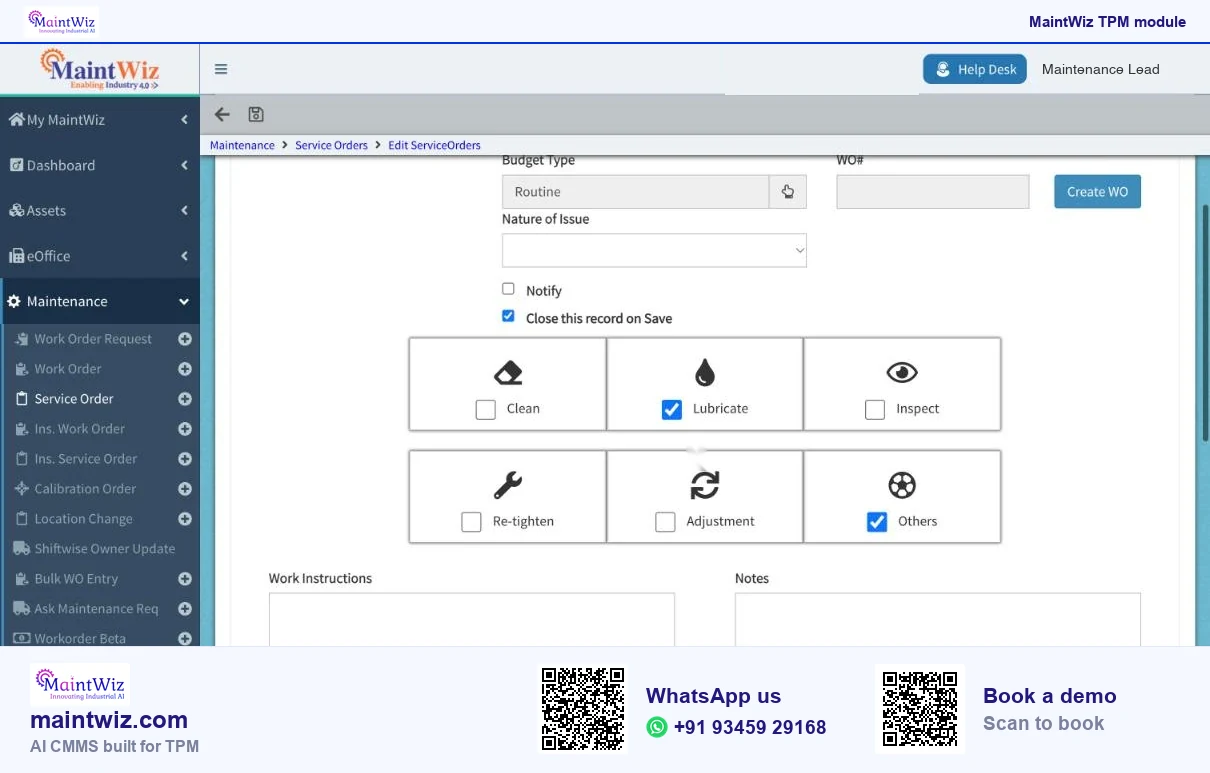
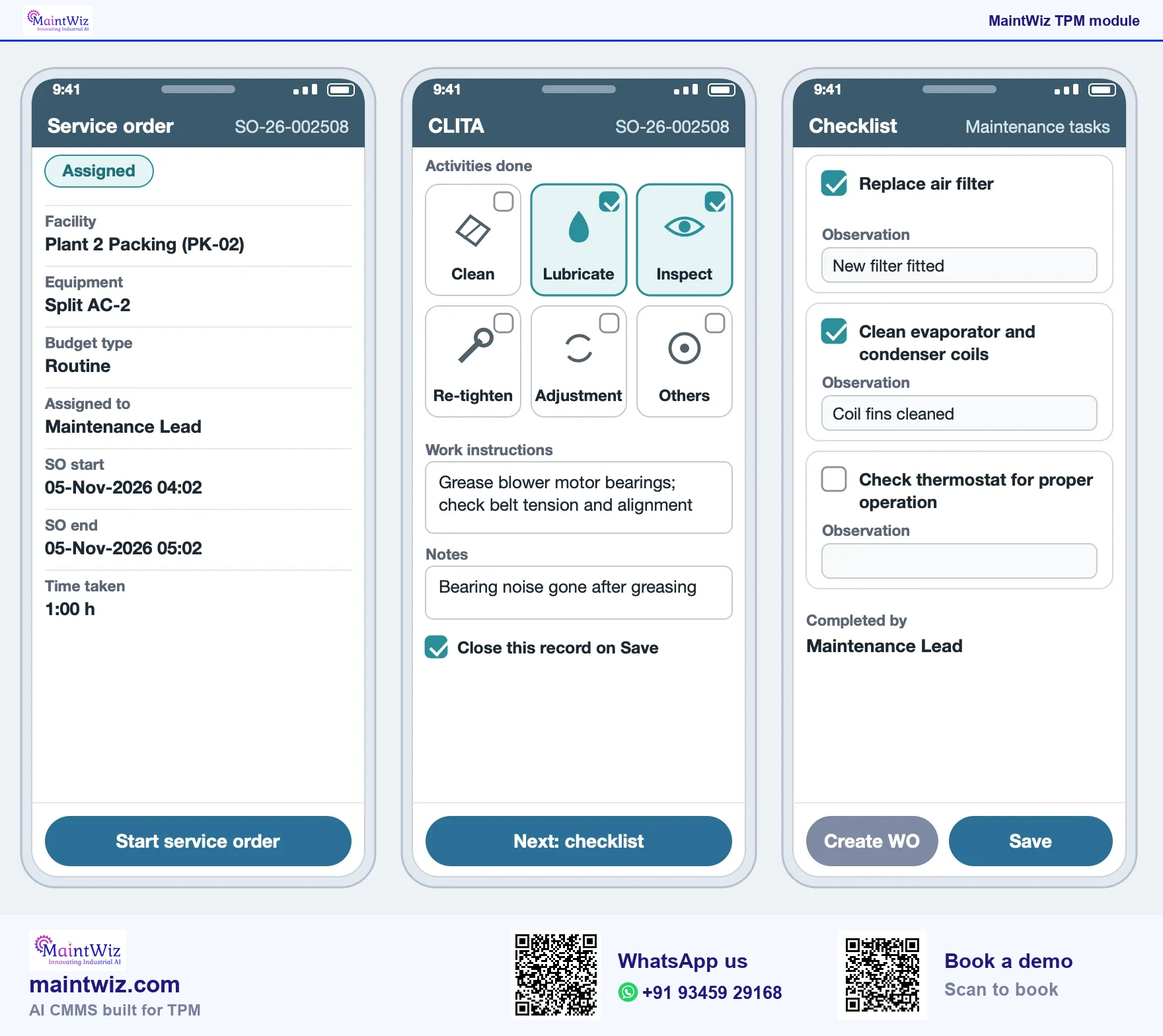
- In MaintWiz the CIL routine runs as a service order: operators tick the clean, lubricate, inspect, re-tighten and adjust activities and work down the checklist, and a failed point goes to the abnormality register with an owner and a target date.
CIL standard
What is a CIL standard?
CIL stands for cleaning, inspection and lubrication; some programmes add tightening and write CILT. A CIL standard is a short controlled document, one per equipment or equipment family, that fixes the basic care operators give. It is written at step 3 of autonomous maintenance, after the equipment has been cleaned and inspected (step 1) and the worst contamination sources and hard-to-reach points have been dealt with (step 2). The standard is what turns a one-off clean-up into a routine that other people can follow and an auditor can check.
The standard is not the same thing as the daily checklist that records whether the routine was done. The standard says what the routine is; the checklist records that it was done, with results. Generate the checklist from the standard so that the two never disagree (Figure 1).
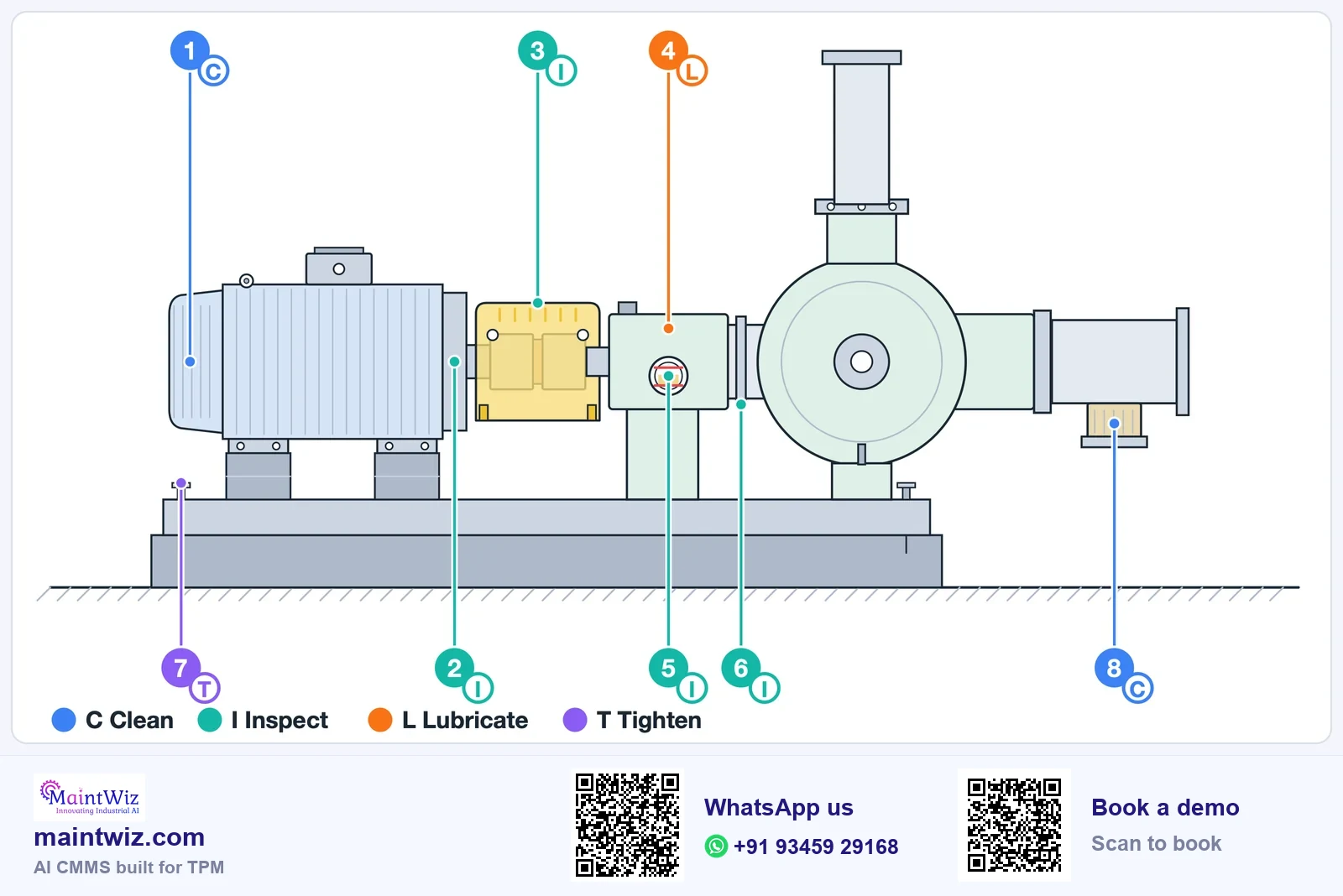
| No. | Point on the pump set | Task | Standard line |
|---|---|---|---|
| 1 | Motor fan cover | C clean | Free of dust and lint |
| 2 | Motor bearing | I inspect | Warm, not too hot to hold |
| 3 | Coupling guard | I inspect | Fitted, no cracks, bolts present |
| 4 | Pump bearing housing | L lubricate | Oil at the middle of the glass |
| 5 | Oil level glass | I inspect | Level between the lines |
| 6 | Mechanical seal | I inspect | Dry, no drip below the seal |
| 7 | Baseplate bolts | T tighten | Match marks aligned |
| 8 | Suction strainer | C clean | Basket clear of debris |
JIPM lists Autonomous Maintenance (Jishu Hozen) among the pillars of Total Productive Maintenance, and the CIL standard is the document that pillar runs on. A CIL task is what operators do every shift; a preventive maintenance task needs maintenance skills or downtime, as autonomous maintenance vs preventive maintenance shows (Figure 2).
Anatomy of a CIL standard
The columns a cleaning, inspection and lubrication standard needs for every point
Point
Location on the equipment, numbered on a photo or sketch
Task
Clean, inspect, lubricate or tighten
Standard
What good looks like, with a limit, gauge mark or reference photo
Method and tool
How to do it, with what, and the safety step
Frequency and time
Each shift, daily or weekly, and the minutes allowed
Abnormality action
When to tag and when to stop and call maintenance
Result
Done, abnormal or not applicable, with initials and date
 maintwiz.comAI CMMS built for TPM
 WhatsApp us
 +91 93459 29168
 Book a demo
What does a CIL standard contain?
| Element | What it holds | Common failure |
|---|---|---|
| Equipment and scope | Equipment name, area, the parts covered and the parts left to maintenance | No boundary, so no one owns the edges |
| Points | A numbered list of points, marked on a photo or drawing | Points described in words only |
| Standard of condition | What good looks like: a limit, a gauge mark, a reference photo, a level line | 'Check it is OK' |
| Task type | Clean, inspect, lubricate or tighten, for each point | Mixed tasks under one line |
| Method and tool | How to do it, with which tool, cloth, lubricant and PPE | Tool kept somewhere else |
| Frequency and time | Each shift, daily or weekly, with the minutes allowed | No time stated, so the routine is skipped |
| Abnormality rule | When to tag, when to stop the machine and call maintenance | No stop rule |
| Safety step | Isolation or guard rule before reaching into the equipment, in line with the plant's procedures | Assumed knowledge |
| Owner, version and review date | Who maintains the standard, the revision and the date it is next reviewed | No owner or review |
The Safety step row links each point to the plant's isolation and lockout procedure, and in MaintWiz the permit is raised in ePTW.
CIL standard example: four machines
One filled row per machine shows the level of detail that works: a point, a condition an operator can pass or fail, the method and tool, the frequency and what to do when the point fails. Copy the layout of Figure 2 and add a minutes column once you have timed the routine with the operators.
| Equipment | Point | Standard of condition | Method and tool | Frequency | If abnormal |
|---|---|---|---|---|---|
| Conveyor drive | Gearbox sight glass | Oil between the minimum and maximum lines | Wipe the glass and read the level against the lines; cloth | Each shift | Red tag and call maintenance when below the minimum line |
| Pump | Gland and seal area | Dry, with no drip below the gland | Wipe the gland and look for a drip; cloth | Each shift | Tag the leak with location and owner |
| Filler | Nozzle guide and sensor lens | Clean, no product build-up, matches the reference photo | Wipe and compare with the photo at the point; lint-free cloth | Each shift | Tag the point and note the false trips it caused |
| Press | Grease point behind the guard | Grease at the point shown on the colour-coded lubricant tag | Grease with the matching gun at the extended nipple | Weekly | Stop and call maintenance if the point is dry or the guard is off |
Downloads
CIL standards sheet, daily check sheet and lubrication chart
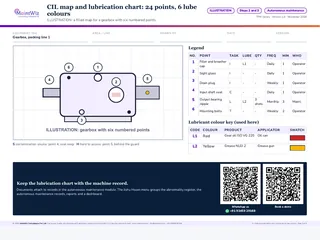 PDFCIL map and lubrication chart: 24 points, 6 lube colours
Sketch the machine, number up to 24 points, and give each lubricant one code and colour so the right grease reaches
- Pages
- 3
- A4 landscape
- Created
- 5 November 2026
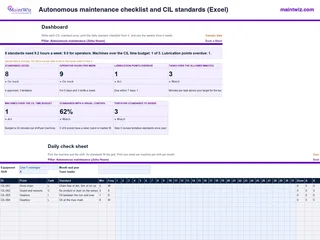 ExcelAutonomous maintenance checklist and CIL standards (Excel)
Write each cleaning, inspection and lubrication standard once, print the daily operator checklist for any machine
- Sheets
- Dashboard, Inputs, Frequencies, Lubricants, Machines, Standards, Daily check sheet, Lube schedule, Lube route, Read me
- A4
- Version
- v1.0, 2 November 2026
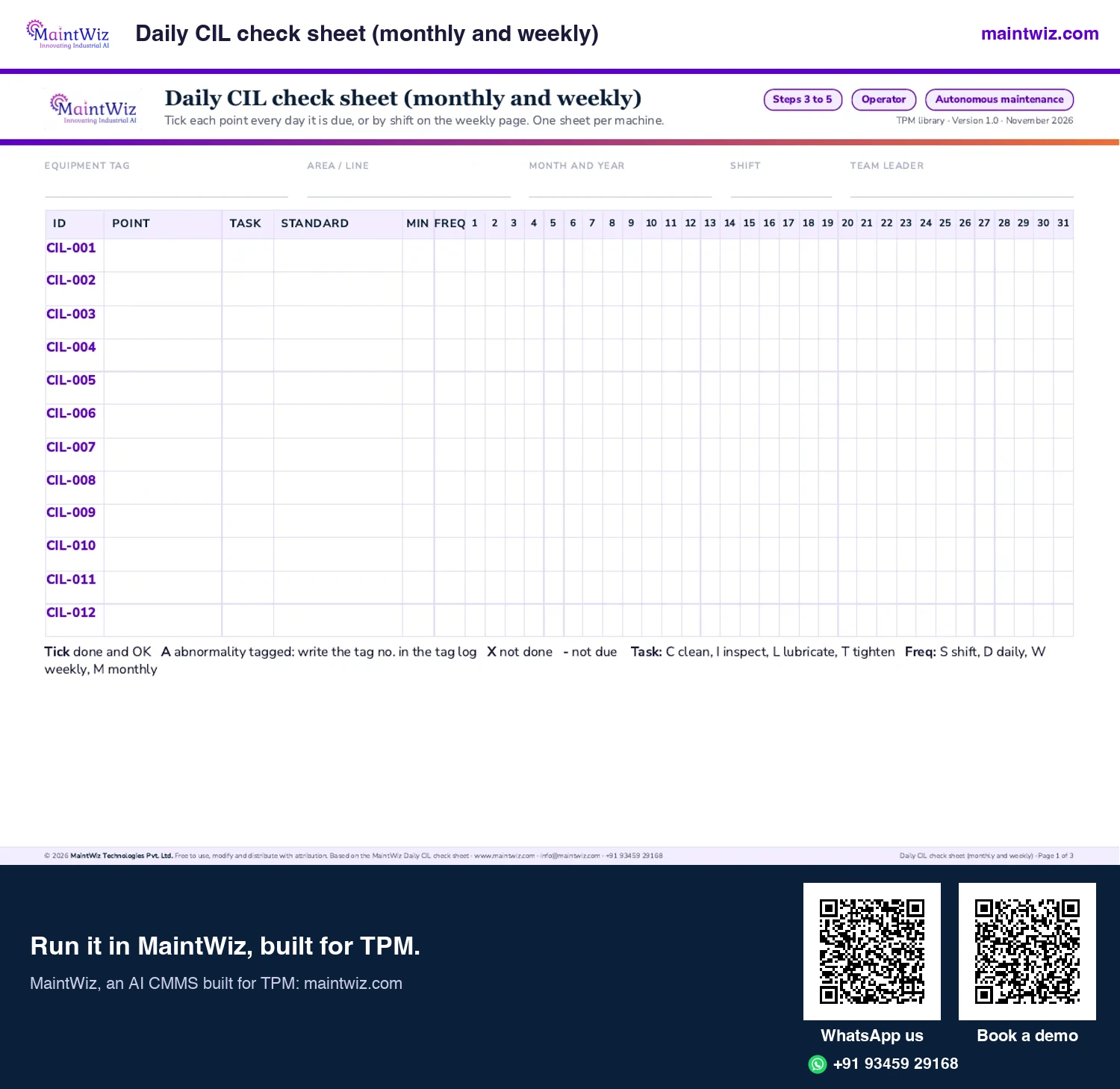
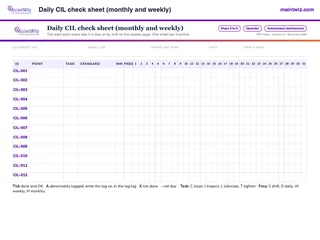 PDFDaily CIL check sheet (monthly and weekly)
Print a daily operator checklist for one machine, monthly or weekly with A, B and C shift boxes
- Pages
- 3
- A4 landscape
- Created
- 5 November 2026
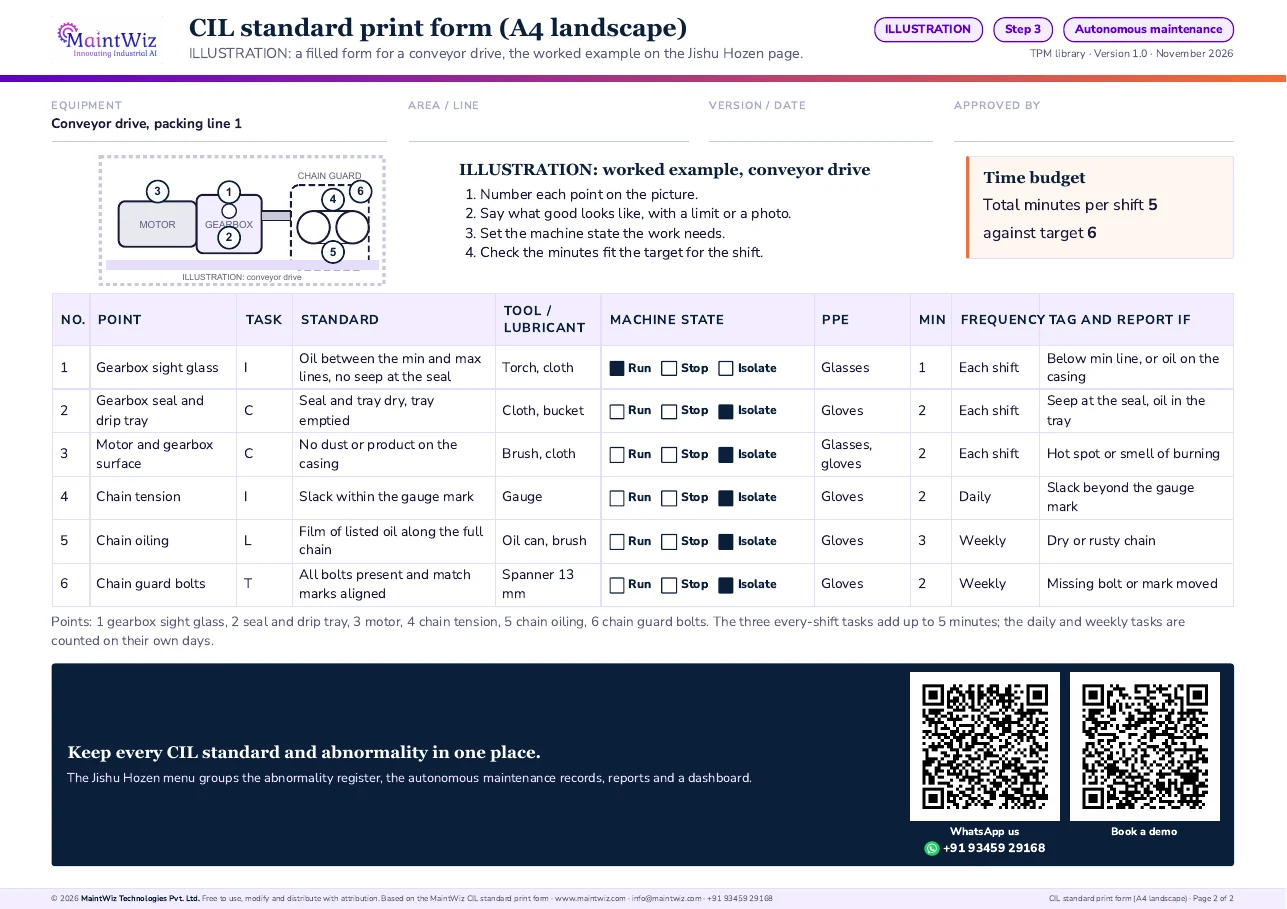
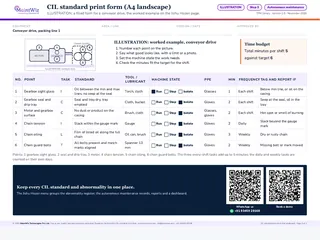 PDFCIL standard print form
Post one page per machine with each point, standard, machine state and PPE
- Pages
- 2
- A4 landscape
- Created
- 5 November 2026
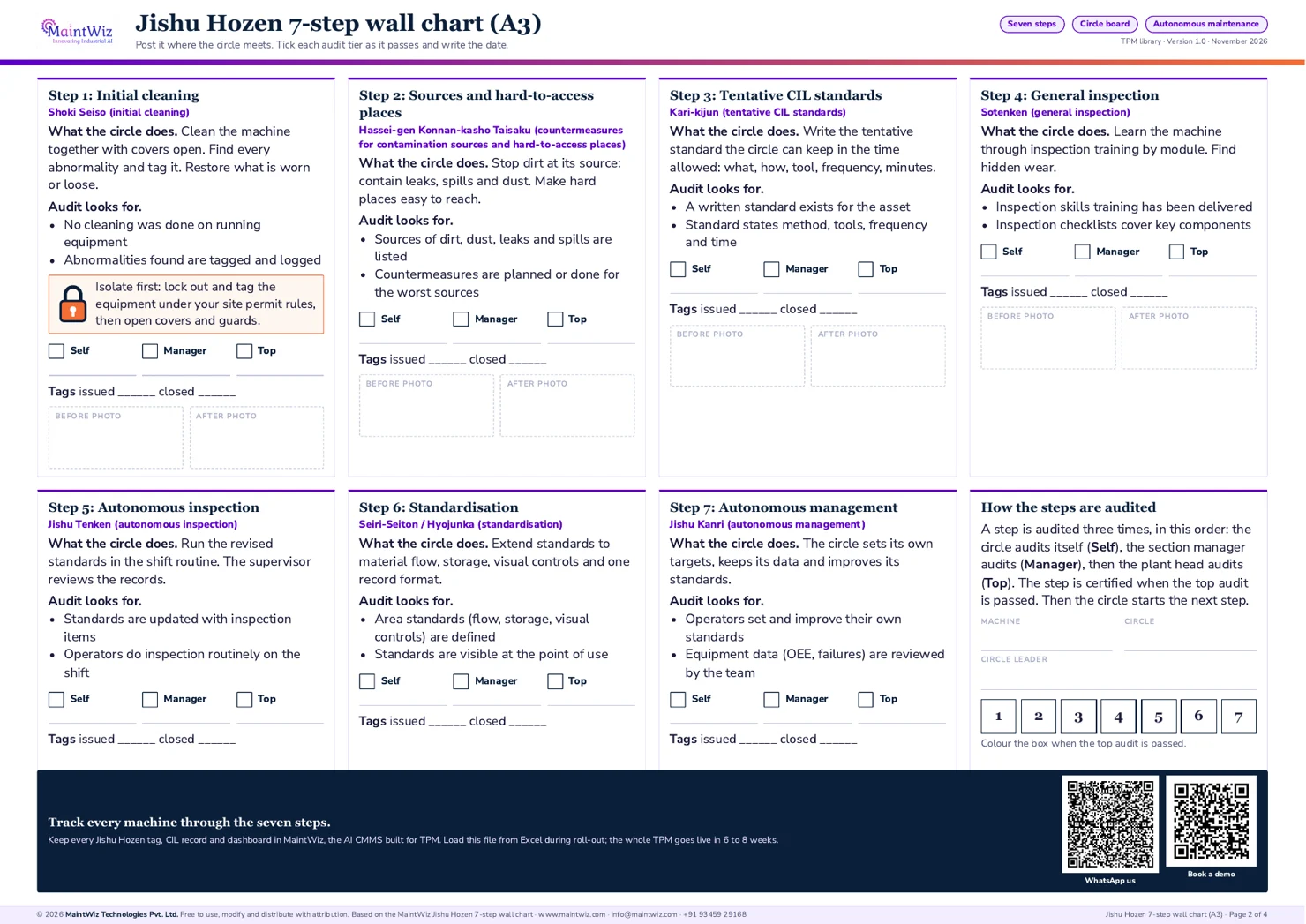
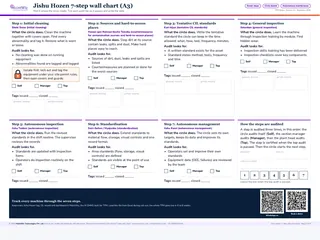 PDFJishu Hozen 7-step wall chart (with Japanese step names and three-tier audit)
Post the seven Jishu Hozen steps at the machine with Self, Manager and Top audit boxes
- Pages
- 4
- A3 landscape (2 x A4 version inside)
- Created
- 5 November 2026
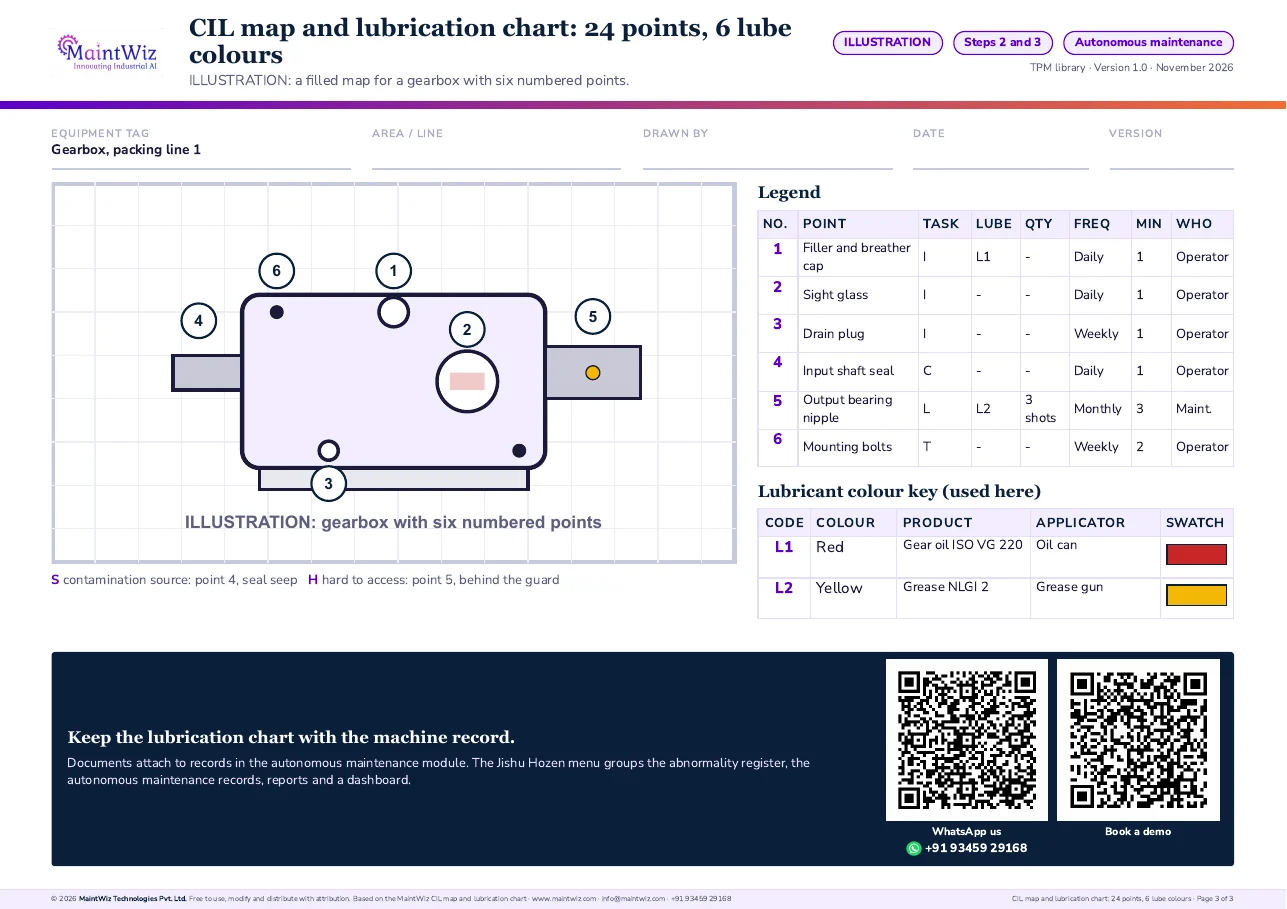
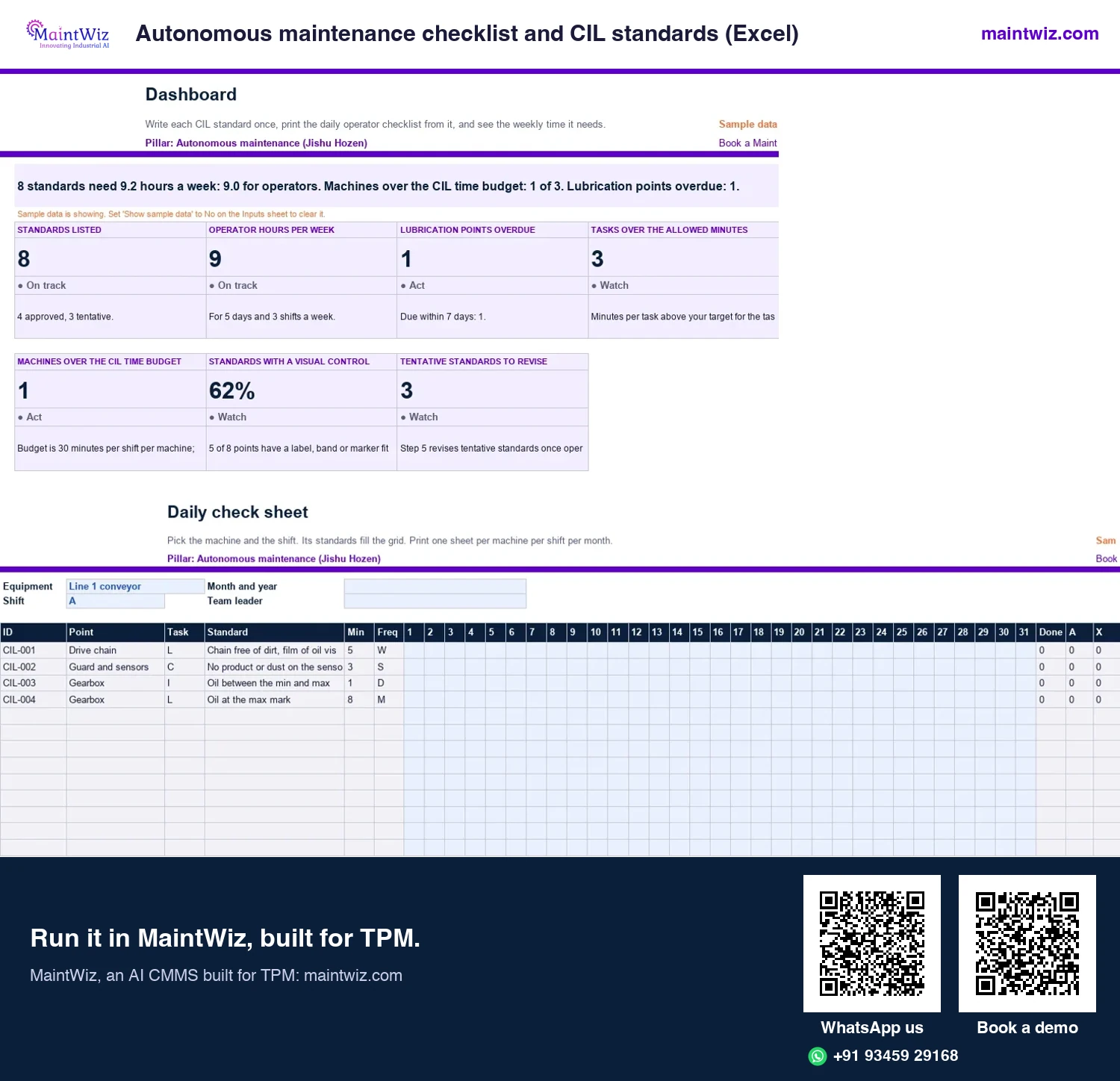
Writing one
How do you write a CIL standard? Eight steps
- Pick one equipment that has passed the step 1 and step 2 audits and gather its operators and a technician.
- Walk the equipment and list every point the operators already clean, inspect, lubricate or tighten, then add points the abnormality tags showed matter.
- Number the points on a photo or sketch; one number, one place.
- For each point write the standard of condition in a form someone can check: a mark, a limit, a reference photo.
- Write the method and tool, and put the tool where the task happens.
- Set frequency and time by doing the routine with a stopwatch and the operators, then compare with the shift plan.
- Trial the draft for a week; correct what operators cannot follow or cannot fit in the time.
- Approve, post at the equipment, and put the review date on it.
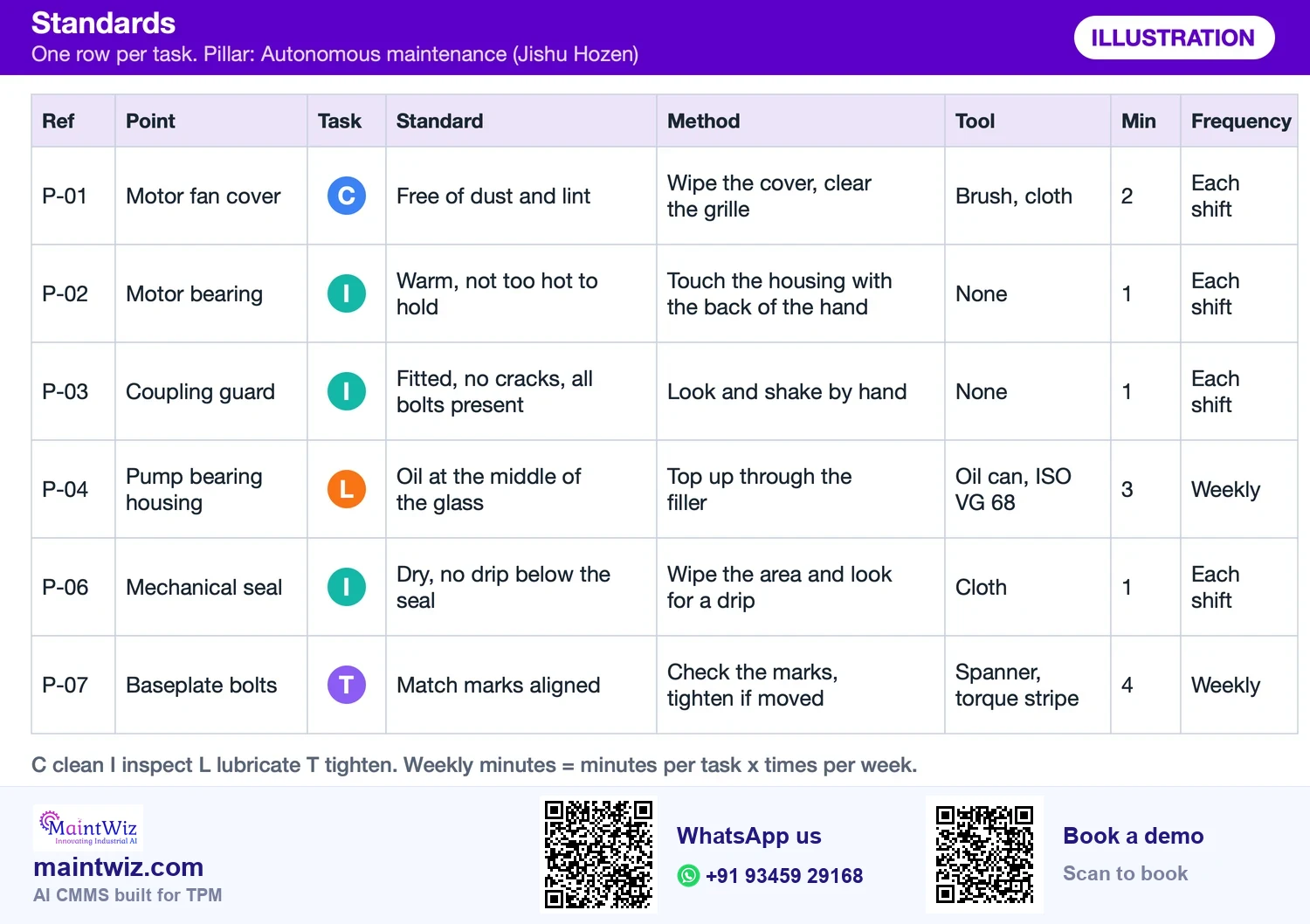
Lay the standard out on the free CIL standards sheet and print form. The standard names the lubricant, the point and the interval, taken from the manufacturer's manual and the maintenance team (Figure 3).
Visual controls
Standards and visual controls
A standard that has to be read is slower than one that can be seen. Visual controls turn the condition into something checkable at a glance:
| Visual control | What it shows | Used for |
|---|---|---|
| Level lines on sight glasses | Minimum and maximum oil level | Lubrication check |
| Colour or paint marks on fasteners | A line across bolt and part that breaks if it moves | Tightening check |
| Direction arrows and flow labels | Which way a pipe, belt or shaft turns or flows | Inspection and reassembly |
| Gauge marks | Green zone for normal pressure, temperature or tension | Reading instruments |
| Lubricant tags with colour codes | Which lubricant goes to which point | Preventing wrong lubricant |
| Reference photos at the point | What a clean or correct condition looks like | Cleaning and inspection |
Visual controls and step 6
Visual controls are also step 6 material; fitting them early makes the step 3 standard shorter. Marking and labelling start in Seiton, the second S, and give each point a standard anyone can see.
Related documents
How CIL standards relate to the checklist, the SOP and the one point lesson
| Document | What it is for | Who reads it | How it relates to the CIL standard |
|---|---|---|---|
| CIL standard | Fixes the routine for an equipment | Operators, supervisors, auditors | The source document |
| Daily or weekly checklist | Records that the routine was done and the result | Operators and supervisors | Generated from the standard |
| SOP (standard operating procedure) | Fixes how to run or change over the equipment | Operators | Separate document; refers to the CIL standard for start-up checks |
| One point lesson | Teaches one task or fact | Anyone | Teaches how to do one CIL point; see one point lessons |
| Planned maintenance task list | Fixes tasks that need maintenance skills or downtime | Technicians | Takes over what operators should not do |
Fitting the routine into the shift
The commonest reason standards fail is time. Measure the routine with operators, add up the minutes and compare with the time the shift plan gives. If it does not fit, look first at the equipment: a leak you wipe every shift should be fixed, a lubrication point behind a guard should be extended to a reachable place, and a cleaning task caused by build-up should be reduced at the source. These are the step 2 outcomes that make a step 3 standard shorter. If the routine still does not fit, move the weekly tasks off the daily sheet or agree extra time; do not shorten the standard so it looks achievable.
- Time each point once with the operator who does it, not with a supervisor.
- Show the total on the standard and on the checklist.
- Re-time after countermeasures: the number should fall.
- Record which tasks were moved to planned maintenance and why.
Reviewing and auditing the standard
A standard is reviewed on a fixed date and whenever the equipment, the lubricant or the product changes, or when a failure shows a missing point. The step 3 audit checks four things: a written standard exists for the equipment, it states method, tools, frequency and time, lubricant and points are identified visually, and operators follow it with records kept. The step-gate audit scores them 0 to 2 each.
Running the CIL routine in MaintWiz
In MaintWiz autonomous maintenance software the CIL routine runs as a service order on the equipment: operators tick the activities done and work down the checklist with an observation per task (Figure 4), and run the same service order on a phone at the equipment (Figure 5). A point that fails becomes an abnormality tag in abnormality management with tag colour, owner and target date; the record can carry documents such as the posted standard, and a tag can be converted to a work order when maintenance work is needed. Book a demo to see CIL standards on your own equipment.
Mistakes
Common mistakes with CIL standards
- Writing the standard at a desk from the manual, not at the equipment with operators.
- Listing every possible point; keep the ones that matter and move the rest to planned maintenance.
- No time on the standard.
- Standards that give no limit: 'check for wear' has no pass or fail.
- Leaving the standard in a folder; it should be at the equipment.
- No owner, so no one revises it after a modification.
- Using the manufacturer's maintenance schedule as the operators' standard without splitting out what needs skills.
FAQ
Frequently asked questions
What is a CIL standard?
A CIL standard is the written, equipment-specific rule for how operators clean, inspect and lubricate: the points, the condition that counts as good, the method and tools, how often, how long and what to do if abnormal.
What is the difference between a CIL standard and a checklist?
The standard fixes what the routine is. The checklist records that it was done, with results. The checklist should be generated from the standard so that the two always agree and a change in one is made in both.
Who writes a CIL standard?
The operators of the equipment write it with a maintenance technician and the supervisor, at the equipment. Operators know what they do and where the problems are; maintenance supplies lubricant and component knowledge.
How often should a CIL standard be reviewed?
On a fixed date set when the standard is approved, and whenever the equipment, lubricant or product changes or a failure shows a missing point. Tie the review to the step audit, so each audit also checks that the standard still matches the machine.
What do CIL and CILT stand for?
CIL stands for cleaning, inspection and lubrication, the core routine of autonomous maintenance. CILT adds tightening as a separate task. The CIL standard names which form the plant uses, point by point.
How long should a CIL routine take?
Fix the slot the shift allows, time each point with the operator who does it, then cut or move points until the total fits. Remove contamination sources and extend lubrication points to save minutes, and move tasks needing skill or downtime to planned maintenance. Show the total minutes on the standard and the checklist.
Where are CIL findings recorded in MaintWiz?
In MaintWiz, findings from the cleaning, inspection and lubrication round go to the abnormality register against the equipment, with tag colour, owner and target date, and the record can carry documents such as the standard. Book a demo to see it on your own equipment.