
Key takeaways
- The CMMS is the owning system for work orders, asset history and the TPM pillar records: tags, audits, training, quality and safety. MaintWiz is the AI CMMS built for TPM, with a module for each pillar.
- The MES or OEE system is the source of production counts and machine states. The OEE module of MaintWiz reads them through IoT, MES, SCADA, PLC or DCS connectors.
- The EAM or SAP holds whole-life asset cost and finance; MaintWiz connects to SAP PM and MM through web services.
- Decide record by record: tag, work order, stop event, count, audit, training session, defect. One record, one owning system.
Compared
How do a CMMS, an MES and an EAM compare for TPM?
A CMMS built for TPM holds the maintenance and pillar records, an MES holds production execution records, and an EAM holds the whole-life asset and finance records. The table sets out what each system answers, holds and does for TPM.
| CMMS built for TPM (MaintWiz) | MES or OEE system | EAM | |
|---|---|---|---|
| Main question | What work is planned and done on which asset, and are the TPM routines running? | What is being produced, and in what state? | How is the asset managed across its life and cost? |
| Records it holds for TPM | Assets, work orders, schedules, parts, history, abnormality tags, step status, audits, training, quality and safety records | Orders, counts, machine states, genealogy, quality results | Asset registers, lifecycle cost, procurement, finance links |
| Main users | Operators, supervisors, planners, technicians, pillar owners | Production, quality, planners | Asset and finance managers |
| Role in TPM | Owns the work and the pillar records on one equipment list; OEE is one of its modules | Supplies counts, states and stop events for OEE | Master record for asset value, cost and procurement |
| Connects to | SAP PM and MM through web services; IoT, MES, SCADA, PLC and DCS sources | SCADA, PLC and DCS at the machine; the CMMS above it | ERP and finance; the CMMS for daily work |
TPM software, in this sense, is the CMMS that runs all eight pillars on one equipment list, and MaintWiz is that CMMS.
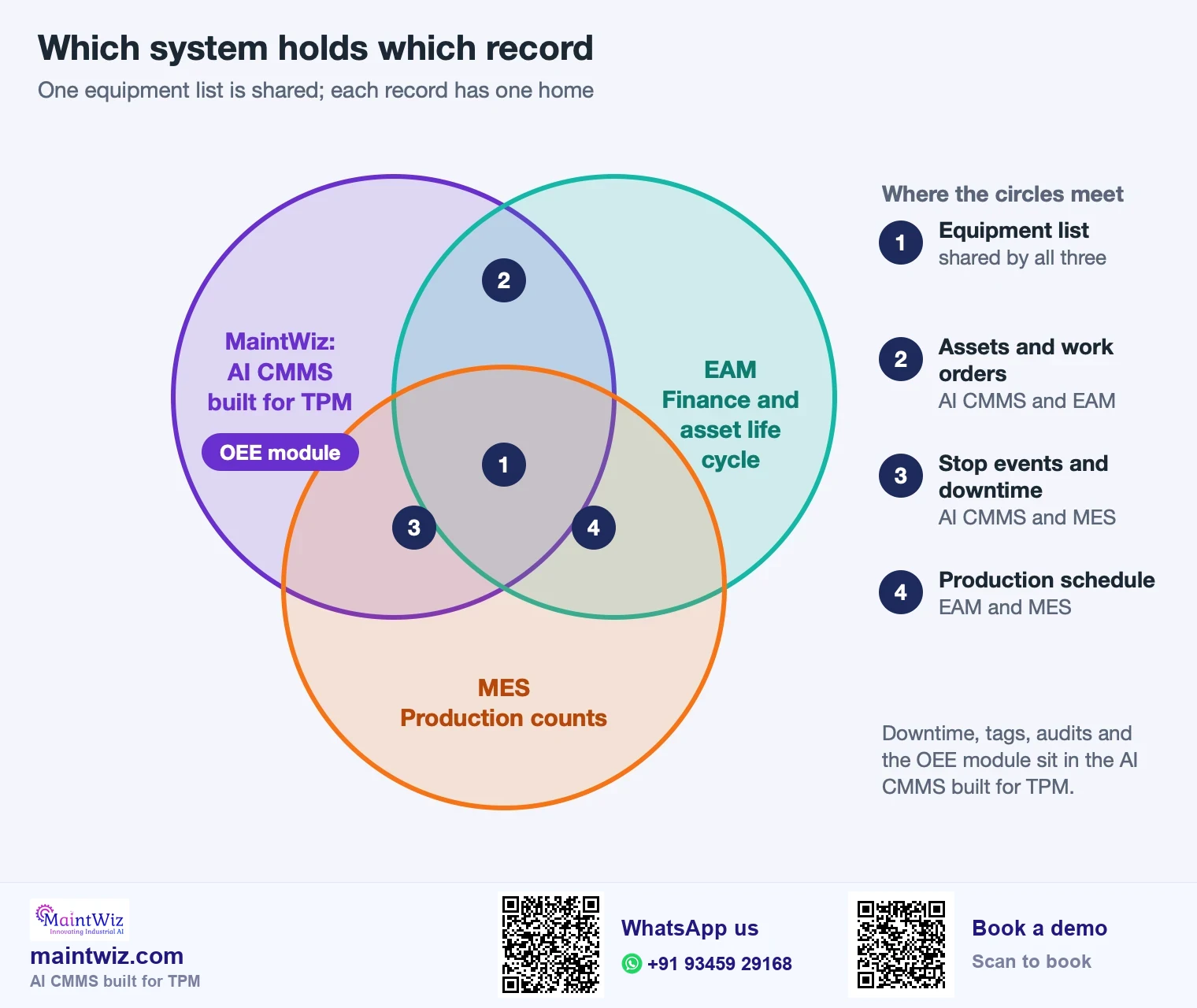
JIPM, the Japan Institute of Plant Maintenance, lists four core pillars (focused improvement, autonomous maintenance, planned maintenance and quality maintenance), two necessary pillars (education and training; safety, health and environment) and two optional pillars (early management and office TPM). MaintWiz carries a module for each, and those pillar records are what decide which system must own what (Figure 1).
CMMS, MES and EAM for TPM
Which record each system holds for TPM
AI CMMS built for TPM (MaintWiz)
- Assets and history
- Work orders and planned maintenance
- Parts and cost
- Abnormality tags and step status
- Audits and training records
- Loss and OEE views by pillar
MES or OEE system
- Production and good counts
- Stop events with reasons
- OEE roll-up
EAM
- Wider asset life cycle
- Finance and procurement
- Planning across sites
 maintwiz.comAI CMMS built for TPM
 WhatsApp us
 +91 93459 29168
 Book a demo
Downloads
TPM software requirements scorecard, cost planner and digital TPM guide
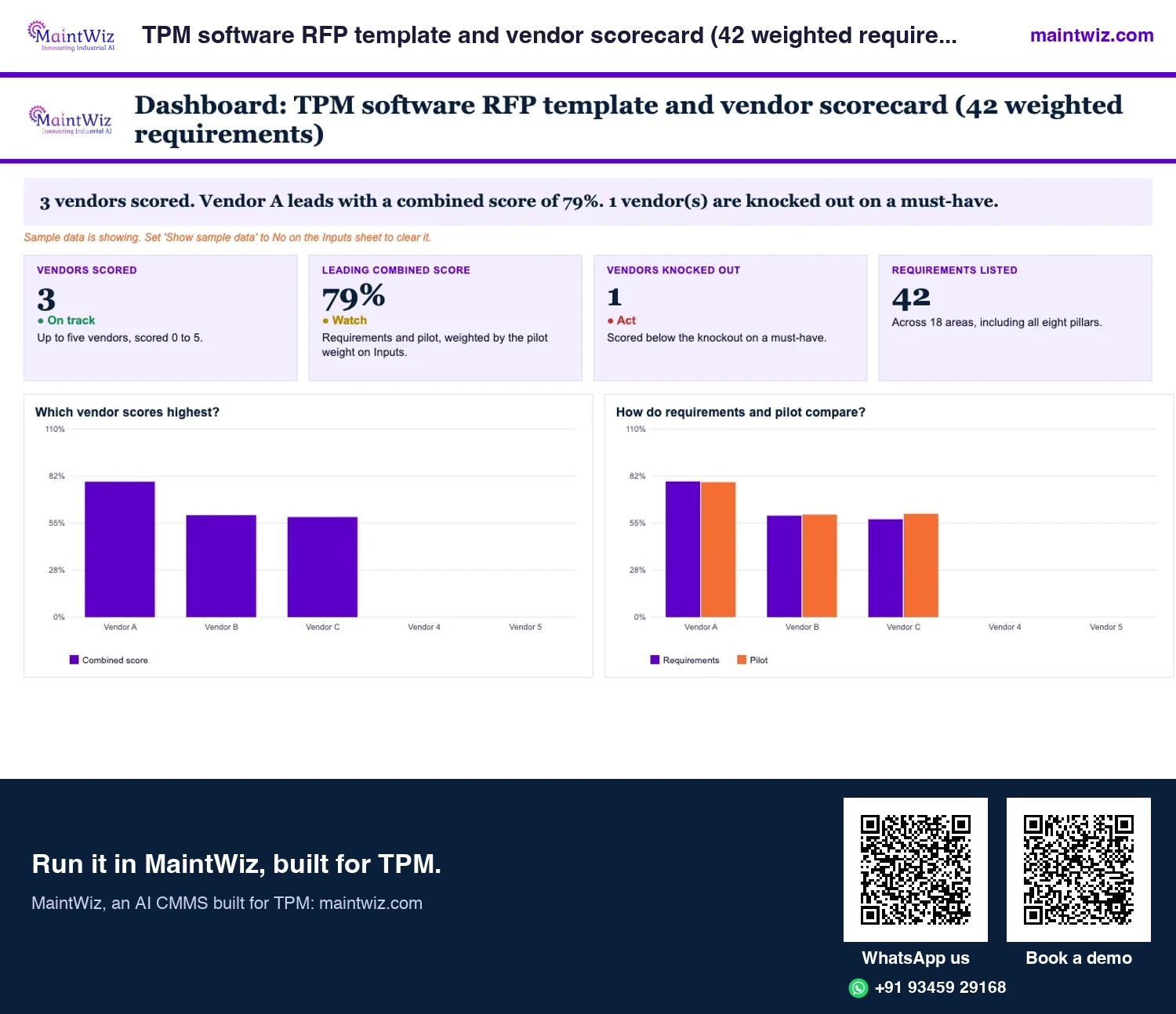
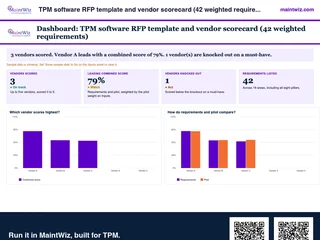 ExcelTPM software RFP template and vendor scorecard (42 weighted requirements)
Weight 42 requirements, score up to five vendors, run a proof of concept on your own equipment list and read a ranked
- Sheets
- Dashboard, Inputs, Scorecard, Pilot scoring, Questions, Proof of concept, Read me
- A4
- Version
- v1.1, 4 November 2026
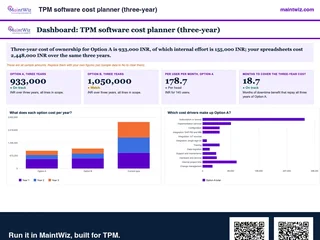 ExcelTPM software cost planner (three-year)
Compare the three-year cost of TPM software on your users, plants and services
- Sheets
- Dashboard, Inputs, Costs, Results, Read me
- A4
- Version
- v1.2, 4 November 2026
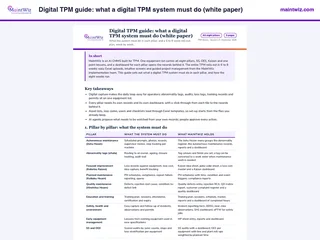 PDFDigital TPM guide: what a digital TPM system must do (white paper)
What a CMMS must hold for each TPM pillar, and how MaintWiz rolls it out in 6 to 8 weeks
- Pages
- 3
- A4
- Created
- 5 November 2026
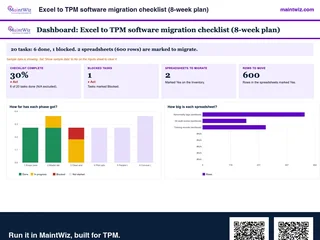 ExcelExcel to TPM software migration checklist (8-week plan)
Plan the move from Excel to TPM software in eight weeks, from scope and master data to the parallel run and cut-over
- Sheets
- Dashboard, Inputs, Inventory, Mapping, Checklist, Read me
- A4
- Version
- v1.1, 4 November 2026
CMMS for TPM
What is a CMMS built for TPM?
A CMMS built for TPM is maintenance management software that runs the routines of all eight Total Productive Maintenance pillars on one equipment list. Work orders and planned maintenance sit beside operator tags, audits, OEE losses, training, quality and safety records, so a tag, its work order and its loss stay linked. MaintWiz is the AI CMMS built for TPM (Figure 2).
- A module for each of the eight pillars, with a dashboard for every pillar.
- Operator tags that convert to work orders after manual review.
- OEE with equipment, line and plant roll-up, 5S, one point lessons and Kaizen records on the same equipment list; see AI CMMS Kaizen.
- SAP PM and MM through web services, and IoT, MES, SCADA, PLC and DCS sources.
MES and OEE
What does an MES hold, and where does OEE sit?
A manufacturing execution system tracks and controls production as it happens: orders, counts, machine states, material and quality results. Because it sees counts and stops, an MES is a natural source for the OEE inputs. In MaintWiz, OEE is a module of the CMMS, reported at equipment level and rolled up to line and plant by planned time; counts and stops come from an MES, SCADA, PLC, DCS or IoT source, or are entered at the machine. Name one source for each input so the definition does not drift. Write one OEE definition and use it in every system; MaintWiz rolls OEE up by planned time, not by averaging percentages.
Which record where
Which system should hold which record?
The CMMS should hold every record that starts or closes work and every TPM pillar record; the MES should hold production counts and states; the EAM or SAP should hold asset financials and stock. The table names the owning system for each record and how the others connect.
| Record | Owning system | How the other systems connect |
|---|---|---|
| Asset register and criticality | CMMS, fed from the EAM or SAP where that is the master | One hierarchy used by the MES, the OEE module and every pillar |
| Work order for planned or breakdown maintenance | CMMS | Notification and order exchanged with SAP PM through web services |
| Abnormality tag from an operator | CMMS, Jishu Hozen module | Converted to a work order after manual review, with owner and target date |
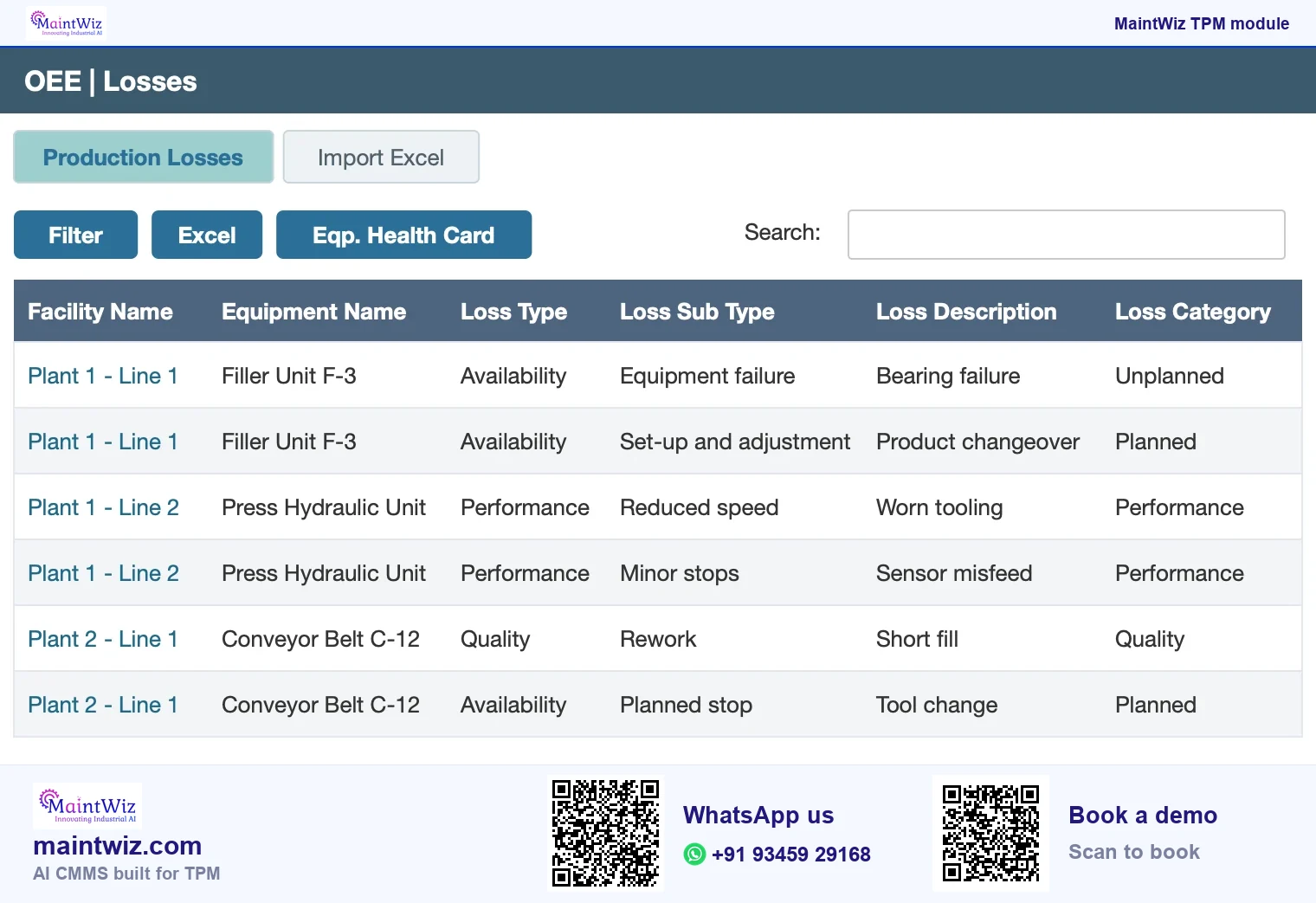
| Stop event with a reason | OEE module of the CMMS, fed by the MES, SCADA, PLC or DCS source | One reason list mapped to the six big losses |
| Production count and good count | MES or line counters | Read by the OEE module for performance and quality |
| Audit score (5S, step audit) | CMMS, 5S and audit modules | Findings raised as abnormalities with an owner |
| Training session and skills | CMMS, education and training module | Personnel master from the HR system or LMS |
| Defect and rejection record | CMMS, quality module; batch genealogy stays in the MES | Linked to the equipment condition that caused it |
| Spare parts stock and purchase | SAP MM or the ERP | Stock and purchase exchanged with SAP MM through web services |
When does an EAM sit beside the CMMS?
An EAM sits beside the CMMS when the business needs whole-life asset cost, procurement and finance in one corporate record across sites. Keep the EAM or SAP as the asset and cost master, and run the daily TPM records on the same asset hierarchy in MaintWiz: operator routines, audits, losses, training and work orders. MaintWiz reads that asset register from SAP PM through web services.
Worked example
How does one breakdown move through the systems?
One breakdown touches six records, and each has an owning system. The steps below follow it from the stop to the dashboard.
- The line stops. The stop event arrives from the PLC, SCADA or MES source, or the operator enters it at the machine, with a reason from the one reason list.
- The operator raises an abnormality tag against the equipment with category, cause, owner and target date. The tag lives in the abnormality register of the CMMS.
- After manual review the tag is converted to a work order. Where SAP PM is the maintenance master, the notification and order are exchanged through web services, so SAP PM holds the order and MaintWiz holds the tag behind it.
- The technician closes the work order with the failure cause, and the history stays on the equipment.
- The stop minutes appear in the OEE module as an availability loss under the breakdown group of the six big losses, using the same reason list.
- The pillar owner sees the closure on the Jishu Hozen and OEE dashboards, and a repeat cause goes to a Kaizen.
The record changes hands, but each one has a single owner, so maintenance and production read the same stop.
Connections
How should a CMMS, an MES and SAP connect for TPM?
MaintWiz connects to SAP through the PM and MM modules using web services, and to IoT, MES, SCADA, PLC and DCS sources, so each record moves from the system that owns it to the systems that read it. Five exchanges carry TPM:
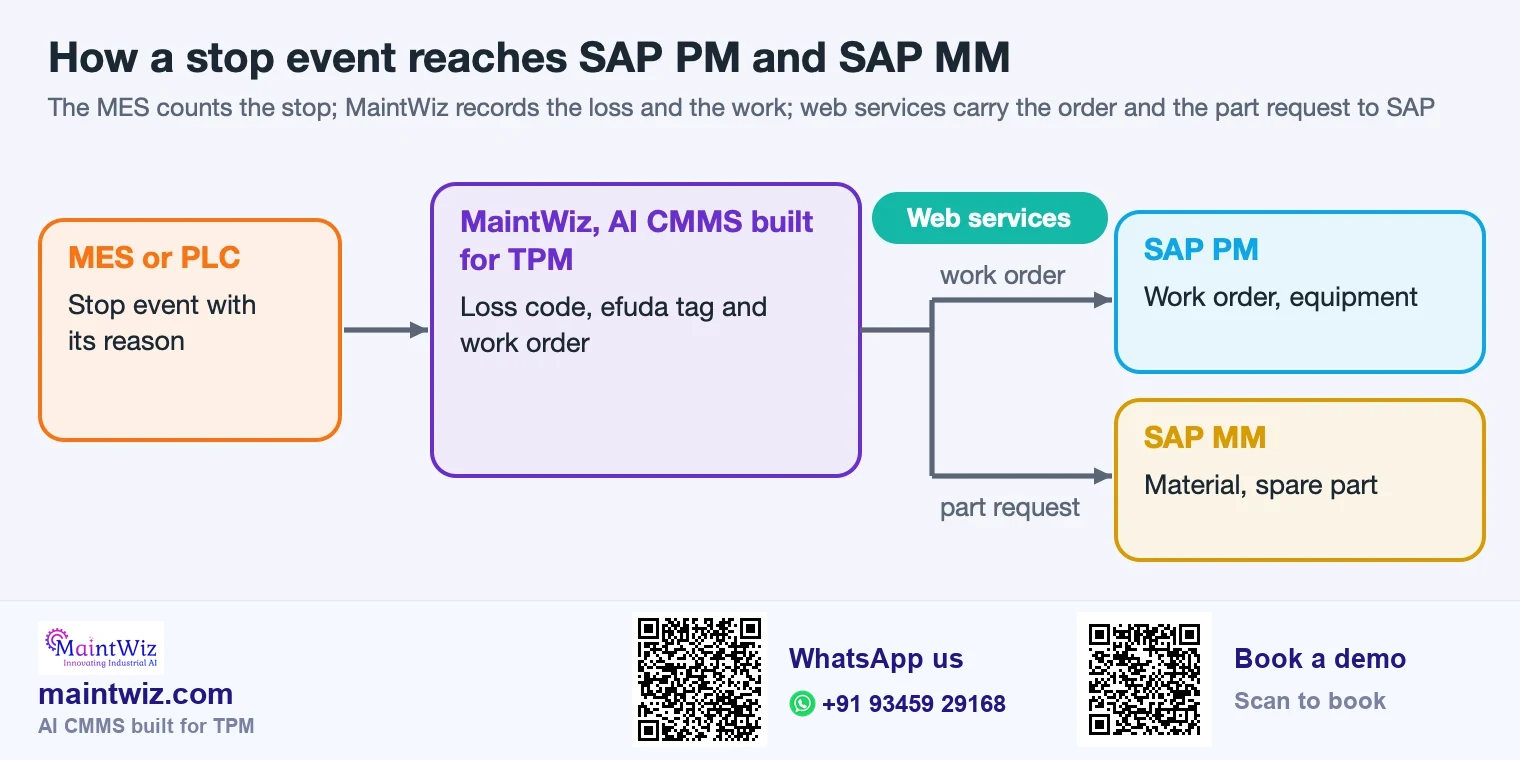
- Equipment hierarchy and identifiers, maintained in one place.
- Stop events with reasons and times, in one direction, on an agreed reason list.
- Production and good counts for OEE, from the system closest to the machine.
- Work orders raised from tags and closed back to them.
- Roles and users, so access follows one policy.
The rule is that the owning system writes and the others read. The equipment hierarchy comes from the master, stop events and counts come from the machine side, and work orders and closure come from the CMMS.
What you need
Do you need a CMMS, an MES and an EAM for TPM?
You need the CMMS built for TPM; the MES and the EAM join it only where the plant already runs them. The table gives the rule for each starting point.
| If your plant | Then |
|---|---|
| Runs maintenance on paper and spreadsheets | Load the equipment list through an easy Excel upload and roll out the entire TPM in 6 to 8 weeks with guided project management from the MaintWiz implementation team |
| Has an MES that captures counts and states | Keep it as the source; the OEE module reads counts and stops through the MES connector, and the CMMS holds tags, work orders and audits |
| Runs SAP PM and MM | Keep SAP as the asset and stock master; MaintWiz runs the TPM records and exchanges notifications and orders through web services |
| Runs an EAM suite across sites | Keep the EAM for whole-life cost and finance; run operator routines, audits and losses in the CMMS on the shared asset hierarchy |
| Has two systems holding the same stop or count | Name one as the record and feed the other |
Book a demo with your SAP and MES scenario.
Why does the same stop appear in a CMMS and in an MES?
The same stop is written twice because each system records it for a different purpose. In a CMMS a stop appears as the duration of a work order: when repair started, when it ended, what failed. In an MES or OEE module it is a production state: the line was down from one time to another for a reason, whether or not anyone repaired anything. A changeover, a wait for material or a minor stop clears without a work order, yet all three count in OEE availability or performance.
TPM answers with one reason list mapped to the six big losses and a rule for which stops create a work order. In MaintWiz both live in the same CMMS, so maintenance and production read the same loss record and the same TPM KPI definitions.
In a demo
What should you see in a demo?
- An operator records a stop and a tag; the tag becomes a work order and its downtime appears in the loss record.
- The reason list is the same in the maintenance and production views.
- The equipment list has one source, and a change in it reaches the OEE module and the pillar dashboards.
- Counts arrive from the MES, SCADA, PLC or DCS source or are entered at the machine, and a correction is traceable.
- XLS and PDF export of the work, loss and audit records.
Confusions
What do buyers confuse between a CMMS, an MES and an EAM?
- 'An OEE system is an MES': an OEE module reads counts and states; an MES controls and records production execution.
- 'A CMMS holds only work orders': a CMMS built for TPM also holds operator tags, audits, training, quality and safety records on the same equipment list.
- 'TPM needs a separate product': a CMMS with a module for each pillar runs TPM, with the pillar records beside the work orders.
- 'EAM is a bigger CMMS': an EAM adds whole-life cost, procurement and finance scope for the corporate asset record.
- 'We need all three': one system is the record for each kind of data, and the others read it.
SAP, MES, plant
How does MaintWiz connect to SAP, the MES and plant systems?
MaintWiz connects to SAP through PM and MM using web services, can connect IoT, MES, SCADA, PLC and DCS sources and supports enterprise single sign-on, each in use in live enterprise implementations. See the SAP PM and MM exchange on your own equipment list in a demo.
MaintWiz is delivered as public software as a service; on-premises deployment is available on request. Pricing is quoted on request and tailored to the modules and users you need; contact MaintWiz for a quote.
FAQ
Frequently asked questions
What is the difference between a CMMS, an MES and an EAM for TPM?
A CMMS holds maintenance work and, in MaintWiz, the records of all eight TPM pillars. An MES holds production execution: orders, counts, machine states and quality results. An EAM holds whole-life asset cost, procurement and finance links. Each owns a different set of records, and all three share the equipment list.
Is TPM software a CMMS?
Yes. TPM software is a CMMS that runs the routines of all eight TPM pillars on one equipment list: tags, work orders, audits, OEE, training, quality and safety. MaintWiz is an AI CMMS built for TPM, with a module for each pillar.
Can an MES replace the CMMS for TPM?
No. An MES supplies counts, states and stop events, but tags to closure, work orders, audits, training and asset history belong in the CMMS. MaintWiz reads MES counts and stops through its connectors and holds the maintenance and pillar records.
Do I need a CMMS and an MES for TPM?
You need the CMMS built for TPM; the MES joins it only if the plant already runs one. Plants with an MES keep counts and states there and the OEE module reads them. Plants without one enter counts at the machine or take them from line counters.
Where should OEE be calculated?
In one system with one written definition. MaintWiz calculates OEE in its OEE module, reported at equipment level and rolled up to line and plant by planned time, with counts and stops taken from the MES, SCADA, PLC or DCS source closest to the machine.
Which system should own the work order, the stop event and the count?
The CMMS owns the work order. The OEE module of the CMMS owns the stop event, fed by the machine-side source, and the MES or line counters own the production count. The other systems read each record instead of keeping their own copy.
How do the CMMS, the MES and SAP connect for TPM?
MaintWiz connects to SAP through the PM and MM modules using web services, and it can connect IoT, MES, SCADA, PLC and DCS sources. These integrations are in use in live enterprise implementations. Each record flows from its owning system to the systems that read it.
How long does it take to set up a CMMS built for TPM?
The entire TPM can be rolled out on MaintWiz in 6 to 8 weeks, with the equipment list loaded through an easy Excel upload and guided project management from the MaintWiz implementation team. Pricing is quoted on request and tailored to the modules and users you need.
Does MaintWiz work with my MES and SAP?
Yes. MaintWiz reads counts and stop events from your MES and exchanges notifications and orders with SAP PM and MM through web services. It holds the tags, work orders, audits, training, quality and safety records; the MES and SAP keep the records they own.