
Key takeaways
- Twelve statements, scored 0 to 4: leadership, basic conditions, data definitions, the eight pillars (as asked here) and systems.
- The average maps to a level: below 1.0 not started, 1.0 to under 2.0 ad hoc, 2.0 to under 3.0 defined, 3.0 to under 3.75 standard, 3.75 and above measured.
- The lowest three areas are where to look first; leadership and basic conditions come before pillar-specific work.
- MaintWiz turns your three lowest areas into pillar records on one equipment list, and the entire TPM rolls out in 6 to 8 weeks.
How it works
How does the self-assessment work?
Each statement describes a practice. Choose the level that is true for your critical equipment, not your best area. The levels apply to every statement (Figure 1).
| Level | Name | Meaning |
|---|---|---|
| 0 | Not started | No defined practice; nothing recorded |
| 1 | Ad hoc | Done by some people or in some areas; not written down |
| 2 | Defined | A written standard exists and is used on some assets or areas |
| 3 | Standard | Followed on all critical assets or areas; records are kept |
| 4 | Measured | Followed, measured, reviewed on a fixed cadence and improved; evidence on file |
Maturity levels used in the self-assessment
The same five levels apply to every statement
- 0
Not started
No defined practice; nothing recorded
- 1
Ad hoc
Done by some people or in some areas; not written down
- 2
Defined
A written standard exists and is used on some assets or areas
- 3
Standard
Followed on all critical assets or areas; records are kept
- 4
Measured
Followed, measured, reviewed on a fixed cadence and improved; evidence on file
 maintwiz.comAI CMMS built for TPM
 WhatsApp us
 +91 93459 29168
 Book a demo
Levels: 0 not started, 1 ad hoc, 2 defined, 3 standard, 4 measured. Below 1.0 not started; 1.0 to under 2.0 ad hoc; 2.0 to under 3.0 defined; 3.0 to under 3.75 standard; 3.75 and above measured.
maintwiz.comAI CMMS built for TPMWhatsApp us+91 93459 29168Book a demoDownloads
TPM self-assessment workbook and pillar audits (Excel)
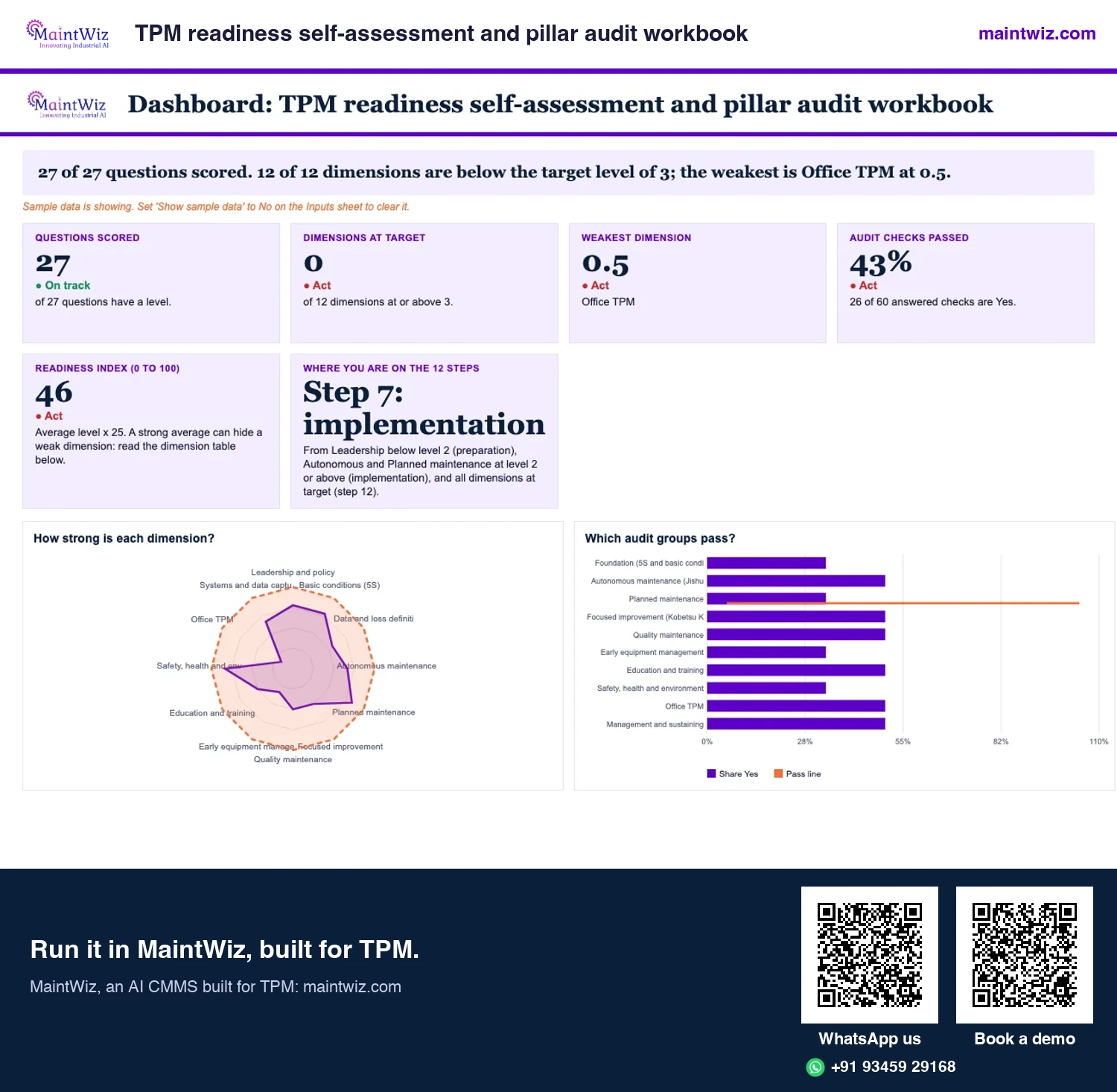
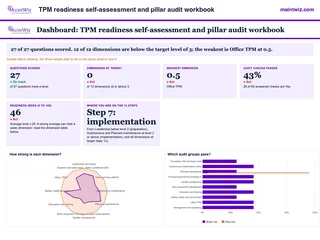 ExcelTPM readiness self-assessment and pillar audit workbook
Score 27 questions across 12 dimensions, read a readiness index from 0 to 100 and your place on the 12 steps
- Sheets
- Dashboard, Inputs, Assessment, Scale, Pillar rubric, Pillar audit, Plant Head page, Read me
- A4
- Version
- v1.0, 2 November 2026
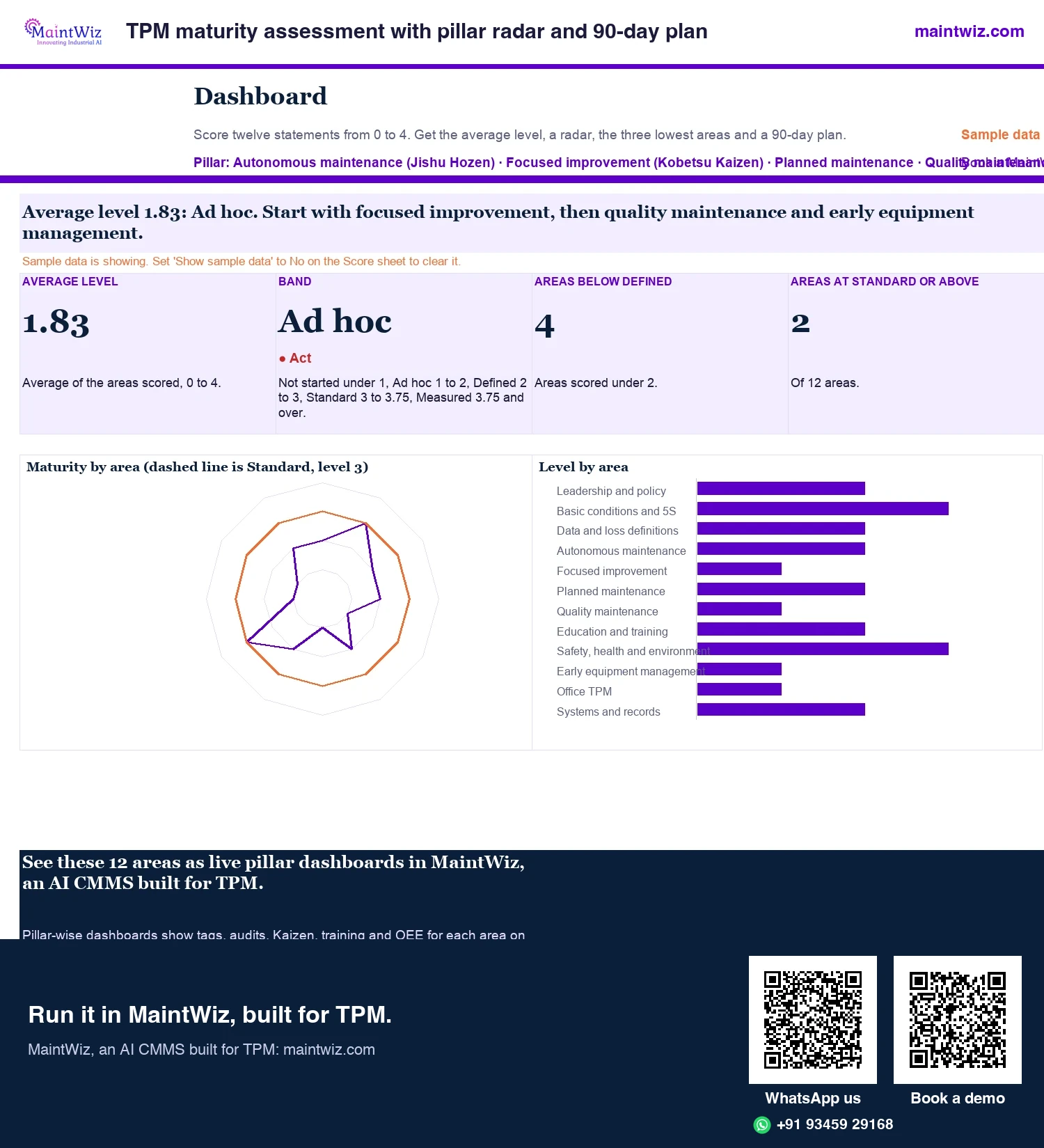
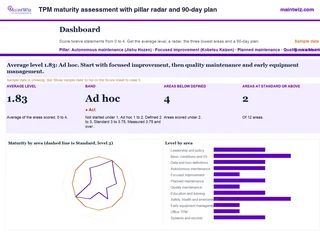 ExcelTPM maturity assessment with pillar radar and 90-day plan
Score a TPM self-assessment across twelve areas and get your maturity band, a pillar radar, the three lowest areas and a 90-day plan.
Inside: Twelve statements scored 0 Not started to 4 Measured · Average level and band · Radar by area · Three lowest areas and the 90-day plan
- Sheets
- Dashboard, Score, Read me
- A4
- Version
- v1.0, 2 November 2026
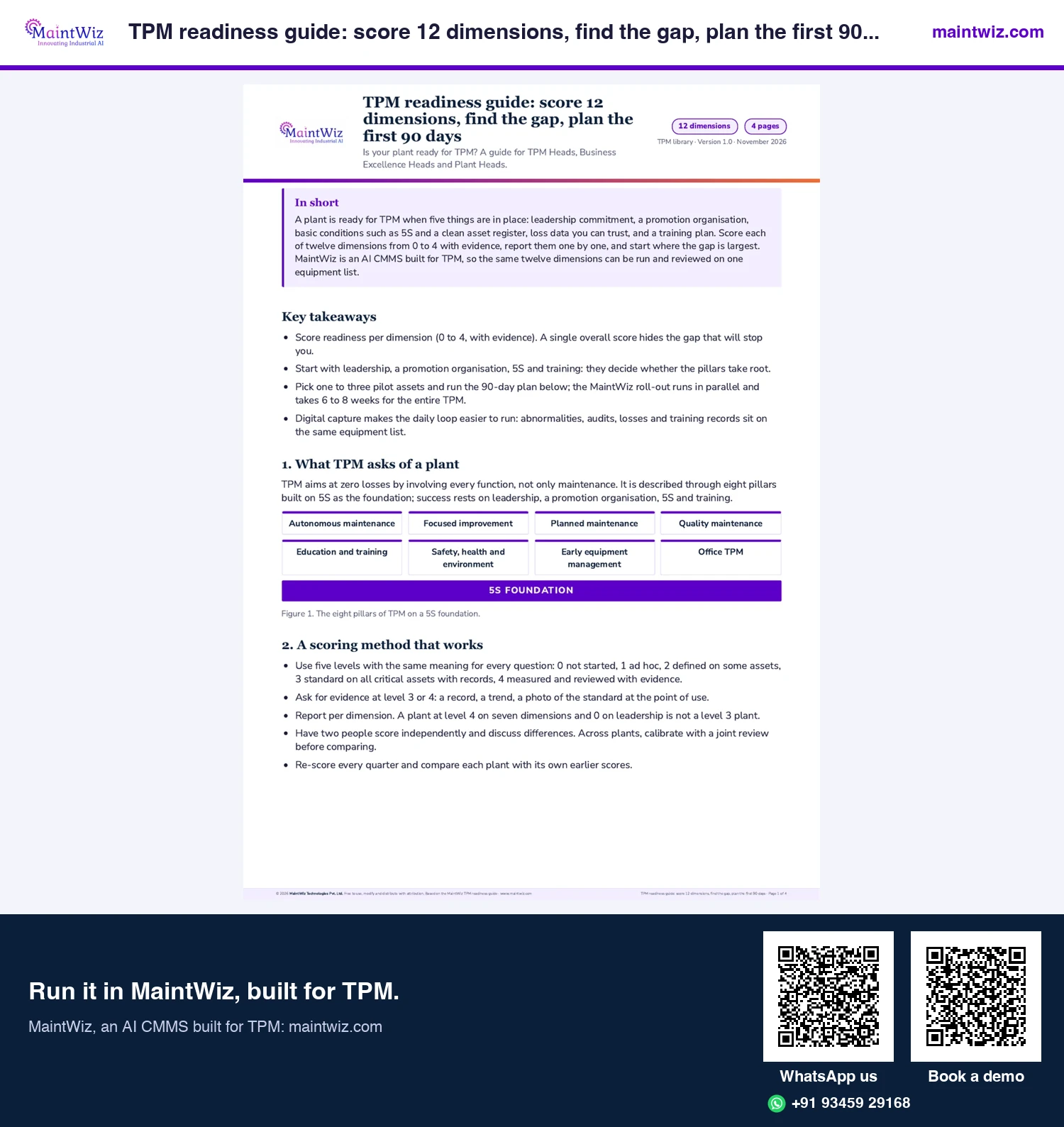
 PDFTPM readiness guide: score 12 dimensions, find the gap, plan the first 90 days
Score 12 dimensions, read the gap with a worked example, and follow the 90-day plan with the 6 to 8 week roll-out lane
- Pages
- 4
- A4
- Created
- 5 November 2026
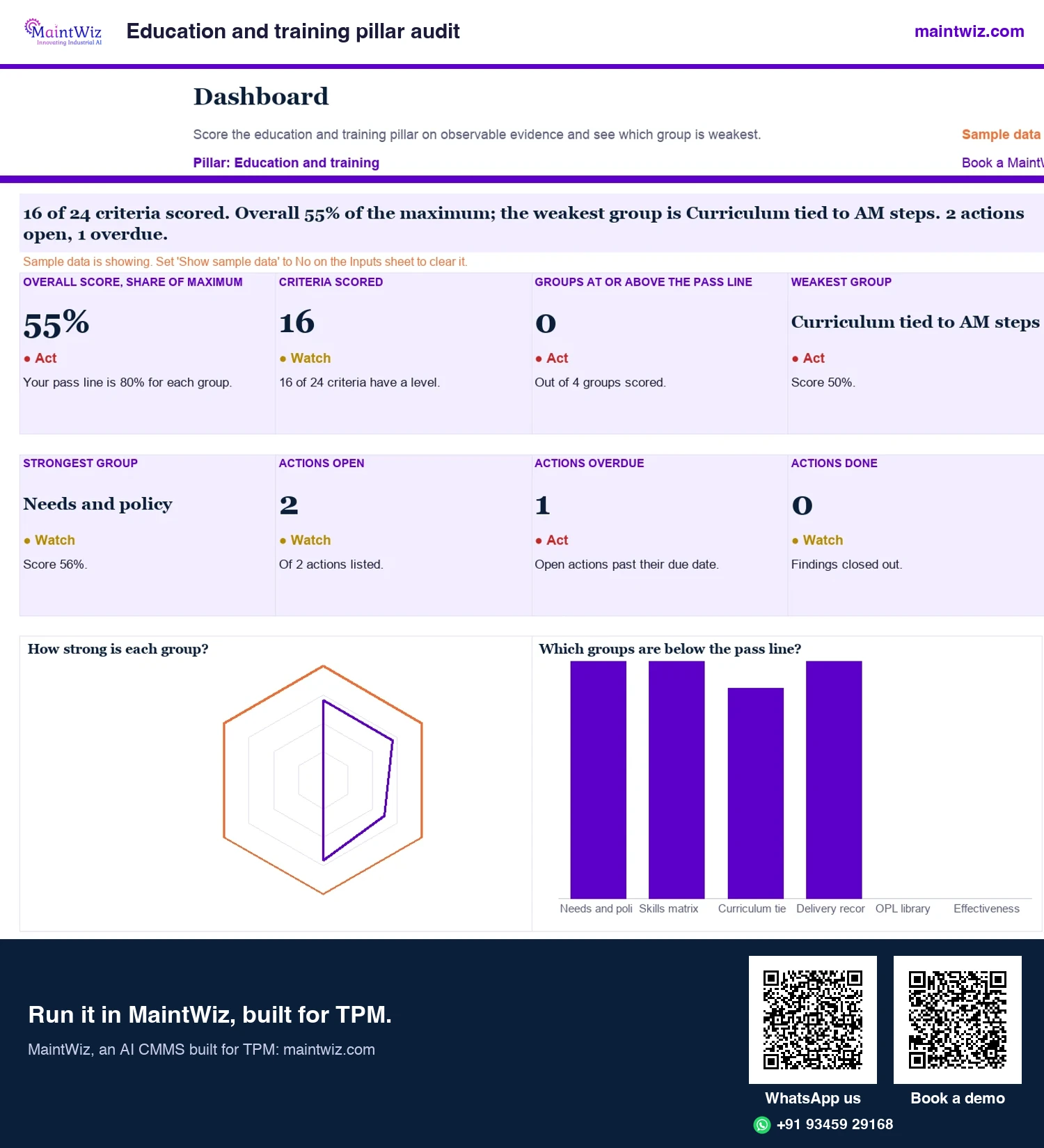
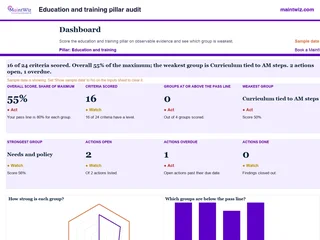 ExcelEducation and training pillar audit
Score the Kyoiku Kunren (education and training) pillar on 24 evidence checks
- Sheets
- Dashboard, Inputs, Audit, Actions, Read me
- A4
- Version
- v1.0, 2 November 2026
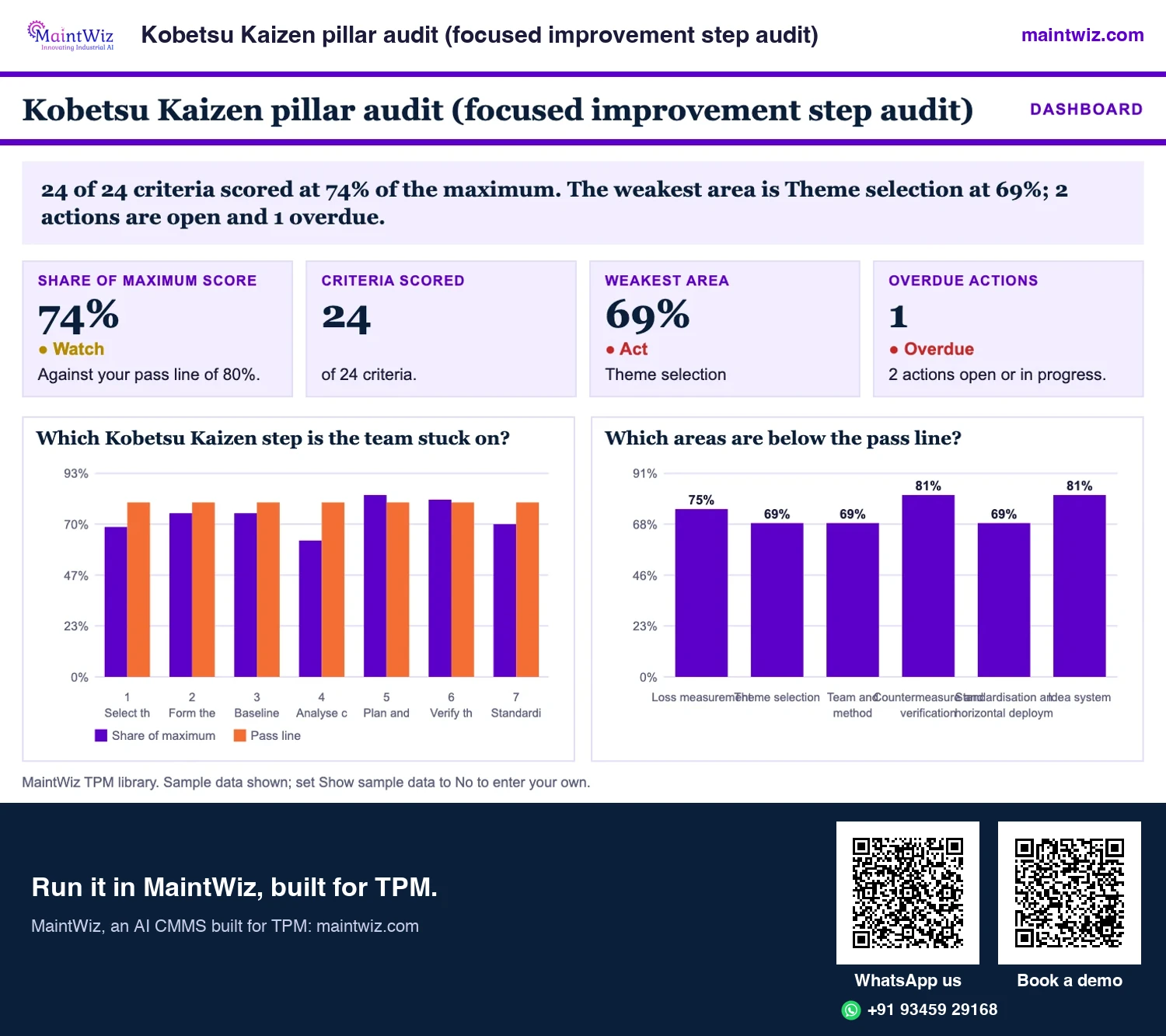
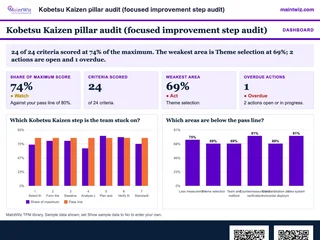 ExcelKobetsu Kaizen pillar audit (focused improvement step audit)
Score 24 criteria across the seven Kobetsu Kaizen steps, see which step a team is stuck on, and track the actions
- Sheets
- Dashboard, Inputs, Audit, Actions, Read me
- A4
- Version
- v1.1, 5 November 2026
Scoring
How is the score calculated?
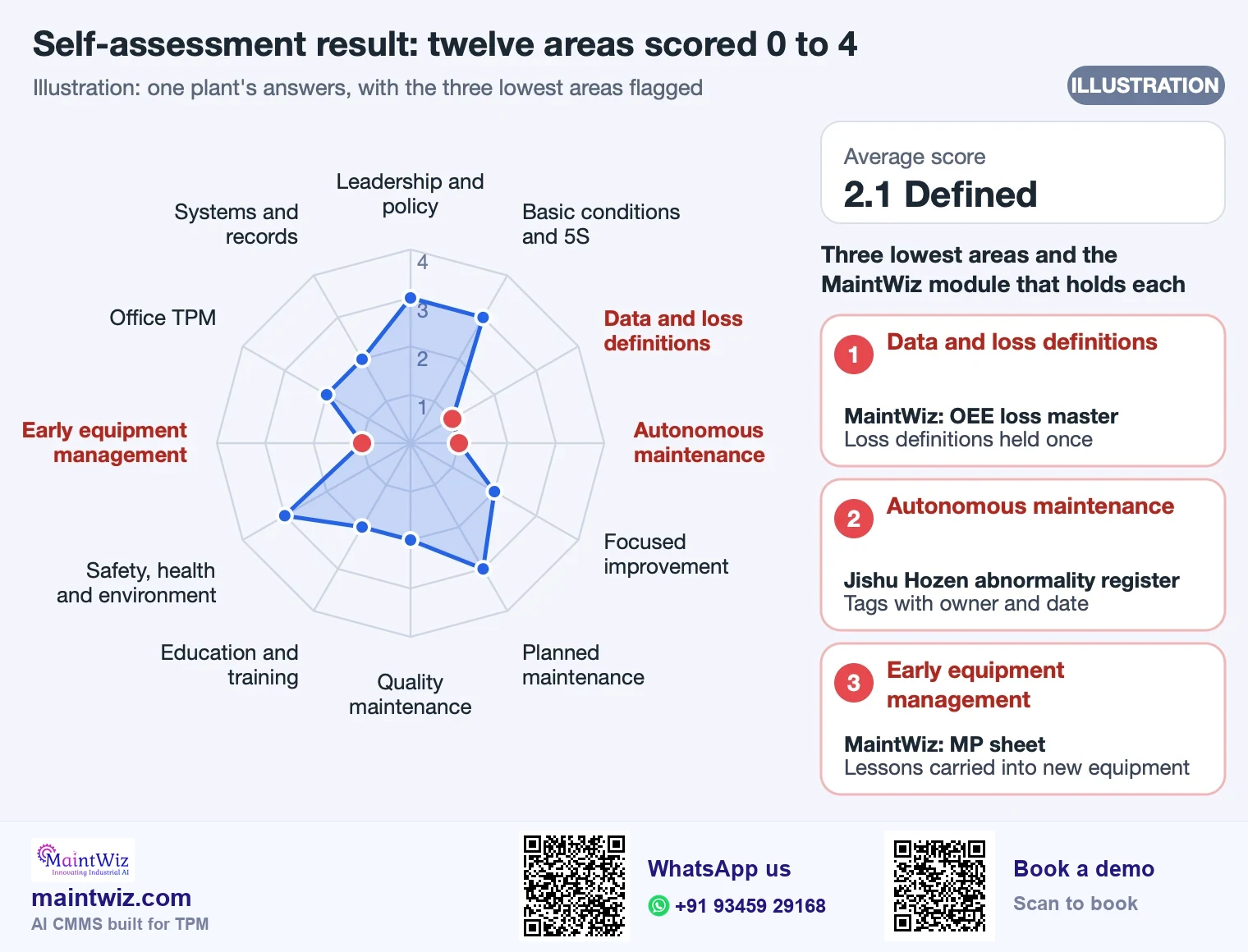
The average of the twelve answers is shown with a level: below 1.0 is not started, 1.0 to under 2.0 ad hoc, 2.0 to under 3.0 defined, 3.0 to under 3.75 standard and 3.75 and above measured. The three lowest answers are listed in order, ties broken by the order of the statements. Areas are scored without weighting by default; the workbook lets you set weights.
The statements follow MaintWiz's own model: leadership, basic conditions, data definitions, the eight pillars and systems (Figure 2).
How should a team use the result?
- Score it in a group of five to eight people from operations, maintenance and engineering, then compare scores: the disagreements are the useful part.
- Keep the evidence for each score in a note: a record, a photo, a standard.
- Retake it every six months with the same group and compare.
- Do not average across plants unless every plant used the same group process.
Next steps by result
| Average level | What it usually means | Suggested next step |
|---|---|---|
| Not started (below 1) | Few practices exist | Secure leadership commitment, agree definitions and start 5S and autonomous maintenance in one pilot area; see TPM implementation |
| Ad hoc (1.0 to under 2.0) | Good practice exists in places but is not written or consistent | Write the standards, name pillar owners and pick a pilot area with a baseline |
| Defined (2.0 to under 3.0) | Standards exist but are not followed everywhere | Audit adherence, close tags on time, extend to more areas and start measuring |
| Standard (3.0 to under 3.75) | Practices are followed and recorded | Measure and review on a fixed cadence; start improving the standards themselves |
| Measured (3.75 and above) | Practices are measured and improved | Check evidence independently and plan the JIPM or CII assessment |
Turn your three lowest areas into pillar records: MaintWiz, an AI CMMS built for TPM, holds abnormality tags, autonomous maintenance and Kaizen records on one equipment list. Book a demo to see them on your own records.
How the self-assessment turns twelve answers into a result
Average level sets the band; the three lowest areas come first
Not started
average below 1
Ad hoc
average 1 to 1.99
Defined
average 2 to 2.99
Standard
average 3.00 to 3.74
Measured
average 3.75 or more
Twelve areas scored 0 to 4:
- Leadership and policy
- Basic conditions and 5S
- Data and loss definitions
- Autonomous maintenance
- Focused improvement
- Planned maintenance
- Quality maintenance
- Education and training
- Safety, health and environment
- Early equipment management
- Office TPM
- Systems and records
The three lowest areas are listed as the first place to work
maintwiz.comAI CMMS built for TPMWhatsApp us+91 93459 29168Book a demoAssessment vs audit
How is this different from a TPM audit?
A TPM audit is an on-site assessment of the pillars against fixed criteria, such as JIPM's award assessment run by JIPM and its associate agencies. This self-assessment is the step before it: your own team scores twelve areas from 0 to 4, finds the three weakest and fixes them first. MaintWiz keeps the evidence (tags, audits and training records) on one equipment list.
Use the score to plan the evidence a JIPM or CII assessor will ask for: the award preparation checklist lists it pillar by pillar. India's external assessment route runs through the CII TPM Club.
From self-assessment to a plan
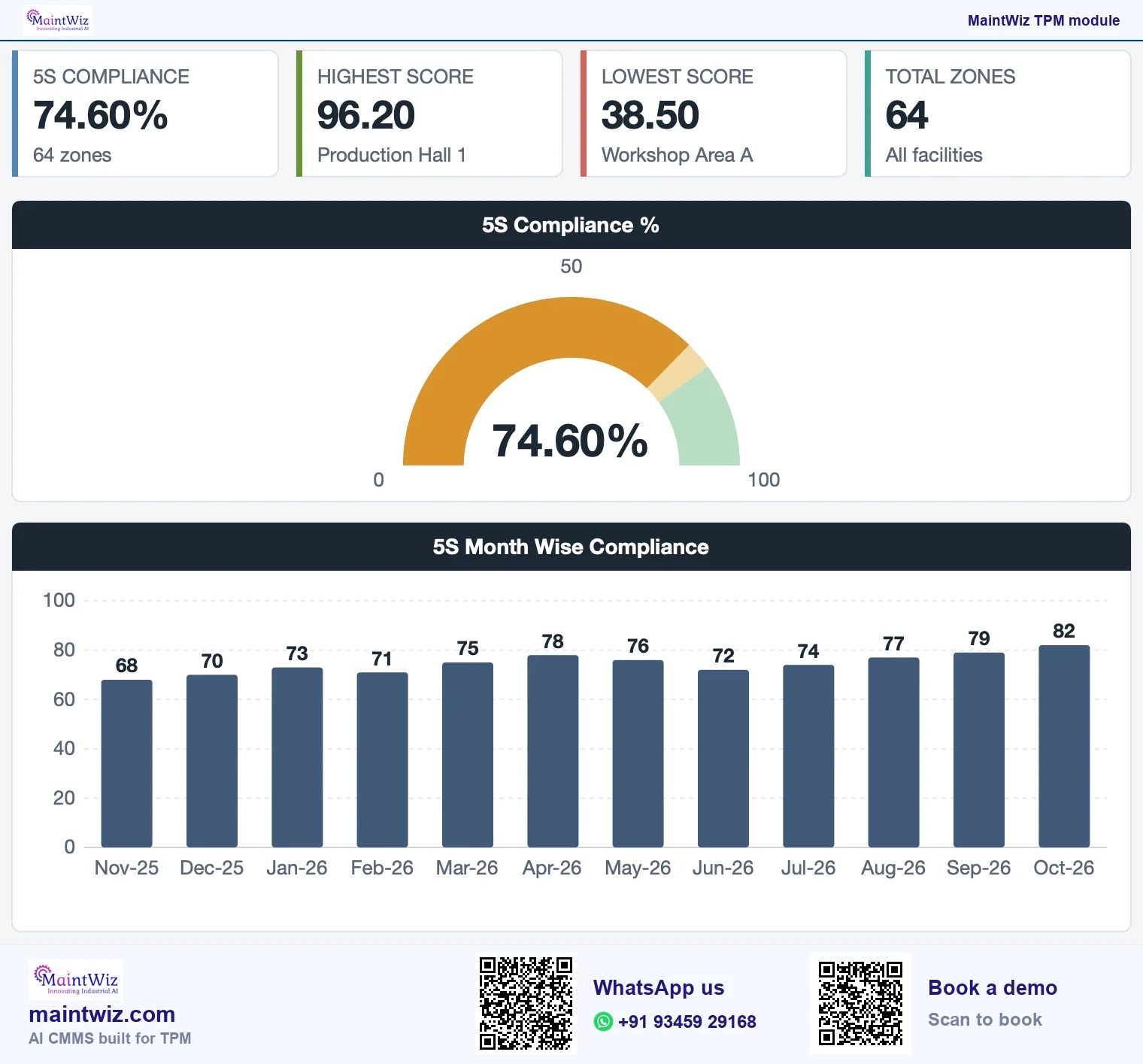
Pick the lowest area that is a precondition for others. Leadership, basic conditions and data definitions come before pillar-specific work. Then set a pilot-area plan with a baseline, a few measures and named owners. A starter roadmap and the eight pillars guide support this, and MaintWiz, an AI CMMS built for TPM, holds the records for all eight pillars (TPM software).
The statements
What each statement is testing
| Area | What level 3 looks like | Evidence to hold |
|---|---|---|
| Leadership and policy | Policy and targets published; steering group meets; leaders visit the floor and follow up | Policy, minutes, Gemba records |
| Basic conditions and 5S | Audit scores trend and corrective actions close | 5S audits, action list |
| Data and loss definitions | Definitions written once; reason codes used on critical lines | Definition sheet, coding rate |
| Autonomous maintenance | Stage per asset recorded and audited; tags closed on time | Step audits, tag register |
| Focused improvement | Loss Pareto drives a project list; results verified | Project files, Pareto |
| Planned maintenance | PM compliance reported monthly and reviewed | Compliance report |
| Quality maintenance | Defects linked to conditions; RCA for repeats | Defect matrix, RCA records |
| Education and training | Matrix current; gaps drive the plan | Matrix, training records |
| Safety, health and environment | Near misses logged with actions and closure | Incident register |
| Early equipment management | Lessons reviewed at design stages | MP sheets, spec reviews |
| Office TPM | Process losses listed with tracked actions | Loss worksheet |
| Systems and records | Data trusted by users and captured at source | System use, data checks |
Common biases when scoring
- Scoring the best area instead of the typical one.
- Scoring intent (a plan exists) as practice (it is followed).
- Letting the most senior person set the score for everyone.
- Giving a 4 without measurement or review evidence.
- Scoring the same each time so the trend is flat.
- Treating a low score as blame: it is a map.
Next steps
Next steps
- See how the entire TPM rolls out in 6 to 8 weeks with MaintWiz: TPM implementation.
- Start with the lowest area: Jishu Hozen, planned maintenance or TPM KPIs.
- Keep the records in one place: TPM software.
FAQ
Frequently asked questions
How do I assess TPM maturity?
Score a set of statements covering leadership, basic conditions, data definitions and each pillar on a 0 to 4 scale for your critical equipment, with evidence for each score, in a mixed team. Then work on the lowest areas.
Is this the JIPM TPM audit?
No. It is MaintWiz's readiness model, built on the eight pillars JIPM defines plus leadership, basic conditions, data definitions and systems, so a team sees which area to work on before any external TPM audit.
What is a good score?
Aim for Standard, a score of 3.0, on the critical equipment in each area, then work toward Measured at 3.75. Until you get there, compare with your own earlier results and start on the three lowest areas.
Does the self-assessment store my answers?
No. The scoring runs in your browser and nothing you select is sent anywhere. The Excel workbook version runs on your own computer, so you can keep a dated record there and compare it next time.
How often should we repeat it?
Every six months with the same group is a common rhythm, so that changes are comparable. Keep the evidence note for each score, because the reasons behind a score are more useful than the number.
Where should a low-scoring plant start?
With leadership commitment, agreed definitions and basic conditions, then 5S and autonomous maintenance in one pilot area with a baseline. Add pillars one at a time as the routines settle.