
Key takeaways
- Step 6 standardises flow, storage, visual controls and records so results do not depend on who is on shift.
- Step 7 hands the standards, the data and the improvement to the team; managers review and support.
- Both steps rely on the earlier ones being real: a standard cannot be sustained if cleaning and inspection are still being chased.
- Audits keep the gains: standards decay when no one checks them.
- MaintWiz gives the team its own Jishu Hozen dashboard and OEE at equipment, line and plant level for its weekly review.
Steps 6 and 7
What are steps 6 and 7 of autonomous maintenance?
Step 6, standardisation, extends the discipline from the equipment to its surroundings and to the way records are kept. Standards are set for how materials, tools and spares are stored and moved, what the visual controls are and what the checklists look like. Step 7, full self-management, is the point at which the team no longer waits to be told. It sets targets for its own equipment, reviews its own data such as OEE and failures, improves its standards and records its ideas. Step 7 closes the seven-step sequence of autonomous maintenance that JIPM teaches.
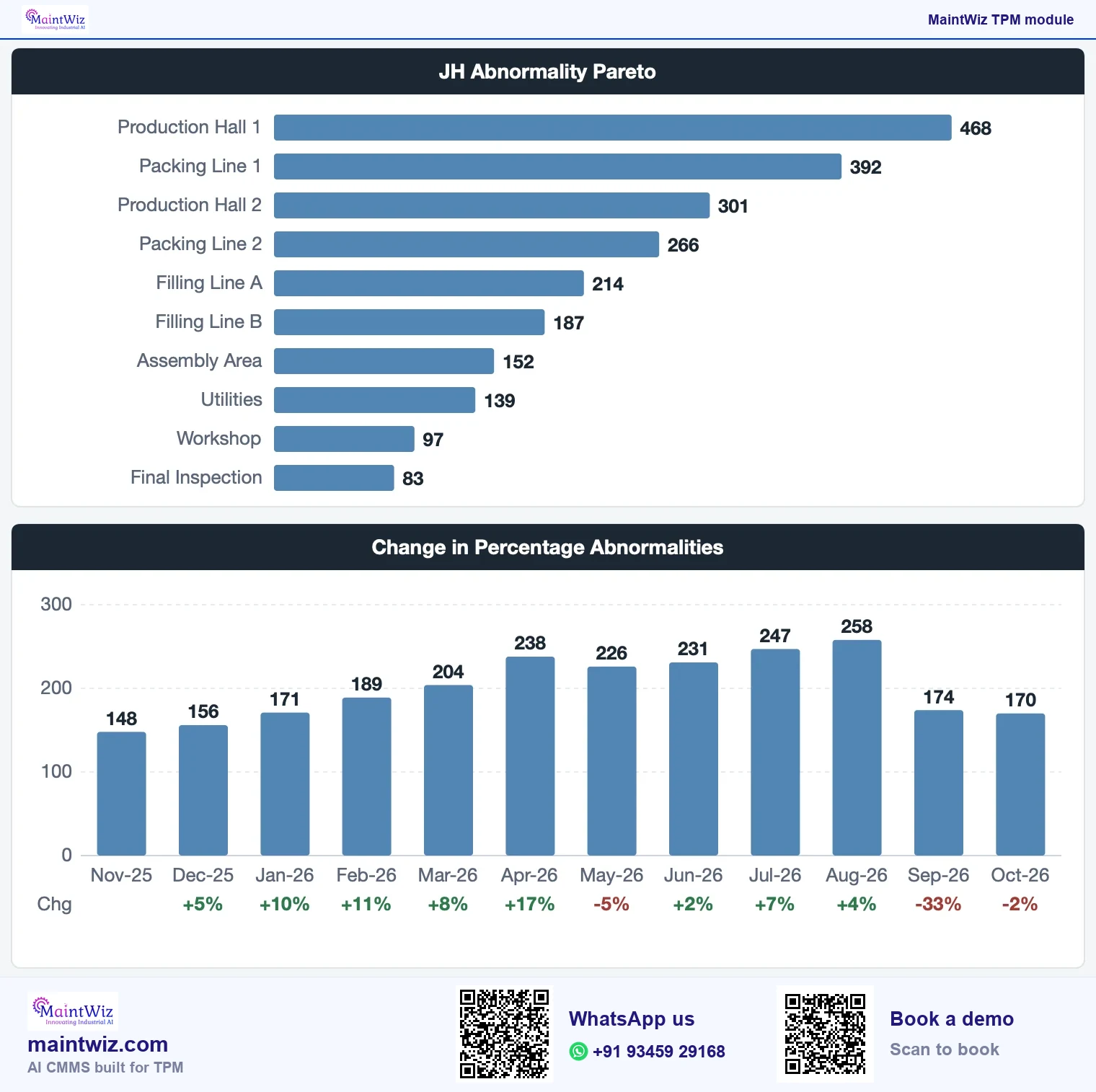
Step 7 is where teams own their results. Each week the team reads what was assigned against what was completed and closes the oldest items first. MaintWiz gives a team the Jishu Hozen dashboard (tag counts by colour, assigned versus completed, cumulative and day-wise closure) to review in its own meeting.
Steps 6 and 7 of autonomous maintenance
From standards for the area to a team that runs its own improvement
Step 6: standardisation
- Work area flow and storage
- Visual controls on equipment and area
- One format for checklists and records
- Audits of the standards on a schedule
Step 7: full self-management
- Team sets targets for its equipment
- Team reviews its own data, such as OEE and failures
- Team improves standards and records ideas
- Results hold across audits
 maintwiz.comAI CMMS built for TPM
 WhatsApp us
 +91 93459 29168
 Book a demo
What does step 6, standardisation, cover?
| Area | What is standardised | Evidence an auditor can see |
|---|---|---|
| Work area flow | Where materials, tools and spares go and how they move | Marked locations, defined routes |
| Storage | What is stored, where, in what quantity, with what label | Labelled locations, quantity marks, no unmarked items |
| Visual controls | Limits, directions and states shown on the equipment and area | Marks on gauges, flow arrows, colour coding that matches the legend |
| Checklists and records | One format for checks and records across equipment | Same layout on every equipment, filled in and filed |
| Audits | A schedule for checking the standards | Audit sheets and corrective actions |
This is where 5S discipline pays off: the Seiketsu and Shitsuke steps (standardise and sustain) are the same ideas applied to the whole area. The free 5S audit checklist scores each zone, and the MaintWiz 5S audit module holds compliance, month-wise scores and the radar.
How do you keep standards alive in step 6?
- Put each standard where it is used, in a form people can read at a glance.
- Give every standard an owner and a review date.
- Audit on a schedule; weak zones are audited more often.
- Treat every deviation as information: either the standard is wrong or the practice has drifted.
- Update the standard when the equipment or product changes, and train on the change.
- Retire standards that no one uses.
The most common failure is a standard that is correct on the day it is written and wrong a year later. A review date and an owner are cheap and prevent it (Figure 2).
What step 6 standardises, and what an auditor sees
Five areas, each with visible evidence
Work area flow
Marked locations and defined routes
Storage
Labelled locations, quantity marks, nothing unmarked
Visual controls
Marks on gauges, flow arrows, colour coding
Checklists and records
One layout on every equipment, filled in and filed
Audits
Audit sheets and corrective actions on a schedule
maintwiz.comAI CMMS built for TPMWhatsApp us+91 93459 29168Book a demo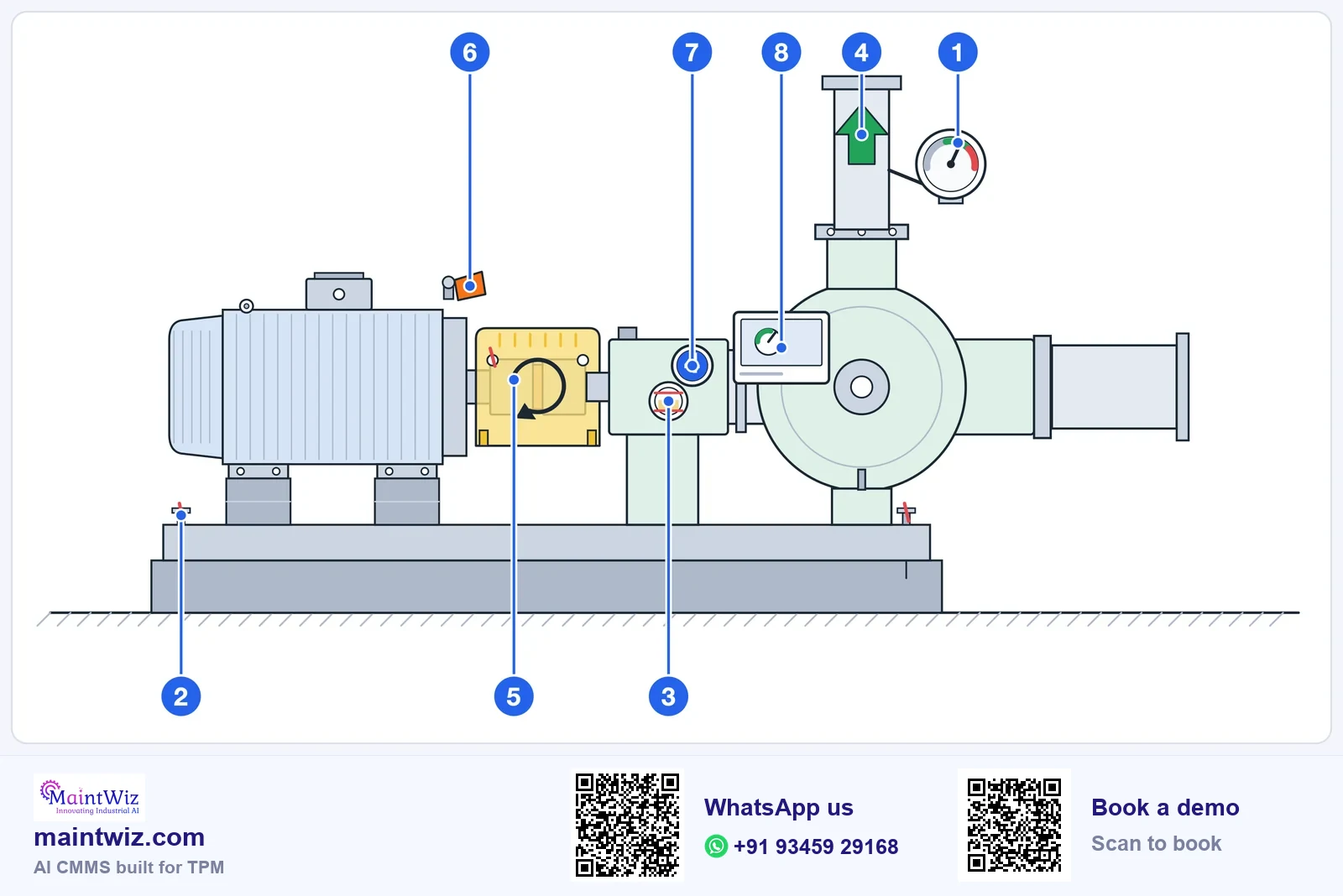
| No. | Visual control | What it shows at a glance |
|---|---|---|
| 1 | Pressure gauge green band | Normal discharge pressure |
| 2 | Bolt match marks | A bolt that has moved |
| 3 | Sight-glass minimum and maximum band | Correct oil level |
| 4 | Pipe flow arrow | Direction of flow |
| 5 | Coupling rotation arrow | Direction of rotation |
| 6 | Lubricant colour tag at the grease nipple | Which lubricant goes in |
| 7 | Numbered inspection point disc | Which point of the standard this is |
| 8 | Reference photo at the point | What normal looks like |
Review closure by colour and day with your team on one dashboard. Book a demo.
Downloads
Steps 6 and 7 templates: 5S audit, step coverage and poka-yoke tracker
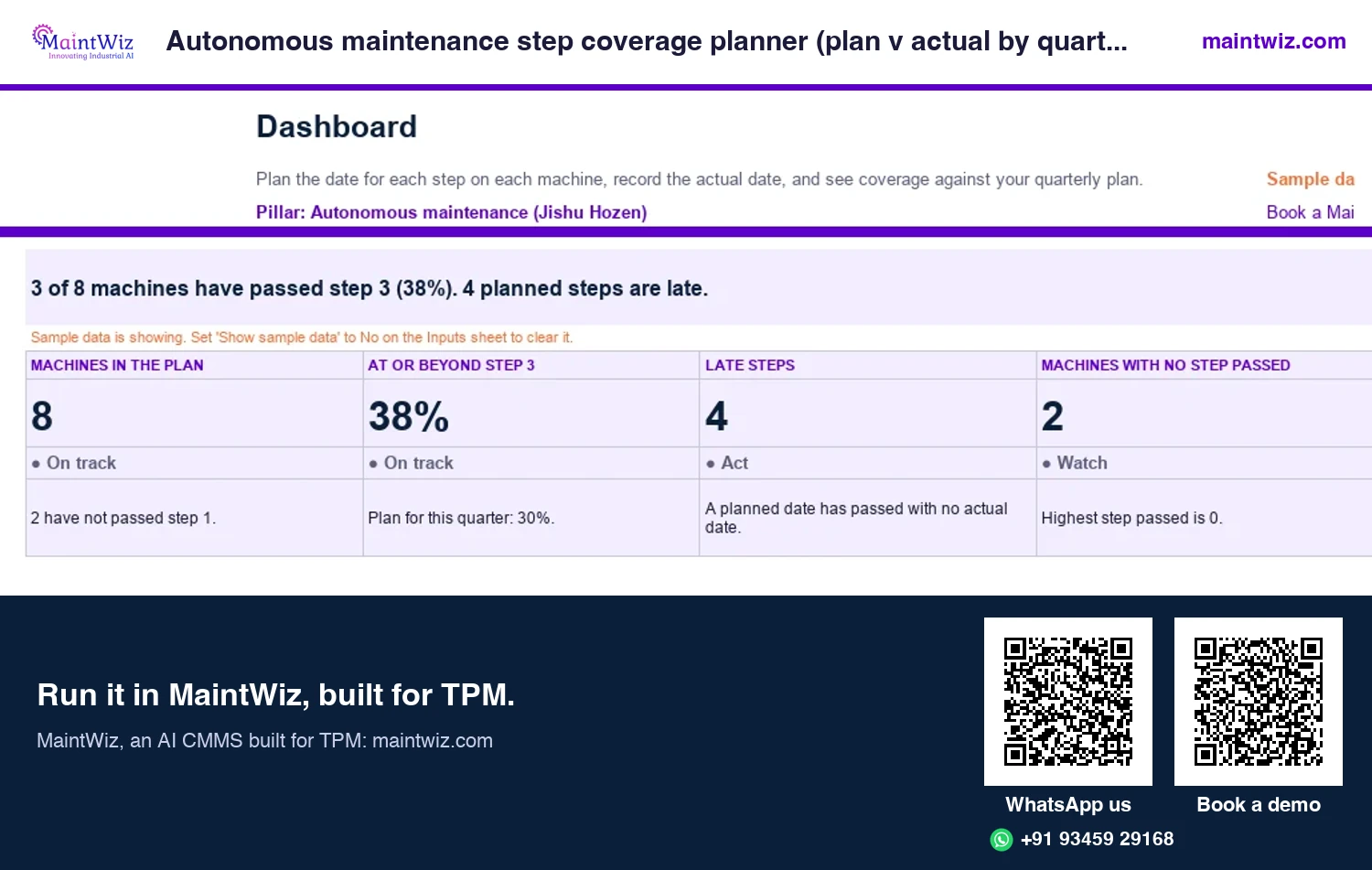
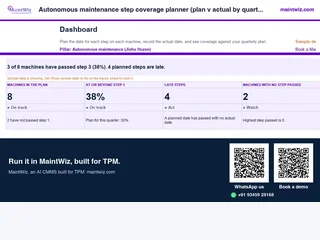 ExcelAutonomous maintenance step coverage planner (plan v actual by quarter)
See how many machines have passed each Jishu Hozen step against your quarterly plan
- Sheets
- Dashboard, Inputs, Machines, Plan dates, Actual dates, Plan, Read me
- A4
- Version
- v1.1, 5 November 2026
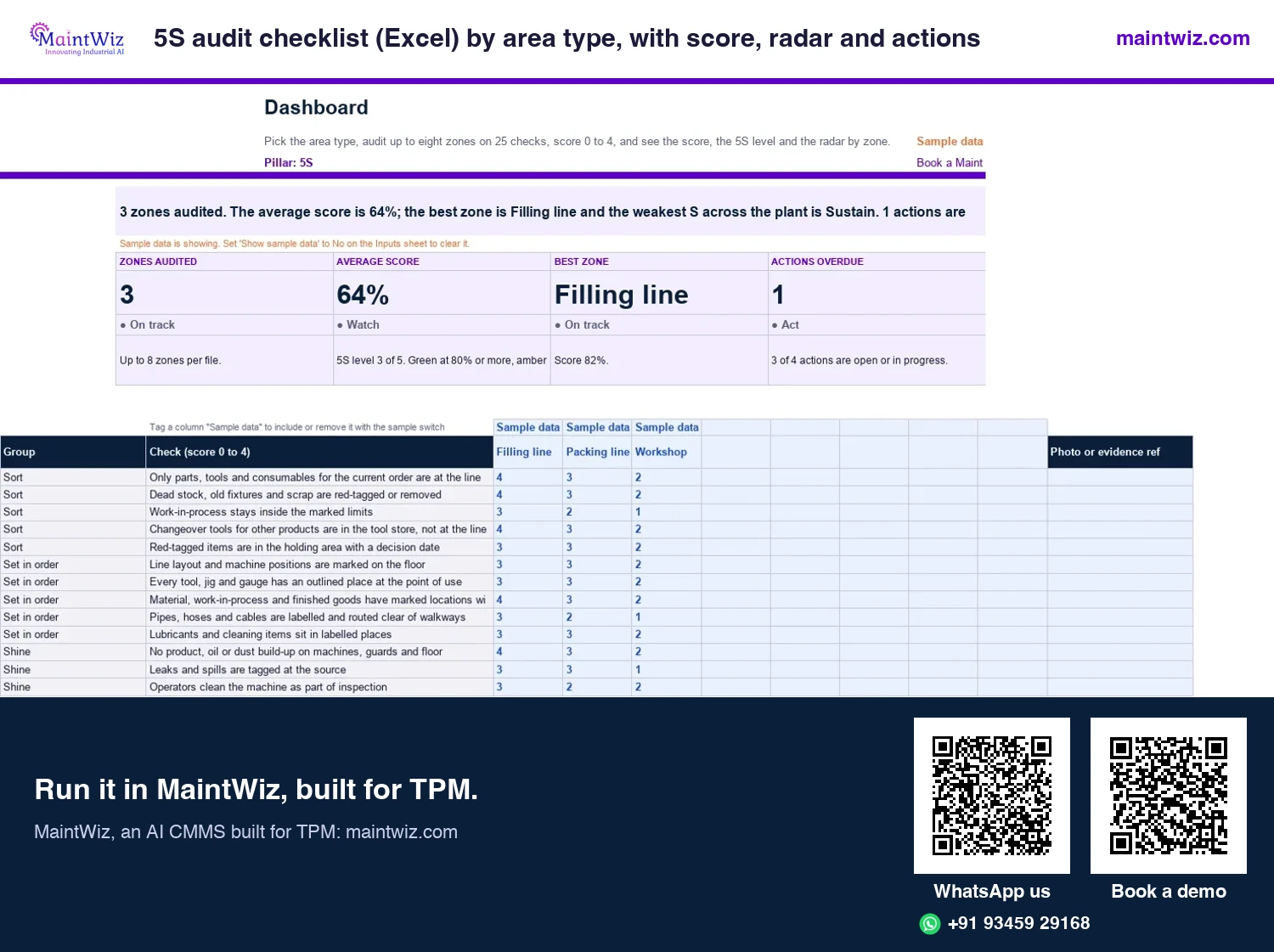
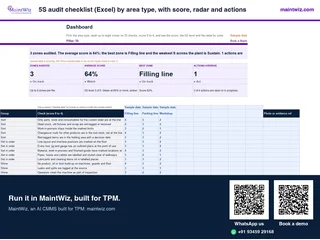 Excel5S audit checklist (Excel) by area type, with score, radar and actions
Run the 5S audit checklist for a production line, workshop, stores, office or utility area: 25 checks, score, 5S level, radar and actions.
Inside: 25 checks, five for each S, scored 0 to 4 · Check wording for five area types: production line, maintenance workshop, stores, office and utility · Up to eight zones per audit with score, 5S level and radar · Action log with owner and due date
- Sheets
- Dashboard, Inputs, Audit, Area checks, Actions, Read me
- A4
- Version
- v1.0, 2 November 2026
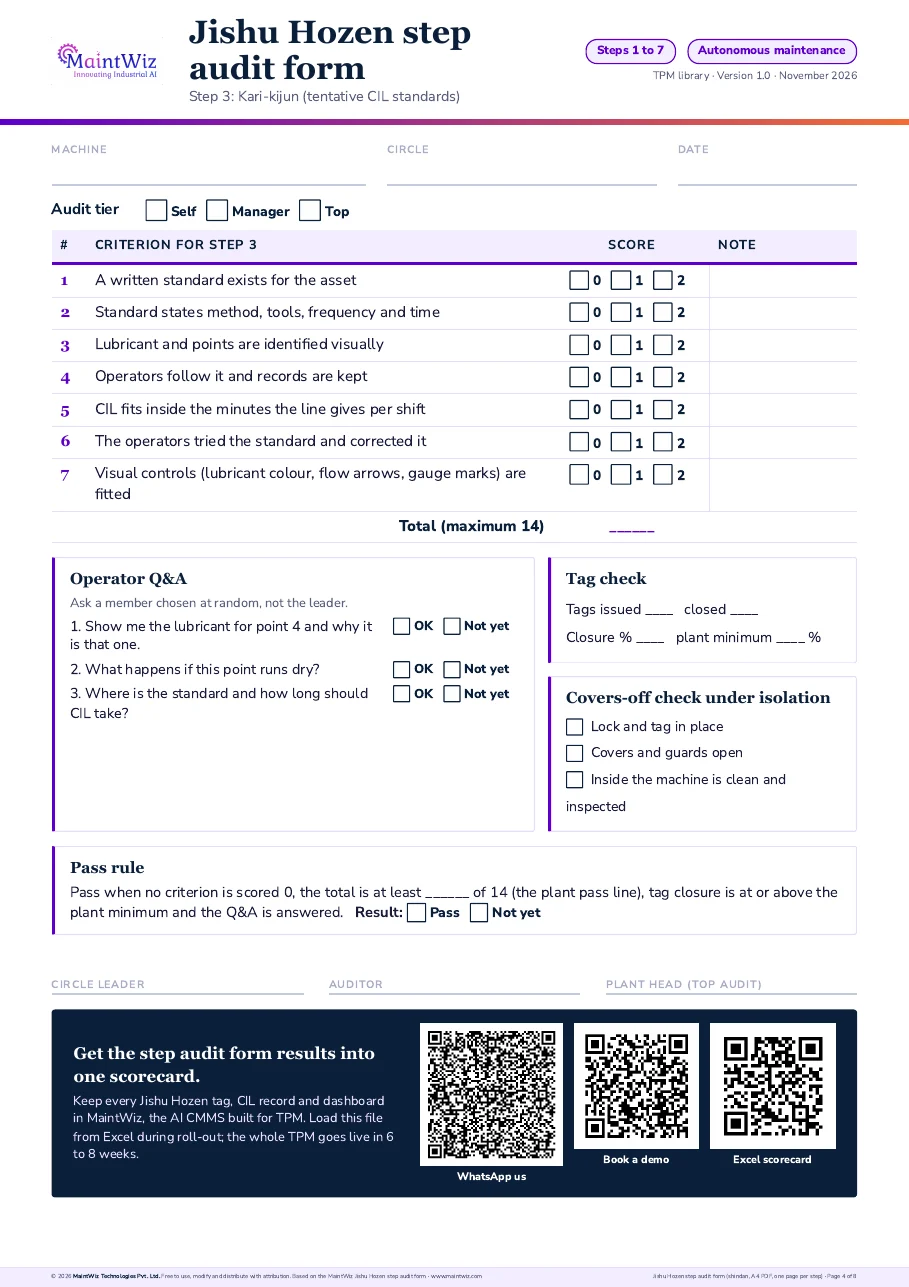
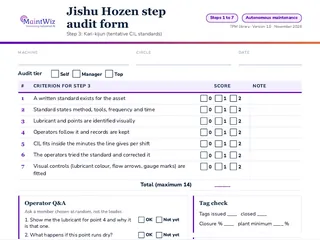 PDFJishu Hozen step audit form (shindan, PDF, one page per step)
Audit any machine with a one-page Jishu Hozen (autonomous maintenance) step audit form: scored criteria, operator questions, tag check and three-tier shindan sign-off.
Inside: One form per step, Step 1 Shoki Seiso (initial cleaning) to Step 7 Jishu Kanri (autonomous management) · Criteria scored 0, 1 or 2 with a pass rule · Three operator questions, a tag count and a covers-off check under isolation · Sign-off by circle self-audit, manager and top management
- Pages
- 8
- A4
- Created
- 5 November 2026
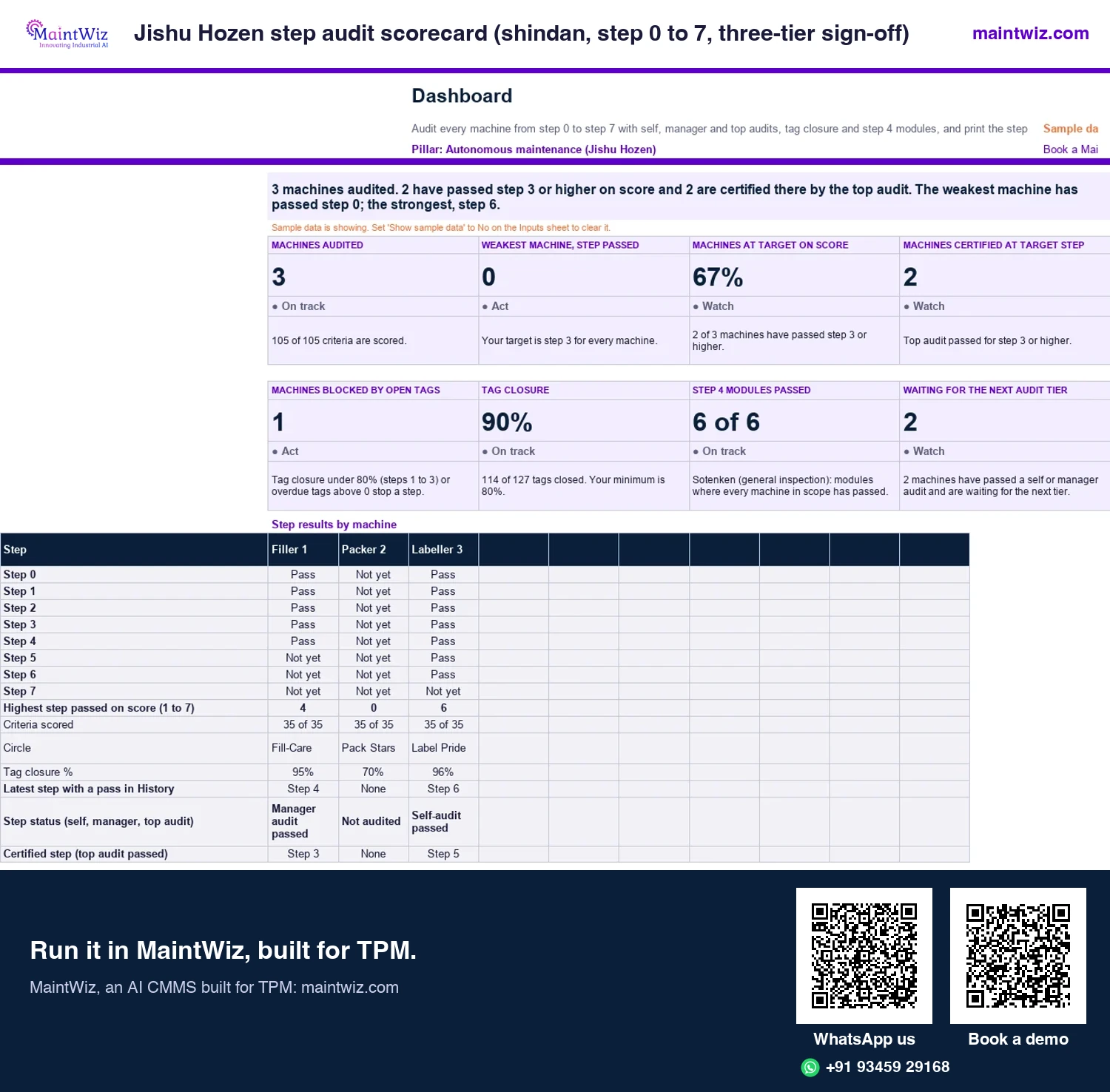
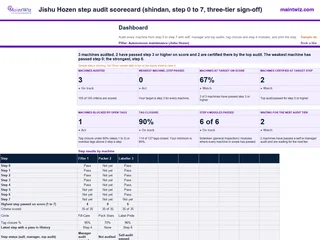 ExcelJishu Hozen step audit scorecard (shindan, step 0 to 7, three-tier sign-off)
Audit every machine through the seven Jishu Hozen steps with self, manager and top audits
- Sheets
- Dashboard, Inputs, Audit, Step 4 modules, History, Certificate, Read me
- A4
- Version
- v1.1, 5 November 2026
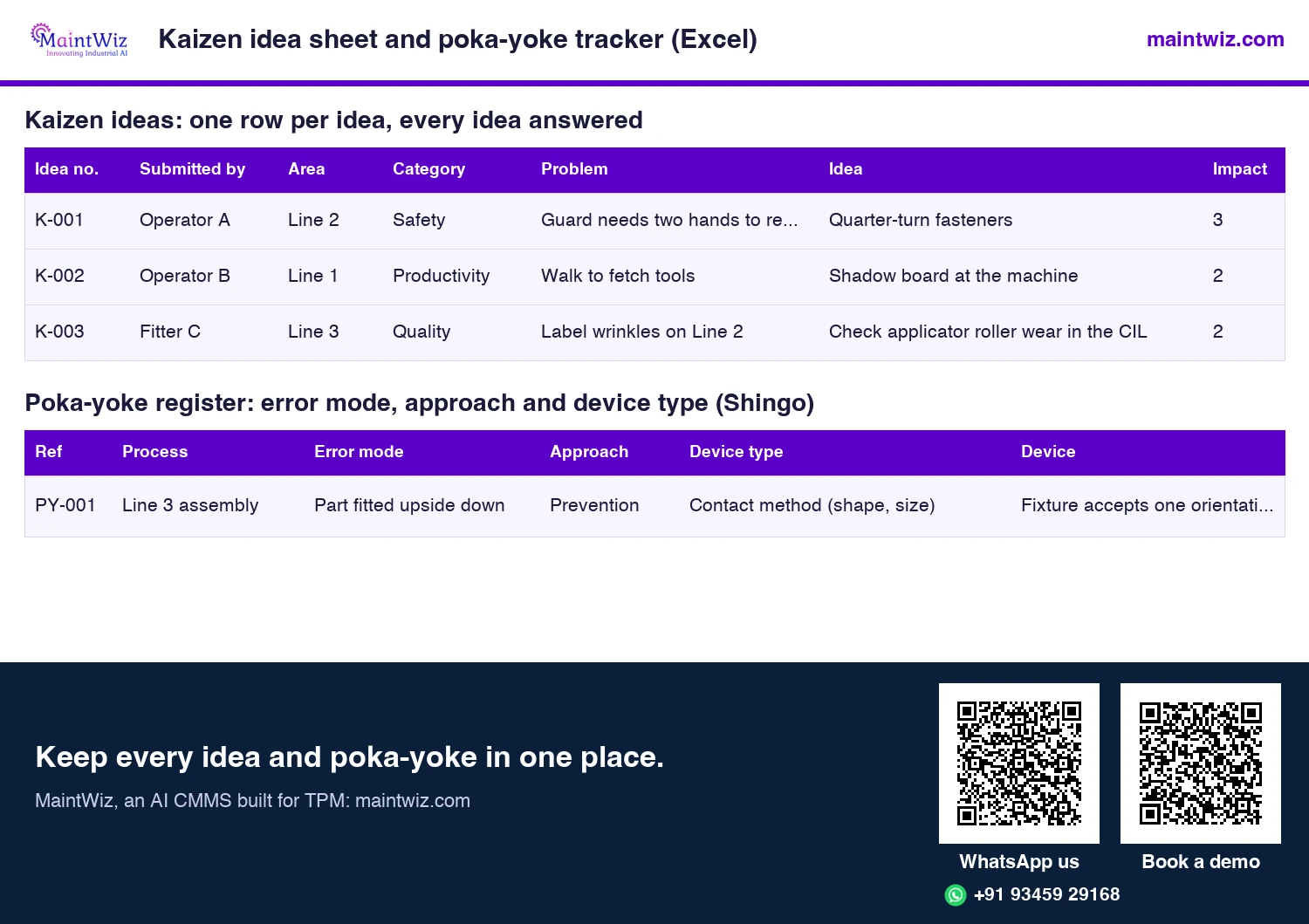
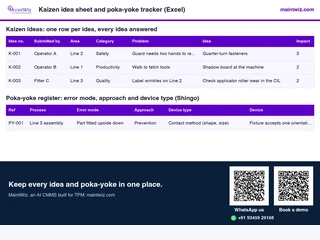 ExcelKaizen idea sheet and poka-yoke tracker
Collect floor ideas by PQCDSM and E category, answer every one
- Sheets
- Dashboard, Inputs, Ideas, Poka-yoke, Summary, Read me
- A4
- Version
- v1.1, 5 November 2026
Step 7
What is step 7, full self-management?
In step 7 the team treats its equipment as its own. It sets targets, reviews data and improves methods. That does not remove management: managers set direction, remove obstacles, review results and recognise progress, but they stop being the source of every action.
| Step 7 element | What it looks like |
|---|---|
| Targets | The team sets measures for its equipment, such as tags closed on time, stops and first-pass quality, with leaders' agreement |
| Data review | The team reads OEE, failures and tags in its own daily or weekly meeting |
| Improvement | Ideas are recorded, tried, standardised or declined with a reason; larger ones are passed to a focused improvement team |
| Skills | Team members can teach each other; a skills matrix template shows who can do what |
| Sustaining | Results are held across audits and personnel changes |
How do steps 6 and 7 connect to focused improvement?
A self-managing team will find losses it cannot remove alone. Those go to a focused improvement team with an owner and a target, and the lesson goes back into the standard. The team's own data, such as the lost-time ranking from OEE, shows where to look first, and the reason-code library keeps stop reasons consistent. Record each idea on a Kaizen sheet so the team's improvements are counted.
Audit
How do you audit steps 6 and 7?
| Step | Criteria checked (score 0, 1 or 2 each) |
|---|---|
| Step 6 | Area standards (flow, storage, visual controls) are defined; standards are visible at the point of use; records and checklists follow one format; audits of the standards are scheduled |
| Step 7 | Operators set and improve their own standards; equipment data (OEE, failures) are reviewed by the team; improvement ideas from the team are recorded; results are sustained across audits |
A step passes at 7 of 8 points, the first score at or above the 80% pass mark. Re-audit passed steps from time to time, because standards decay when no one looks. The free step audit scorecard scores all seven steps.
Common mistakes in steps 6 and 7
- Declaring step 7 by decree: self-management cannot be ordered; it follows steps that worked.
- Writing standards for show: if they are not used they are not standards.
- Counting audits passed instead of looking at whether the standards are in use at night and at weekends.
- Giving the team data it cannot read or act on.
- Leaders who attend the first meeting and never return.
- Moving a team to step 7 targets without the skills to meet them.
Where does the work go after step 7?
Autonomous maintenance never finishes: new equipment, new products and new people restart parts of the sequence. Lessons from step 7 teams feed the other pillars: design weaknesses into early equipment management, training needs into the education and training pillar and recurring failures into planned maintenance. Reaching step 7 on several areas is one milestone a mature programme can show an external assessor; see the TPM Excellence Award.
Running steps 6 and 7
How does MaintWiz run steps 6 and 7?
- Register entry: abnormalities found on routine checks stay in the same register as the earlier steps.
- Assignment: each entry has an owner and a target date, with an overdue alert when the date passes.
- Dashboard: tag records by colour, with cumulative and day-wise closure, so the team reviews its own results.
MaintWiz runs this in its autonomous maintenance software, on the abnormality register shared with the other TPM modules. MaintWiz shows OEE at equipment, line and plant level for the team's meeting, in its OEE software. Book a demo to run steps 6 and 7 on your own equipment.
FAQ
Frequently asked questions
What is step 6 of autonomous maintenance?
Step 6 is standardisation: setting standards for the work area flow, storage, visual controls and records so that every shift works the same way and results do not depend on who is on duty.
What is step 7 of autonomous maintenance?
Step 7 is full self-management: the team sets targets for its equipment, reviews its own data such as OEE and failures, improves its own standards and records ideas, with managers supporting.
What is the difference between step 3 and step 6?
Step 3 writes the cleaning, inspection and lubrication standard for the equipment. Step 6 extends standardisation to the work area around it, to storage and visual controls, and to the way records and checklists are kept.
What does reaching step 7 show?
A team that sets its own targets and improves its own standards. Step 7 on several areas is evidence a mature programme shows an external assessor, such as the TPM Excellence Award.
How do you keep standards from decaying?
Give each standard an owner and a review date, audit on a schedule, treat deviations as information, update standards when equipment or product changes and retire ones that nobody uses.
What happens after step 7?
The work continues. New equipment, products and people restart parts of the sequence, and step 7 teams feed lessons to focused improvement, planned maintenance, training and early equipment management.
How does software help with steps 6 and 7?
Step 6 needs one record that is the same on every shift, and step 7 needs the team's own data. The MaintWiz Jishu Hozen dashboard gives tag counts by colour, assigned versus completed, and cumulative and day-wise closure, so a team can review its own results.